MK IV, the ultimate Ford GT

After ita choreographed 1-2-3 finish at the 24 Hours of Le Mans in 1966, Ford came back the following year with an evolution called the MK IV, a big-block Ford GT with extended, aerodynamic bodywork. One of them, shared by A.J. Foyt and Dan Gurney, churned its way to an unstoppable win that gave Ford back-to-back victories in the Sarthe classic over arch-rival Ferrari. That’s an accomplishment worth remembering, which Ford is doing today with a track-only version of its current-generation GT, which is nearing the end of its life cycle.
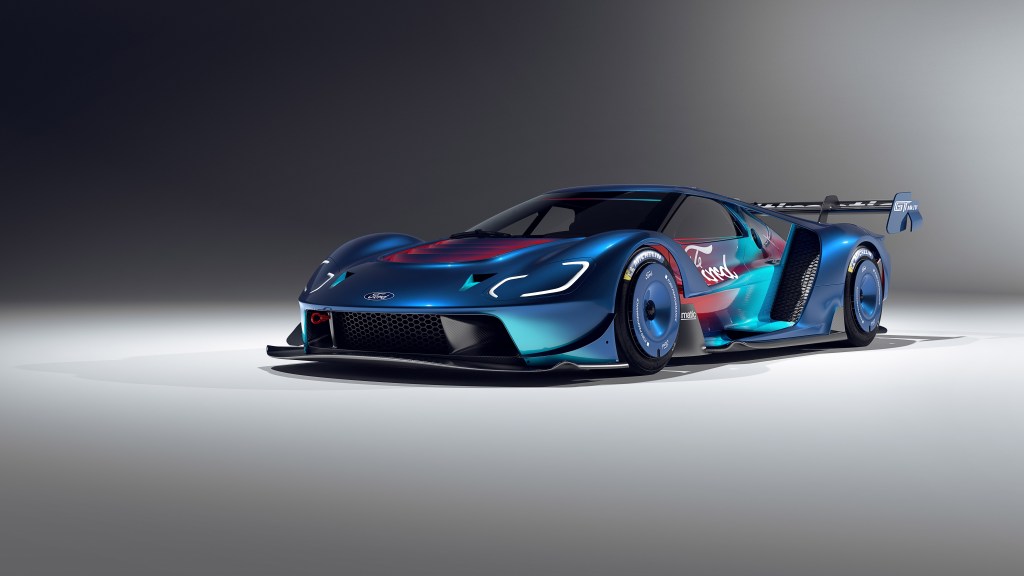
This computer-generated image shows what will become Ford’s tribute to the Le Mans veteran, the 2023 Ford GT MK IV, which will begin deliveries late next spring in a limited edition of just 67 – get it? – copies. This car is pledged to offer the very best in performance, grip and all-around technology, with the cars to be produced by Ford technology partner Multimatic, which handles Ford GT assembly. You want punch? The MK IV’s power comes from a model-specific, twin-turbocharged EcoBoost engine rated at more than 800 horsepower, a full-race transmission under a longtail carbon-fiber body, and the fitment of the Multimatic-produced Adaptive Spool Valve suspension. With an estimated retail price of $1.7 millon, the MK IV will go to production shortly at Multimatic’s facility in Markham, Ontario, Canada. Want one? You can join the reservation process by going here.
EV sales soaring in Dearborn

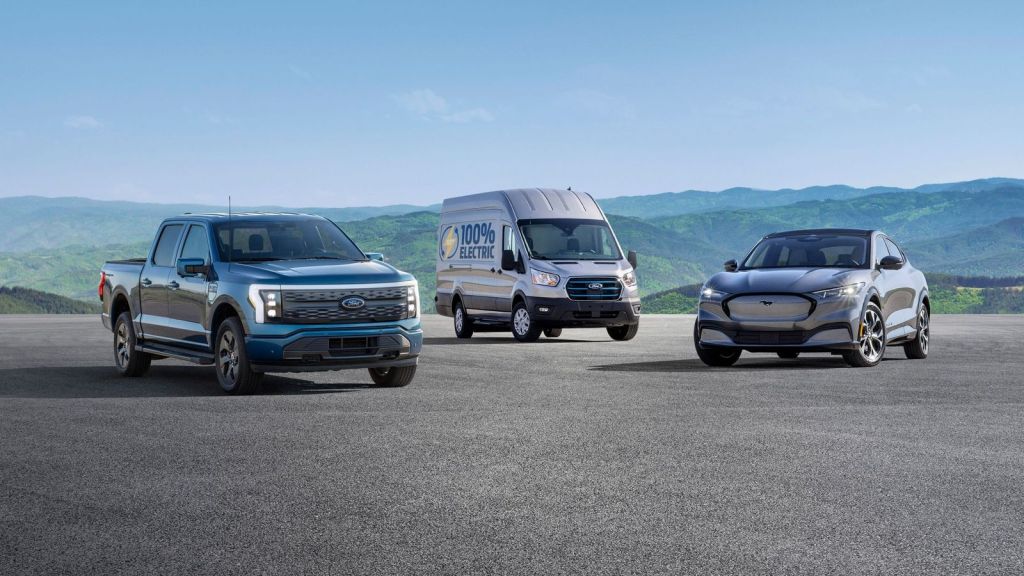
Electrified vehicles of all sorts have become very big business at the Ford Motor Company, which disclosed this week that its EV sales for November zoomed upward by 103 percent over the same period in 2021. That makes Ford the United States’ second-largest seller of EVs, headed only by Tesla. Sales of the F-150 Lighting totaled 2,062 units in November, making it the domestic market’s biggest-selling electrified pickup, and setting the F-150 on course to become North America’s biggest-selling vehicle of any kind for the 46th consecutive year.

Ford is investing $22 billion in electrification through 2025 as part of its plan to lead electrification in areas of strength. The company is electrifying its most iconic products – the Mustang, F-150 and Transit – with many more to come in the years ahead. In addition to offering zero-emissions versions of its most popular vehicles, Ford is harnessing electrification to deliver more of what customers love about them: Performance, capability and productivity.

There’s more: The Ford E-Transit continues its booming lead in the commercial EV sector with fully 80 percent of the market. As we reported here earlier, the Mustang Mach-E climbed 14.6 percent over the same month last year with total unit production now in excess of 150,000 vehicles. And the Ford Maverick compact pickup – it’s a hybrid, not a pure EV – nonetheless has proven to be exceedingly popular in its brief existence, ringing up nearly 68,500 sales, an increase of 847 percent over the same sales figure last year, when the new-generation Maverick was first introduced. Ford is investing some $22 billion through 2025 in its effort to electrify its product lineup.

Bentley Batur begins testing

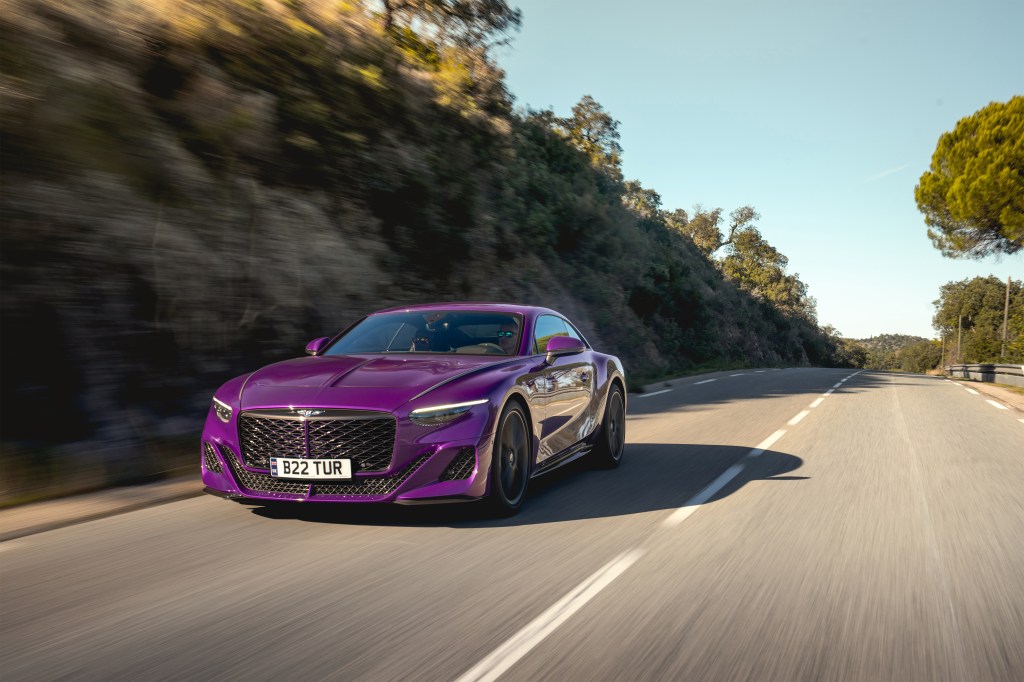
With W-12 power, and with all 18 scheduled examples of the ultra-luxury car already snapped up through its reservation process, the Bentley Batur has begun pre-delivery trials across Europe that will consist of 158 different forms of evaluation conducted over 58 weeks. Marketed by Bentley as the most advanced and luxurious GT car in its history, the Batur has already completed more than 100 weeks of powertrain testing, which has resulted in what Bentley says is the most powerful car in its history, with a claimed 729 boosted horsepower on tap.

With a multi-shaded finish based on a shade of Sector Purple that fades to a crystal black, Batur number 0 – that’s “zero,” to use the Associated Press stylebook treatment – was created in the same fashion as the eventual customer cars, with heavy buyer input directed at the coachbuilder Mulliner. Customers will be able to set the style, and finish, of each car individually, resulting in a highly personalized, and highly priced, GT driving experience.

Zero to 150K for Mach-E

When the first Ford Mustang was introduced midway through 1964, it took Ford barely 18 months to zoom all the way to 1 million Mustang sales. You can’t help but be reminded of that factoid when contemplating the run that the all-electric Mustang Mach-E, a totally different kind of Mustang, has enjoyed since reaching the marketplace barely two years ago. Ford announced this week that it has produced 150,000 copies of the Mach-E since its 2020 rollout, with the EV now sold in 37 countries, with more markets expected to be announced soon. So much for the naysayers who insisted that an electric Mustang would never gallop.

The Ford image shows employees at Dearborn’s Cuautitlán Stamping and Assembly Plant in Mexico saluting the landmark Mach-E as it rolls off the line this week. Ford is now in the process of scaling up Mach-E production toward an annual goal of 270,000 units, part of Ford;s plan to sell 600,000 EVs annually the end of 2023, a number it expects will grow to 2 million EV units per year by the close of 2026. More than eight in 10 Mach-E buyers in the United States have used to to replace an internal-combustion vehicle, a statistic that grows to more than nine in 10 in Europe. The marketplace vigor of the Mach-E has made Ford the second-largest seller of EVs in the United States.

A Nissan ahead of its time

Auto manufacturers spend an inordinate amount of time, and money, brainstorming about future products. Most of these design studies never make it to the showroom, at least not intact. But looking them over after the passage of 20 years of more reveals ideas that were more broadly applied in years to come across vehicle choices that really did make it to the marketplace. Nissan unveiled one such concept more than 30 years ago, the Gobi compact all-activity pickup, which made its debut at that year’s North American International Auto Show in Detroit. Named for the endless expanse of Chinese desert, the Gobi made the rounds of other major auto shows that year and then disappeared – almost. Read on.

If the basic shape of the Gobi rings any bells, that’s because both its exterior lines and interior layout were inspired by light helicopters, such as the U.S. Army’s Little Bird gunship, with rounded shapes and a control-laden cabin environment. Created by former Nissan designers late Jerry Hirshberg, Bruce Campbell and Diane Allen at Nissan Design International, which today is known as Nissan Design America, the Gobi featured storage binnacles labeled “stuff” and “things,” plus a detachable glove compartment that could be transformed into a backpack. Today, the Gobi is part of the Nissan Heritage Collection, which is maintained at the Lane Motor Museum in Nashville, where Nissan now has its base of North American operations.

Want history? Buy a tractor!

Depending on where you live, you may have experienced the offshoot of the old car hobby that focuses around restoring and collecting tractors and other agricultural implements, the relics of farming’s imprint on American society. As you might guess, the people who do this tend to live in rural areas and had farm equipment as an integral part of their lives. Just for example, we know of a collector who lives in Salem, New York, not far from the Vermont border, whose front yard is dotted with unrestored Farmall tractors of the past. Arguably, no auction house more tightly embraces the nuances of this market than Wisconsin-based Mecum Auctions, which recently concluded its 2022 Gone Farmin’ Fall Premier Auction at the Bend XPO in East Moline, Illinois. How big is tractor collecting? Enough that Mecum rang up more than $6.5 million in sales during the three-day auction.

This hugely unusual piece does not pull planes around an airport, but it can still cruise credibly down the highway in its top gear, which makes the tractor’s streamlined, nearly Art Deco bodywork all the more appropriate. What is it? It’s a 1938 Minneapolis-Moline UDLX, described as one of the finest examples of this rare and unusual farm tractor in existence. When the bidding was concluded, the UDLX had a winning high bid of $210,000, which is astronomical for a restored tractor, regardless of rarity. By comparison, the auction’s second-highest sale was the $154,350 hammered for a one-of-one International Harvester HT 340 tractor prototype, with gas turbine power. This was a major event in the world of collectible farming memorabilia, with Mecum finding new homes for 1,302 lots of all types at a very strong 94 percent sell-through rate.

The car that launched an auto industry, remade by its creator

We rightly view Hyundai, the industrial giant from South Korea, as an integral part of the automotive marketplace, and industry, in North America. It’s hard to grasp today that nearly 50 years ago, most Americans didn’t know how to produce the company’s name, much less have a firm understanding of what it produced. In fact, it would be years before Hyundai vehicles would be sold in the United States at all. The car that truly launched Hyundai as an auto manufacturer, and led us where we are today, was the 1974 Hyundai Pony Coupe, the first car built by Hyundai that wasn’t a knockoff of somebody else’s car and the first true mass-produced automobile in the history of South Korea. A lot of history flows from this one car, so it’s fitting that it’s being re-created as a celebration of Hyundai heritage.

Hyundai has announced that it will work with the design firm GFG Style to rebuild the Pony Coupe as a retro concept to mark the firm’s half-century of producing its own automobiles. GFG Style is the successor to Ital Design, whose founder, Giorgetto Giugiaro, penned the wedge-shaped, very 1970s design before going on to achieve design immortality by drafting the look of the original Volkswagen Golf and Scirocco, among many other vehicles. Guigiaro’s son, Fabrizio, is now part of GFG Style and will be working on the Pony Coupe resurrection. Hyundai has hinted that the concept project could lead to more cooperation with GFG Style on future production models, a lofty prospect given the dramatic looks for which Hyundai is already well known.

Alexa added to 2023 Armada

If you’re one of the buyers who likes to boogie to the max when it comes to your vehicle selection, the huge, luxury-bedecked Nissan Armada SUV is likely to land on your shopping list at some point. The 2023 edition of Nissan’s maximum-sized land cruiser – sorry, that was irresistible – comes in four trim levels, S, SV, SL and Platinum, following a moderate refreshing for the 2021 model year. Nissan’s 2023 Armada lineup takes an already thoroughly equipped premium SUV and adds Amazon Alexa voice command across all the SV, SL and Platinum ranges. Alexa will give the Armada the capability to place phone calls, select music and more, based solely on your vocal inputs.

Pricing for the 2023 Armada range begins at $50,400 for a two-wheel-drive example in the base S trim level. The price of this large SUV grows to $69,720 when you select a Platinum version with all-wheel drive. Sales start immediately.

It’s the ’67, not you-know-what

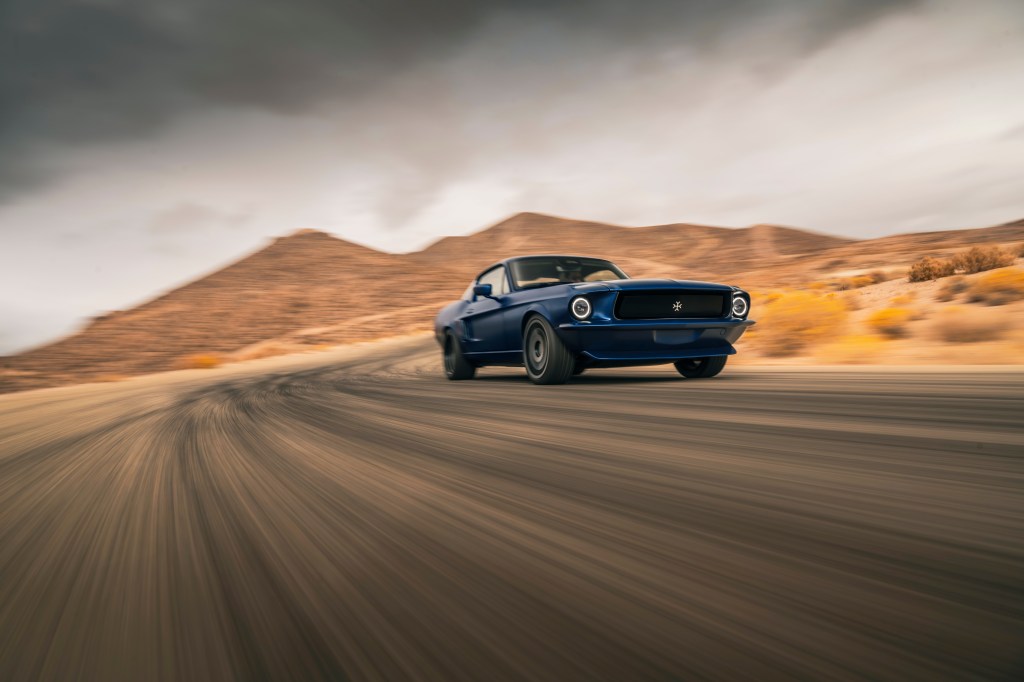
Believe the copy, not your eyes, because this very trick British EV known simply as the ’67 is most assuredly not a product of the Ford Motor Company, no matter how it looks. Instead, the ’67 is the creation of Charge Cars, based in London, and which despite its retro looks is a smorgasbord of the latest in both vehicle architecture and electrified propulsion. The ’67 is making its debut, fittingly enough, at the ongoing Los Angeles Auto Show, which runs through the end of the month. It’s the ’67’s first public showing after it was first rolled out to selected media last month.

Note that Charge Cars uses a Maltese cross-style emblem in place of the chromed pony you’d ordinarily expect to find at both ends of the car. With production limited to a run of 499 vehicles worldwide, the ’67 utilizes a carbon-fiber body shell with a battery pack underneath the floorboards. Four electric motors give the car AWD with vectoring, plus more than 1,100 claimed lbs.-ft. of torque, enough to wake anyone up. Total peak power comes to 400kW. According to the manufacturer, the ’67 will see 60 MPH in 3.9 seconds, with an operating range estimated at 200 miles.

Swan song in Ohio: Honda builds final Acura NSX Type S

It probably didn’t get grear notice but it’s still a milestone in the world of ultra-performance sporting cars, as the final second-generation example of the mid-engine Acura NSX Type S was completed this week at the Honda-operated Performance Manufacturing Center in Marysville, Ohio, where Honda has a major U.S. production presence. The last of the hybrid-electric mid-engine supercars, bearing serial number 350 out of 350 units in the production run, was finished in Gotham Gray and closed out a build cycle that dated to 2016.

That’s an instant collectible if one ever existed. As to the PMC in Marysville, it’s already underway on its next job, the assembly and rollout of the limited-run 2023 Acura TLX Type S PMC Edition. To be offered in three NSX-exclusive colors, reservations for the first two series, in Curva Red and 130R White, were booked solid within minutes after being announced. Total production of the PMC Edition will be limited to 100 units in each color.