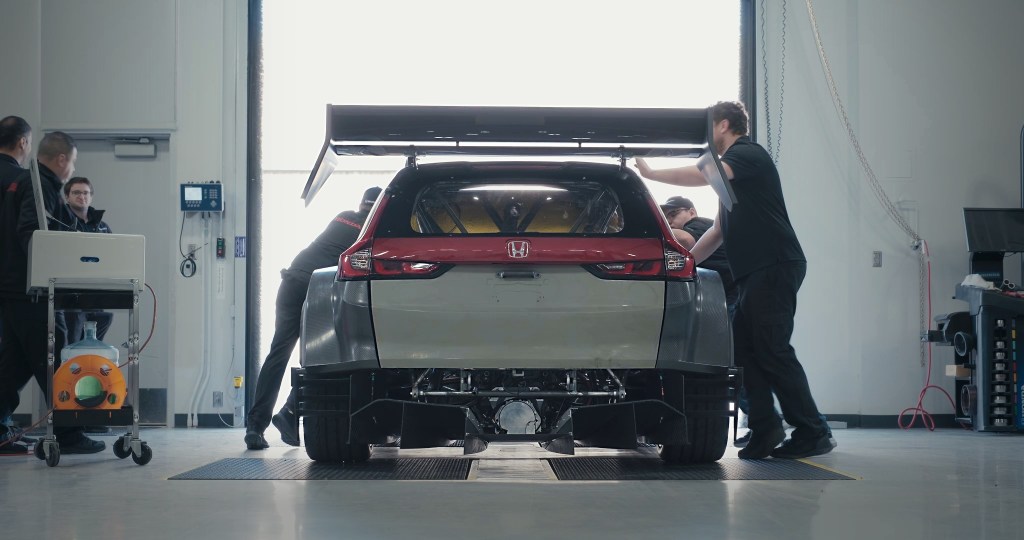
You think you know the Honda CR-V. Probably, you know somebody who owns one. It’s an efficient, inoffensive compact SUV that does pretty much everything well with no real downsides. So it’s understandable that they’ve sold in massive numbers, with the CR-V holding down the distinction of being California’s best-selling motor vehicle for a time. Honda is now on the cusp of revealing a CR-V that’s very different, a screaming, sporting track-day beast with a hybrid powertrain that Honda says will thump out at least 800 horsepower.
The Honda CR-V Hybrid Racer project vehicle, as it’s officially known internally, is scheduled for a rollout by the end of this month. The project is a joint effort between Honda Performance Development and Auto Development Center, and designers from North America Auto Design Division of American Honda. Note the huge two-element wing at the rear of the roofline, and the under-body diffuser. This is serious stuff. Stay tuned. Are you paying attention, Subaru WRX STI owners?
Kia is a triple threat in competition for the annual World Car Awards, now under deliberation, with the candidates spanning three award categories. The Kia Niro is a finalist for overall World Car of the Year honors, while the electrified Niro EV is similarly a finalist for World Electric Vehicle of the Year. And for those who like to drive very quickly, the Kia EV6 GT, with up to 567 horsepower under your foot, is a contender for World Performance Car honors.
The World Car Awards were established 19 years ago, and are bestowed by a jury of 100 journalists, representing 32 nations, who drive and evaluate the candidates. The awards are scheduled to be announced at this year’s New York International Auto Show on April 5th.
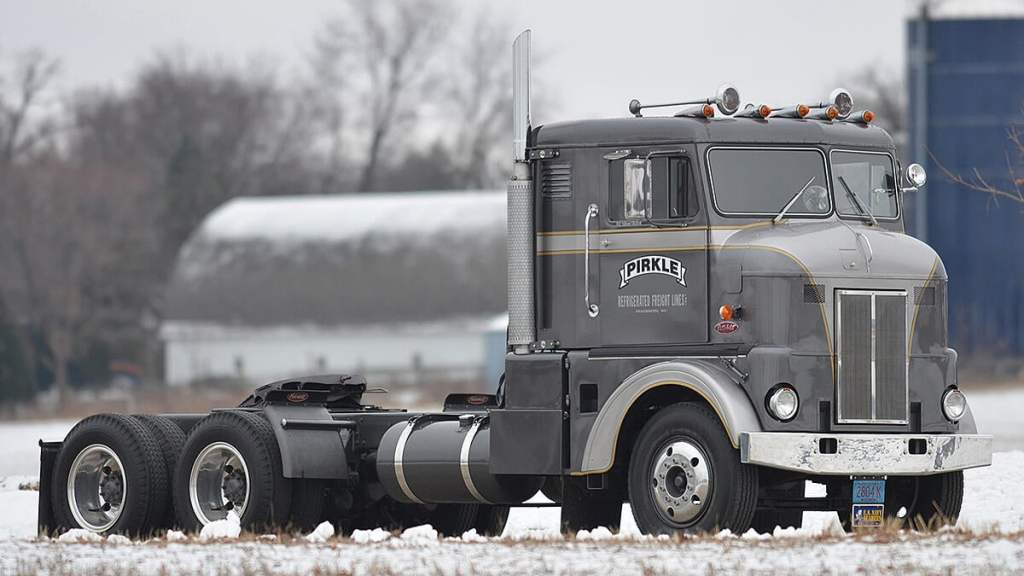
For those who have the space to accommodate them, noting compares to having a collection of classic highway trucks, the ones that moved commerce across the United States on the Interstate system as well as the two-lane ribbons to the horizon that preceded it. Imagine tooling along with planet-shifting torque under the huge right foot pedal, diesel stack blatting as you stir your way through multiple gearboxes while towering high in your air-ride seat above the masses. It’s heady, modern-cowboy stuff, and truck collecting is a vibrant adjunct of today’s automotive hobby. When it comes to presenting these rigs of old for sale, few do it better than Mecum Auctions of Wisconsin.
To that end, Mecum is offering 10 historic big rigs from the holdings of truck collector and restorer Gene Olson at its upcoming Gone Farmin’ Spring Classic auction, which focuses on antique tractors, trucks and implements, and is set for March 24th and 25th at Bend XPO in East Moline, Illinois. The collection being offered will include vintage haulers produced by Kenworth, Peterbilt, Mack and International Harvester. The arguable star of the group is this classic of the American highway, a 1954 Peterbilt 350 cabover tractor, known as a “bubblenose” for the frontal protrusion on its tilt cab. It’s got a long “West Coast” wheelbase and five-hole aluminum wheels. Power comes from a supercharged Cummins diesel that produces 275 horsepower, linked to a four-speed main transmission and three-speed auxiliary gearbox that are guaranteed to keep the driver busy with their twin shifters. Incidentally, we recently researched Cummins engine history as part of our retrospective on Cummins’ 1952 entry in the Indianapolis 500, in which the Indiana firm built the first turbocharged engine ever to race at the speedway. The story is in the current issue of Tazio, the quarterly journal of international motorsport history that you ought to be reading.
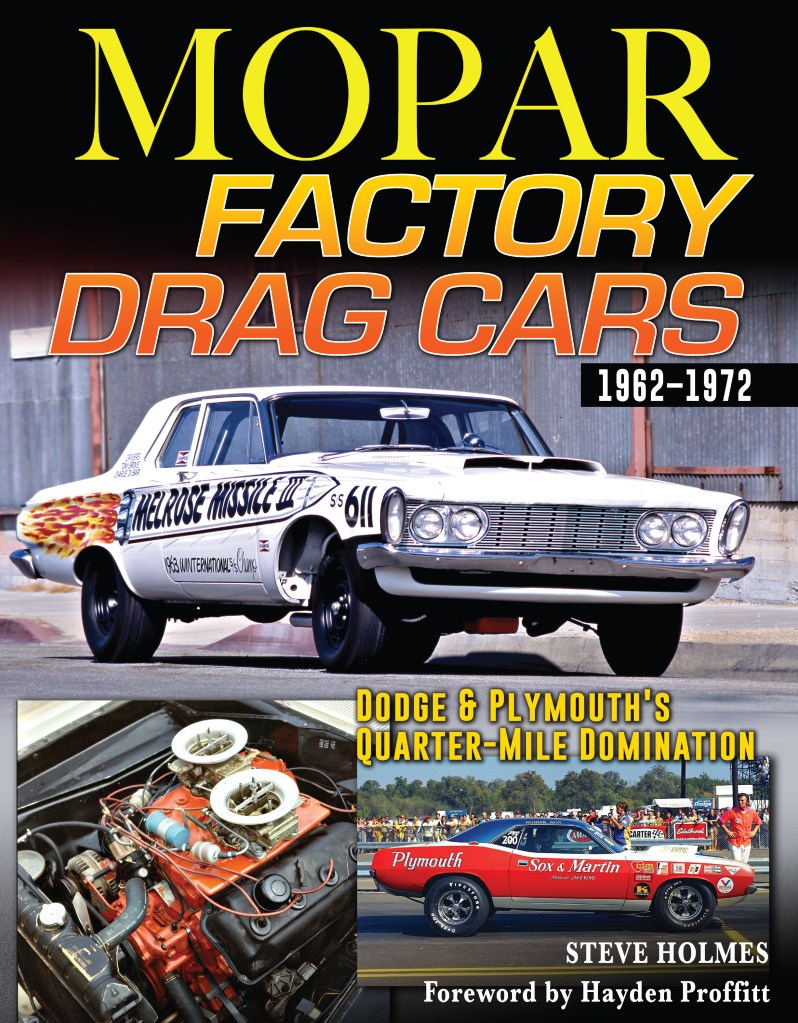
It remains one of the great stories in motorsport history, the great rise of Super Stock and F/X drag racing beginning in the 1960s, an exercise in full-on factory warfare, especially where Chrysler was concerned. The story of its engineering prowess, and the drivers who took advantage of it, is magical and always merits telling, especially in the concise manner that marks this new volume from CarTech. Mopar Factory Drag Cars 1962-1972 is a little unusual given its subject matter in that it’s written my a motorsport historian from New Zealand, who clearly knows and appreciates his topic.
In 176 softbound pages, author Steve Holmes takes the reader on a year-by-year progression of Chrysler’s famed presence in big-time doorslammer drag racing, tracing the tale from early Max Wedge action in Super Stock to the early Funny Car years, the coming of the Hemi and altered wheelbases, and the dawn of Pro Stock. The notorious tale of how the NHRA scissored away poundage from those early Pro Stocks to help hook an anchor to Mother Mopar is told in full here. The list of Chrysler drag luminaries in the volume runs from the original Ramchargers all the way through the original Motown Missile and then some. You simply can’t have a complete drag racing library without this. Order now, and you get a special introductory price of $29.56.
Nothing like this has ever happened to me before. I was one of several people inducted last night into the Hall of Fame that’s organized by the Motor Racing Fan Club in The Villages, the sprawling resort community that encompasses part of three central Florida counties and counts hundreds of race enthusiasts among its members. It’s an annual event that recognizes people in motorsport for lifetime achievement, in a variety of fields, mine being journalism. To put it plainly, and gratefully, the induction was an honor, especially so when it comes from your peers. The other enshrined members are the Indianapolis Motor Speedway track photographer Bill Watson, Blackie Wangerin, who made it all the way from the Minnesota short tracks to the Daytona 500; the second-generation stock car pioneer and historian Bill Blair Jr. of Mount Airy, North Carolina, on whose radio broadcast I’ve appeared several times; the current central Florida journalist Cody Hills, the onetime Chicagoland stock car terror Jerry Clark, and Richard Poindexter, who’s been winning short-track races in northern Florida and neighboring Georgia for generations now.
You get a chance to make acceptance remarks after the award, and I chose, then and here too, to recognize some people who crucially helped me learned the skills and standards of this line of work. I want to thank my first newspaper editor, John “Pinky” Grau, my first daily editor, Dan Eisenhuth, who encouraged me to write about cars and motorsport and gave me the space to do it; my friends Dick Berggren and the late Robin W. Hartford, who not only provided me an entry into magazine writing but also taught me photography skills that I use to this day; my good friend and fellow journalist Ron Hedger, who was there to support me last night and has always been a role model, my brother and newspaper mentor Steve Wujcik, to whom I owe a lifetime of gratitude; my late friend A.B. Shuman, the pioneering New England hot rodder and journalist who encouraged me to expand my professional horizons, and my friend Don Miller, former president of Team Penske, who graciously allowed me to tell his remarkable life story in the form of a biography. A special thanks goes to Richard Lentinello, who vastly expanded my horizons in terms of both writing and photography when he hired me, first at Hemmings Motor News and now at Crankshaft. I also want to thank my longtime pal and automotive PR cohort Chris Dirato for introducing me to the audience in such an unforgettable way. Thanks, everyone.
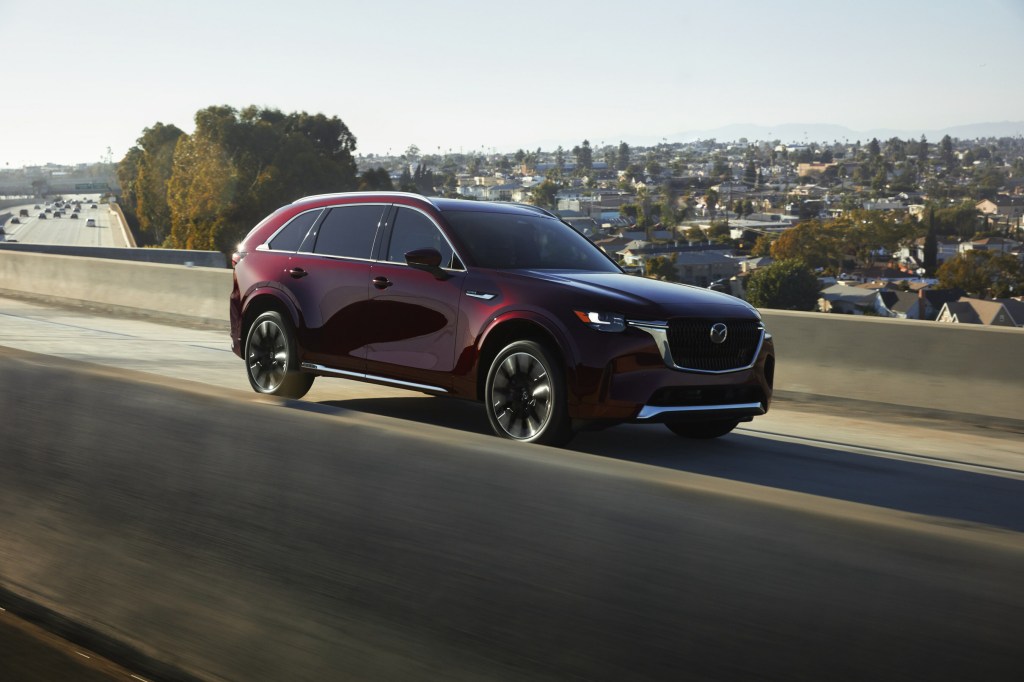
If you need a traditionalist SUV with lots of room and a conventional layout, you’d be wise to add a stop at your local Mazda dealer to your shopping trip. Mazda is just rolling out its 2024 CX-90 premium SUVs, with three rows of seats, and riding on an all-new platform that packages a front engine with rear-drive bias into the CX-90. The Performance Oriented Platform, as it’s called, is a new base for present and future rear-drive vehicles at Mazda, whether they incorporate petroleum fuel, a hybrid powertrain or full EV operation.
While the CX-90’s hybrid driveline is based around the familiar Mazda 2.5-liter four-cylinder engine, buyers who insist on traditional gasoline-fueled performance will not feel abandoned. The CX-90 can be specified with the e-Skyactiv G 3.3-liter turbocharged inline six-cylinder engine, which is rated by the manufacturer at 323 horsepower when premium fuel is used. This powertrain is equipped with a mild-hybrid driveline evolution that places an electric motor between the engind and transmission, offering both gas-burning go and a strong measure of efficiency. All CX-90 powertrains are mated to a new Mazda eight-speed automatic transmission. To accomodate the longitudinal electric-boosted powertrain, the transmission does away with the conventional torque converter.
I recently had a story published in Crankshaft magazine about how my pal, the NASCAR pioneer Johnny Allen, was part of a team that Lincoln-Mercury assembled to run a fleet of new 1965 Mercury Comets on a torture run from the tip of South America to frozen Alaska. Next month, once the weather improves a bit, Nissan plans to outdo this long-ago feat by taking a modified, off-road-ready version of its new Ariya EV on a run from the magnetic North Pole all the way to the South Pole, some 27,000 kilometers distant.
The pole-to-pole EV blast, which you can follow here as it happens, will use an Ariya upgraded and modified for the mission by project ally Arctic Trucks, which specializes in preparing commercials vehicles for duty in extreme winter climes. As part of the journey, Nissan will use a custom pull-along trailer incorporating a wind turbine and solar panels that will allow the Ariya to recharge in places where charging stations won’t exist for a long time. The Ariya itself is modified with fender flares, 39-inch BFGoodrich all-terrain tires, and most importantly, an onboard espresso maker that will brew sustainable coffee. Nissan has been planning this trip for four years, almost as long as the Ariya has been conceptualized.
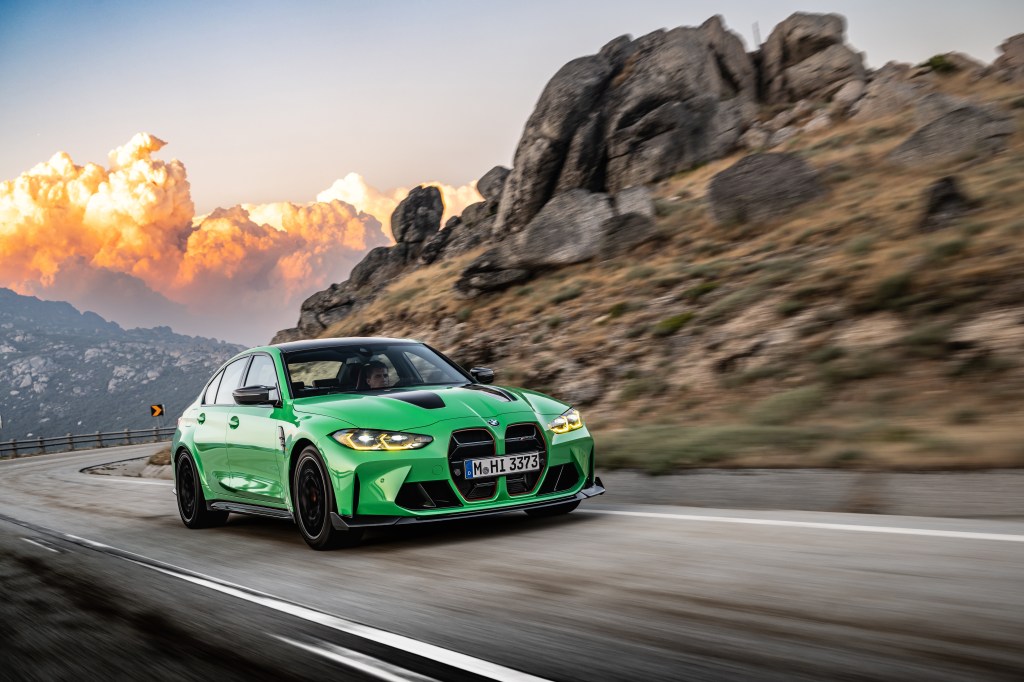
In BMW parlance, “CS” stands for Competition Sport, the Bavarian firm’s designation for its line of limited-production models in the M series that combine blinding road performance with strong track-day capabilities. BMW is just now extending the concept to its M3 models, already the performance pinnacle of its beloved 3-series, with production getting underway next month. The BMW M3 CS, as it’s formally known, is lighter, stronger and faster than its M3 predecessor, which is quite a statement. The extensive use of composite materials in the M3 CS’ construction, for instance, drops its overall curb weight by 75 pounds.
The CS continues to offer BMW’s M xDrive, Its attributes include a twin-turbo inline six-cylinder engine rated at 543 horsepower, linked as standard to xDrive and the standard eight-speed M Steptronic transmission. BMW is advertising a 0-60 time of 3.2 seconds and a standard top speed of 188 MPH. Carbon ceramic brakes and track-oriented tires will be offered for the truly dedicated. M Carbon bucket seats will be standard up front. The MSRP for everything is $118,700 plus destination charges.
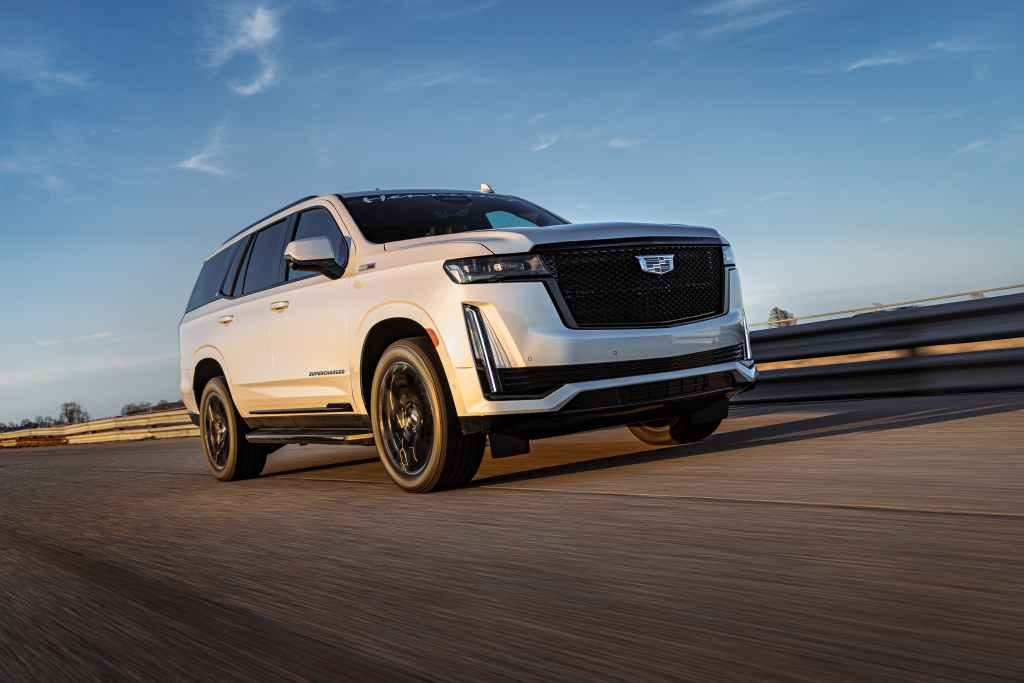
Taking delivery of a new Cadillac Escalade is an event in and of itself. And now, you can do yourself one better with your new acquisition, thanks to Sealy, Texas-based hypercar tuner Hennessey Performance, which has a General Motors-approved supercharger upgrade now available: Not just for the Escalade, but also for large GM SUVs sharing the same platform ranging from the Chevrolet Tahoe to the GMC Yukon XL.
The Hennessey package takes the Escalade’s 6.2-liter V-8 and adds a 2,9-liter-capacity belt-driven supercharger, hardened chromemoly pushrods, a specific intake system, a high-flow intercooler and specific powertrain mapping to boost, literally, the GM V-8 from its standard 420 horsepower all the way to 650, which ought to help immensely with any high-speed on-ramp merge, just for openers. The supercharger kit lops nearly one full second off the Escalade’s 0-50 time, dropping it to around five seconds flat, and is backed by a full three-year, 36,000-mile warranty from GM. The conversion’s MSRP starts at $27,950.
Yes, the latestt $918 million that it plans to spend includes an investment in EV production, largely through foundry work, but General Motors is indeed putting money where its internal-combustion mouth is by earmarking major funds for the development of its forthcoming sixth-generation small-block gasoline V-8. There is, you see, indeed life for powertrains that aren’t fully electrical, even in 2023.
The bulk of the money will go to Flint Engine Operations in Michigan, where the new engines will be assembled along with needed block, cylinder head and crankshaft machining. Flint will also continue to produce GM’s 3.0-liter turbocharged diesel for light-truck applications. Camshaft and connecting rod assembly for the new V-8 will take place at Bay City GPS in Michigan, with Defiance Operations in Ohio handling block casting and other needs, and Rochester Operations in New York tasked with developing intake manifolds and fuel rails. GM does plan an all-electric future but will clearly be relying on ICE power in the interim.



 Jim Donnelly On Wheels