Maserati returning to motorsport, of a very specific variety

Officially, the once-independent specialty automaker Maserati pulled out of global motorsports at least as far as a works team went, after the spectator tragedy at the Mille Miglia in 1957 that also spelled death for the iconic open-road race around Italy. As the Maserati photo shows, 1957 was nonetheless one of the Trident’s greatest years in racing, as the immortal Juan Manuel Fangio captured the last of his five Formula 1 championships aboard a Maserati 250F monoposto, also scoring the last of his 24 wins at the sport’s pinnacle that same season. Maserati S.p.A. has undergone periods of ownership by the Orsi family, Citroen, de Tomaso and Fiat before becoming part of an operating unit, with Alfa Romeo, that’s owned by today’s Chrysler-encompassing conglomerate, Stellantis. It’s this new generation of ownership that plans an atypical Maserati return to racing.

Only this time, the racing won’t involve the shriek of a multi-cam V-8. Maserati will instead revive its competitive spirit by entering the 2023 edition of the ABB FIA Formula E World Championship, contested among open-wheel EVs. So yes, it’s a global competition among whirring, emissions-free racing cars. Not everybody considers it to be a traditional or, dare we repeat it, a legitimate form of automobile racing. To the doubters, we say this: Formula E has a full international schedule that includes street races through both London and Manhattan. The lineup of teams includes entries from Dragon/Penske and Andretti Autosport – with Andretti IndyCar prospect Oliver Askew as one of its drivers – plus factory teams from major producers including Mercedes-Benz, Porsche/TAGHeuer, Mahindra, Volkswagen and Jaguar. So don’t laugh, and recognize the fact that at least in this branch of racing, teams are jumping in, not scaling back.
This is good: A cheap EV with a Chevy bowtie up front

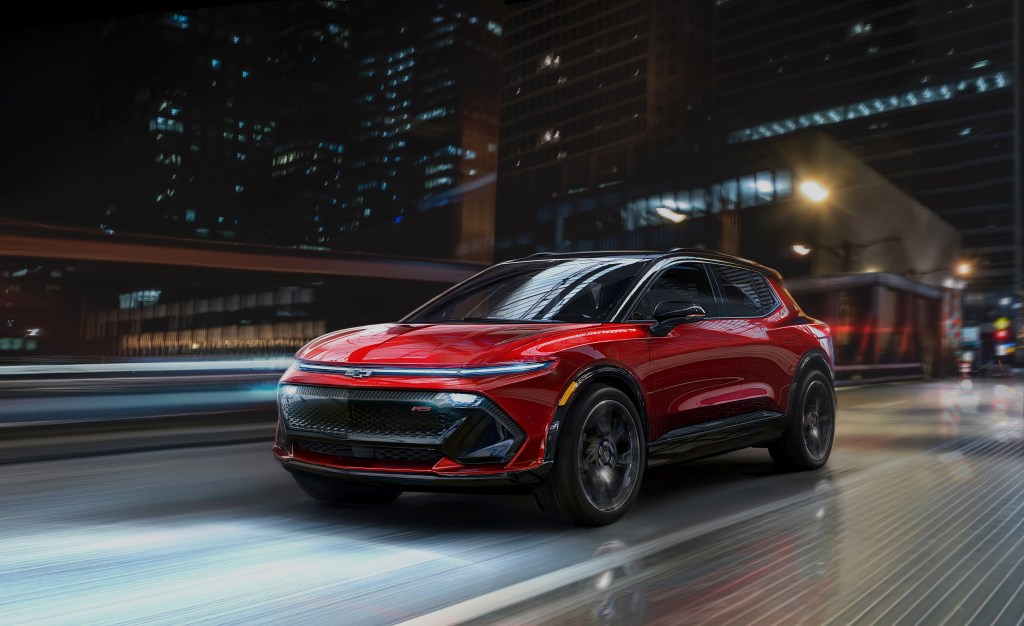
Yeah, Toyota may have unhorsed General Motors as the world’s biggest automaker, a development that likely surprised no one last week, but the House that Durant and Sloan Built isn’t buried yet by any measure. Here’s some tangible proof: Chevrolet, still the only automaker that really matters for millions of people, says it will introduce a new, highly affordable all-electric SUV in the fall of 2023. GM is predicting that the 2024 Chevrolet Equinox EV will have an opening MSRP somewhere around $30,000, significantly less money than just about every other kilowatt-fueled vehicle that’s out there right now.

GM chairwoman and CEO Mary Barra announced plans to build the Equinox EV at the ongoing CES extravaganza in Las Vegas, which has become a markedly important jumping-off point for automotive technology advances, especially involving in-cabin infotainment. The Equinox EV will be introduced in both fleet and retail versions, in both LT and RS trim levels, making use of GM’s Ultium dedicated EV platform. The Equinox EV announcement follows disclosed plans for an EV version of the Chevrolet Blazer and the green-lighting of an all-electric Silverado pickup, the latter also due for the 2024 model year.

Whatever it’s called, The Amelia is still motoring’s best

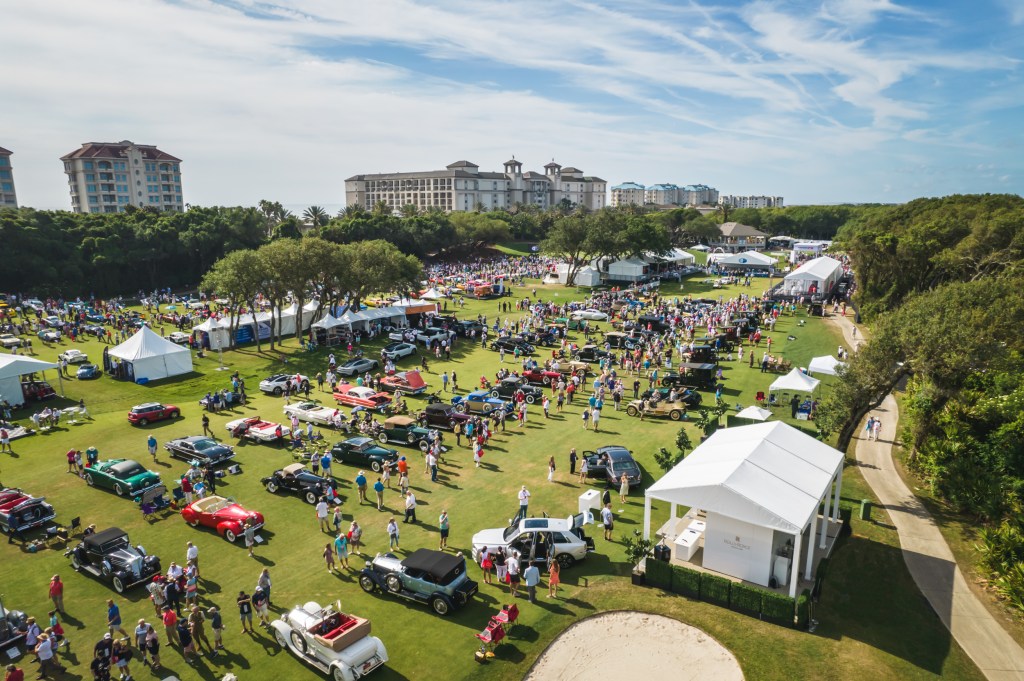
The changing of the guard in northeast Florida became a reality this week as Hagerty, the insurance and marketing powerhouse out of Traverse City, Michigan, took over as owners and operators of the Amelia Island concours. In a long-expected announcement of the ownership change, this terrific annual gathering of historic automobiles has be rebranded simply as The Amelia, with the 27th edition of the elegant show set for March 3rd through 6th at the Ritz-Carlton on the coast of Nassau County, Florida.

The image makes clean that even in the necessarily COVID-limited event of 2021, stunning delights abound on the show field at the Ritz-Carlton, whose beachfront hotel you can observe in the background. The Amelia is unique among the world’s great automotive concours in that it assigns equal significance to competition and road vehicles. To that end, the 2022 edition of The Amelia will mark historic anniversaries for both the 24 hours of Daytona (60 years) and the 12 Hours of Sebring (70), plus the 75th anniversary of Ferrari, the centennial of Lincoln and the 90th anniversary of the car that launched a million hot rods, the 1932 Ford. Other judged categories will evaluate Indy roadsters, the quirky little microcars of Davis, aluminum-bodied Porsche racing cars and automobiles with Waterhouse custom coachwork. We feel confident that besides its ownership change and renaming, The Amelia will still represent the very finest in cars. And what would you rather do, sitting freezing somewhere in March or come to the beach in Florida to examine glorious automobiles?

A Benz that makes Tesla sweat

It’s called the VISION EQXX, and it’s a tantalizing hint of what a full-size premium car might look like in the readily foreseeable future. The reason is that unlike pretty much every EV on the market today, or projected to arrive shortly, this Mercedes-Benz design study claims to erase the major obstacle to EVs being accepted, as real-world, workaday transportation alternatives. Mercedes-Benz reports that at least through computer simulations, the EQXX is capable of delivering 620 miles of range on a single charge of its battery pack, well beyond the distance that most people would ever attempt in a single-day drive. All of a sudden, finding a recharging station isn’t that big of an obstacle anymore.

Specifically, the performance estimate suggests that the EQXX is capable of burning just 10 KwH for every 100 kilometers of distance. Is this the invention of the no-fault, no-hassle EV? Time will tell, but consider a few things: The EQXX makes extensive use of cutting-edge materials including magnesium wheels for ultra-low friction and plant-based composite materials, Mercedes-Benz engineering concepts have a strong record of making it to volume production nearly intact, and that the EQXX’s drag coefficient of 0.17 beats the 1970s-era C111 concept car, with mid-mounted Wankel power, which was transformed into a rekordwagen and then hot-lapped the Daimler-Benz test track at 250 MPH some 50 years ago. Stay tuned.

Customs burn hot where it often turns really, really cold

The photograph that accompanies this entry didn’t come from southern California, the pages of Rod & Custom, or from the early 1960s. It was taken right during our lifetimes, featuring traditional customized American cars, that great advance in backyard automotive restyling whose creations were usually anything but amateurish, and which launched a galaxy of angel-hair car show displays, glue-and-putty models, well-thumbed magazines and dreams that refused to be buried. A lot of those dreams are still vivid, and sometimes come from other countries. That’s because the customs you’re looking at originated in Scandinavia, where the fervor for traditionalist American automotive culture burns white hot.

The biggest showing of old-school customs outside the United States arguably takes place in Sweden, where the Norway-based website Kustomrama has teamed up with Gasoline magazine to present the Kustomrama Invitational, which drew 20 tried-and-true rocker-draggers last year despite the global upending that COVID caused. The date for the 2022 edition has been set for this coming July 23rd in Grangesburg, Sweden, about the only time of the year when you can hold such an event in those climes. The Swedes, Norwegians, et al are wonderfully affectionate of and respectful toward American automotive culture of all sorts, as a whirl through one of Kustomland’s emailed newsletters makes clear. You ought to check it out. Let the folks in Norway know that we sent you.

Ferrari history, writ large across 75 glorious years of production

The world has borne witness to numerous books about the men and automobiles of Maranello, but Ferrari only marks 75 years of existence, creating cars that bordered on the miraculous, only once. For that reason, we reached out for the newest in comprehensive U.S.-published reviews of Ferrari’s body of work, created by a respected American automotive historian. In Ferrari 75 Years, Dennis Adler’s just-published work on these landmark sports and racing cars, the author devotes coverage to all of the marque’s most significant models, starting with the 125S of 1947 all the way to La Ferrari, the current big-buck auction megastar.

The volume runs to 336 big portrait-format pages, several of which are devoted to every Ferrari model of significance, illustrated with both beauty and archival imaging that recount the prancing horse’s proud canter along the world’s most esteemed road circuit. If you’re a Ferrari owner or better yet, aspire to become one, this book will help make your obsession abundantly clear to the uninitiated. We would be remiss if we didn’t mention that the foreword was contributed by our longtime pal Luigi Chinetti Jr., the son of Ferrari’s first U.S. importer, who owns a class win at Le Mans aboard one of the family N.A.R.T. Daytona coupes. Price is $50.

Nissan locks in pricing, trims for 2022 Kicks model lineup

The Nissan Kicks, nee Juke, is, well, kicky, a bite-size SUV with irreverant lines and a personality to match that’s been a reliable seller on both sides of its reimagination and redubbing. The 2022 edition of the Kicks is now hitting retailers across three trim levels, with a standard EPA combined fuel economy rating of 33 MPG. All Kicks are being sold for 2022 as front-drive models, powered by a standard 1.6-liter engine with variable valve timing, 16 valves and 122 horsepower. The Nissan-built Xtronic automatic transmission is also standard.

The Kicks will be offered for 2022 in S, SV and SR trim levels, all with front drive. Apple CarPlay and Android Auto are standard across all Kicks grades, along with Nissan Safety Shield 360 and class-exclusive Rear Automatic Braking. Among the options are a remote WiFi hotspot and automated collision notification.

Acura commences production of sporting MDX Type S

Honda’s halo brand, Acura, sometimes gets a little lost amid the horde of choices available to buyers in North America. Here’s something that could sharpen the public’s focus on this eminently competent line of premium vehicle, one of which is the car-based MDX, which now forms the pinnacle of Acura’s passenger-vehicle lineup. Joining the fourth-generation luxury SUV’s array of selections is the 2022 MDX Type S, which just commenced production at Honda’s sprawling assembly complex in East Liberty, Ohio, for an expected short-term rollout at Acura dealerships.

The Type S is being correctly promoted as the most potent and appointment-heavy MDX yet. Standard powered by a turbocharged V-6 – also assembled in Ohio – rated at 355 horsepower, plus standard adaptive air suspension, Brembo front brakes and 21-inch wheels. Available optioning adds massaging front seats, along a 25-speaker audio system powered by 1,000 watts. The MDX joins existing Type S versions of the TLX sedan and the limited production NSX mid-engine sports car.

Teasing the Maserati MC20

Though under the same ownership umbrella as Ferrari, Maserati has carved out an enviable niche by offering essentially hand-assembled performance vehicles, outfitted with the richest interior materials imaginable, in very limited numbers. The Trident, affectionately named and with each tine representing one of the firm’s three founding brothers, is preparing to return to supercar territory, a turf it once firmly occupied alongside the prancing horse, with its new-generation MC20. That car made a memorable reveal that encompassed part of Maserati’s august past.

Emerging in this image is the MC20 cabriolet prototype, not very determinedly disguised, at the factory that will build it in volume. The Viale Ciro Menotti plant in Modena, Italy, has been a benchmark of Maserati history for more than 80 years, with some of the marque’s most historic offerings rolling from its gates. The factory has been fully retooled for the MC20, including the use of automatically guided vehicles to move under-construction MC20s between assembly stations. Maserati is vocal about the fact that the Menotti plant’s MC20 process will involve just three robots – two for painting, one to spread the glue that holds the windshield and backlight in place – with most construction hearkening back nearly to the craft era.

History’s page turns at Lotus

Lotus, the esteemed British specialty builder established by the brilliant-but-flawed Colin Chapman, has closed a significant chapter in its history this week. Now under joint Chinese and Malaysian ownership, Lotus brought an uncommonly long production cycle to a close at Lotus Cars’ headquarters in Hethel, Norfolk, where the final copies of its Elise, Exige and Evora sports cars were assembled this week. Production of the three lines could trace its roots back 26 years, reaching to 1996 when the first-generation Elise and Exige were first introduced. Product evolution tends to be gradual at Lotus – the immortal Seven is still being offered by other specialized manufacturers – but the closure of three model ranges at once stands as a true Lotus landmark.

Over the course of their combined runs, the Lotus trio accounted for total sales of 51,738 units, an astronomical number by Lotus standards. The Elise and Exige are enduring veterans of the Lotus small car platform, which also, for a time, underpinned home-market sporting pieces from Opel and Vauxhall, continuing a partnership between Lotus and General Motors that produced such items as the jointly GM-marketed and Lotus-badged Isuzu I-Mark sedan and Impulse sports coupe, which were briefly marketed through Chevrolet dealers under the Geo sub-brand, for those who care to remember. The Hethel assembly lines for all three Lotus cars will be dismantled as the factory retools for the forthcoming Lotus Emira, due in the spring.