Journalism is my life. I've been at it since the 1970s, starting in news and developing specialties in covering automobiles and motorsport. I hold more than 50 journalism awards for work in both newspapers and magazines. I have developed a global audience during my career.
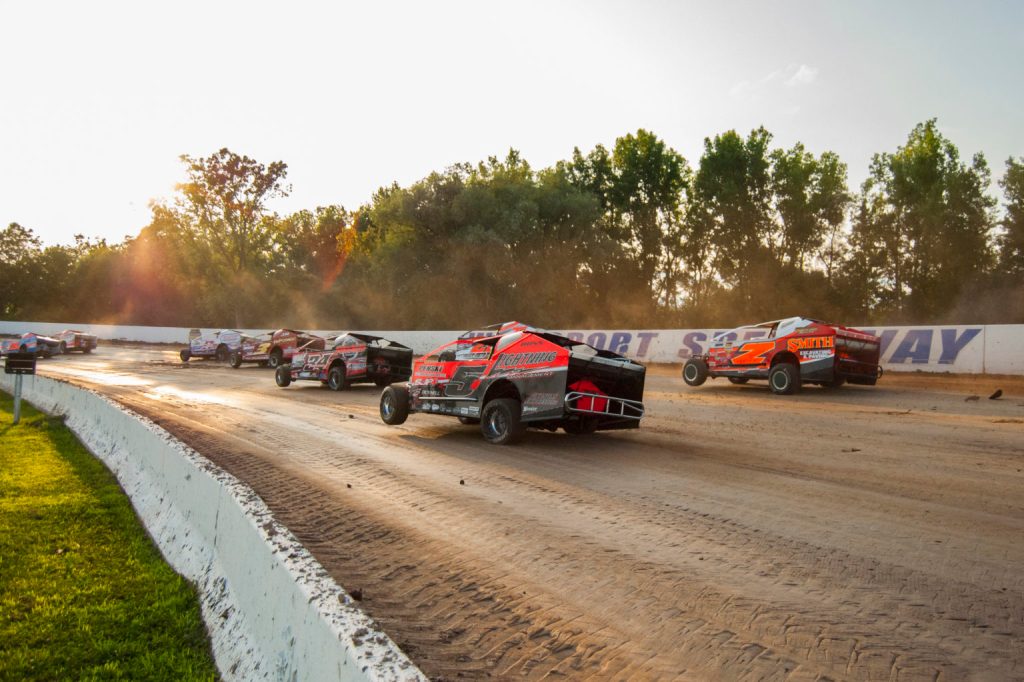
Even since it lost its founding home on the mile at the New York State Fairgrounds in Syracuse, the Super DIRTcar Series for big-block dirt Modifieds has been settling into the new home of its biggest event, the annual October extravaganza known as Super DIRT Week, at Oswego Speedway. That track is north of Syracuse along Lake Ontario, and for every other week of its season, it’s a paved track. The World Racing Group, which owns the Super DIRTcar Series, rents out the track once its regular season ends, grades truckloads of clay over the blacktop, and goes dirt racing for a week. Only this year, the coronavirus and related New York restrictions on public events have claimed Oswego’s entire season. This week, World Racing Group announced that the Oswego program is cancelled for 2020, and that a weeklong slate of events called DIRTcar OktoberFAST that will string six racing events over six October nights at six New York speedways – without spectators – that will be broadcast live to fans via DIRTVision.
OktoberFAST will get underway with DIRTcar divisions on Tuesday, October 6th, from Albany-Saratoga Speedway in Malta. Subsequent stops will be, in order, at Utica-Rome Speedway, Fulton Speedway, Can-Am Speedway, Land of Legends Speedway, before taking on the finale at the circuit’s home track, Weedsport Speedway. Again, no spectators will be allowed for any of these races, so click on the hyperlink to sign up for the broadcasts.
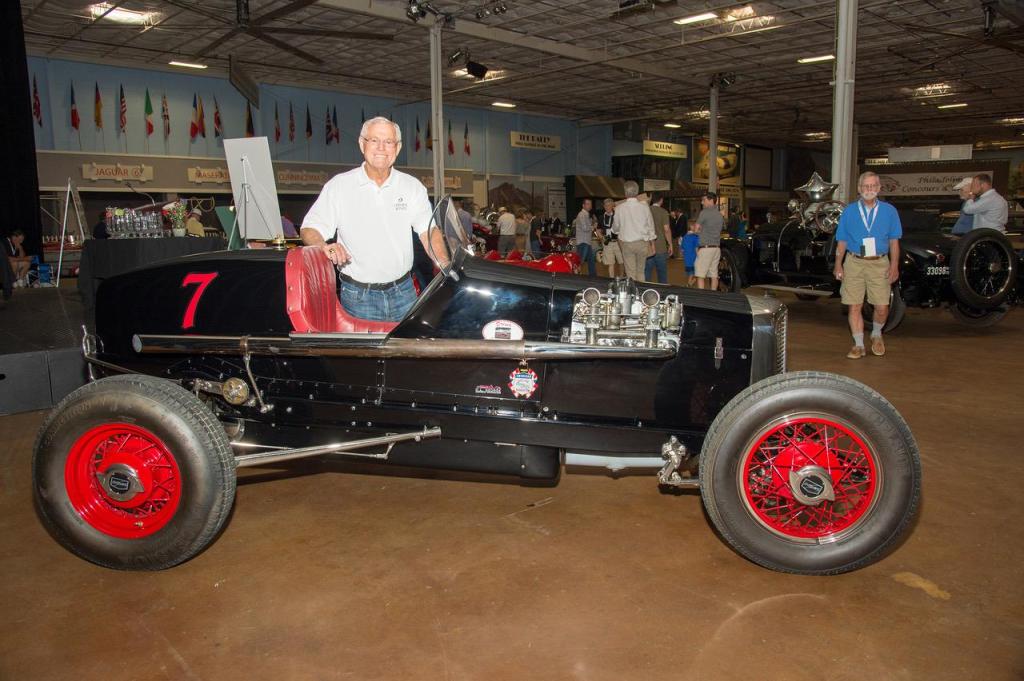
Maybe you didn’t grow up in or around Philadelphia, but you still ought to know that Dick Vermeil is something on the order of a deity in that neighborhood. If you’re wondering who we’re talking about, let us inform you that Dick Vermeil is an icon of professional football, especially in Philly. He began his NFL coaching career with the Philadelphia Eagles, took them to the playoffs within two years, and in another two, took them to Super Bowl XV where they lost to the Oakland Raiders. Vermeil worked in broadcasting for 15 years before he returned to coaching, and led the St. Louis Rams to a Super Bowl title in 2000, before going on to coach the Kansas City Chiefs. He has been named Coach of the Year at every level of football in which he participated. Vermeil’s always been an esteemed presence in Philadelphia, where he maintains a country home in Chester County. Most people don’t know it, but Vermeil is also a noteworthy car guy. His father, Louis, is enshrined in the National Sprint Car Hall of Fame for his work as co-founder of the Northern Auto Racing Club, while running a garage near historic Calistoga Speedway in California. The elder Vermeil also fielded Sprint cars, including this one, a 1926 Ford-powered Miller-Schofield, which Dick Vermeil restored.
Vermeil remains highly active in charitable work in and around Philadelphia, especially as it involves the well-being of children. He is an active board member at Cool Cars for Kids Inc., which has presented the Philadelphia Concours d’Elegance since 2017 at the Simeone Foundation Automotive Museum just off Interstate 95 in South Philadelphia, and is affiliated with a globally famed institution of healing, Children’s Hospital of Philadelphia. This year would have marked the concours’ fourth edition, but the viral pandemic put the kibosh on that. Regardless, Vermeil is the star of a new video promoting the concours, and the cause, which can be viewed on the CCfK website, as above. It’s a prime example of a great guy doing great things for a great cause. If you’ve never been to the Simeone Museum in South Philly to check out its stunning collection of unrestored racing cars, do make plans to get there. The neighborhood dining options are wonderful. And if you want to keep abreast of doing regarding the Philadelphia concours, click here.
Not that long ago, I was at the big annual automotive blowout at Hershey, Pennsylvania, with my friend George Mattar, when both of us were with Hemmings Motor News. We ran into a guy we’re going to discuss in a minute. Just rolled off the truck was the last rear-engine Top Fuel dragster raced by the former child actor Tommy Ivo, fresh off a meticulous restoration. We helped the guy who restored it, Bruce Larson, fire it up for the first time. It was deafening, eye-watering, and all-around delightful. Befitting a legend of East Coast hot rodding and drag racing, Bruce immediately drew a crowd as big as the dragster did. It happens a lot, because Bruce is genuinely a likeable, approachable, truly friendly guy. On the side, he’s made a lot of quarter-mile history. Let’s meet him.
In the long history of drag competition, Bruce goes down as one of the founding fathers of its most popular class, Funny Car, back in the 1960s. He was born in 1937 in Camp Hill, Pennsylvania, across the Susquehanna River from the state capital, Harrisburg, where he became an active street racer while barely past adolescence. At the time, Bruce worked for a local mowing contractor who owned and raced a 1941 Ford with a full-on flathead V-8 for power. Bruce was duly inspired and though only 14 years old, he bought and built up a chopped, fenderless 1932 Ford five-window coupe, crafted to mimic the smooth hot rods coming out of California, and eventually stuffed with Oldsmobile power. In 1954, he took it to Linden, New Jersey, where the first National Hot Rod Association-sanctioned drag race was taking place at a local airfield (it’s still there). Bruce was hooked. He still has the car, by the way, and it, too, has been restored.
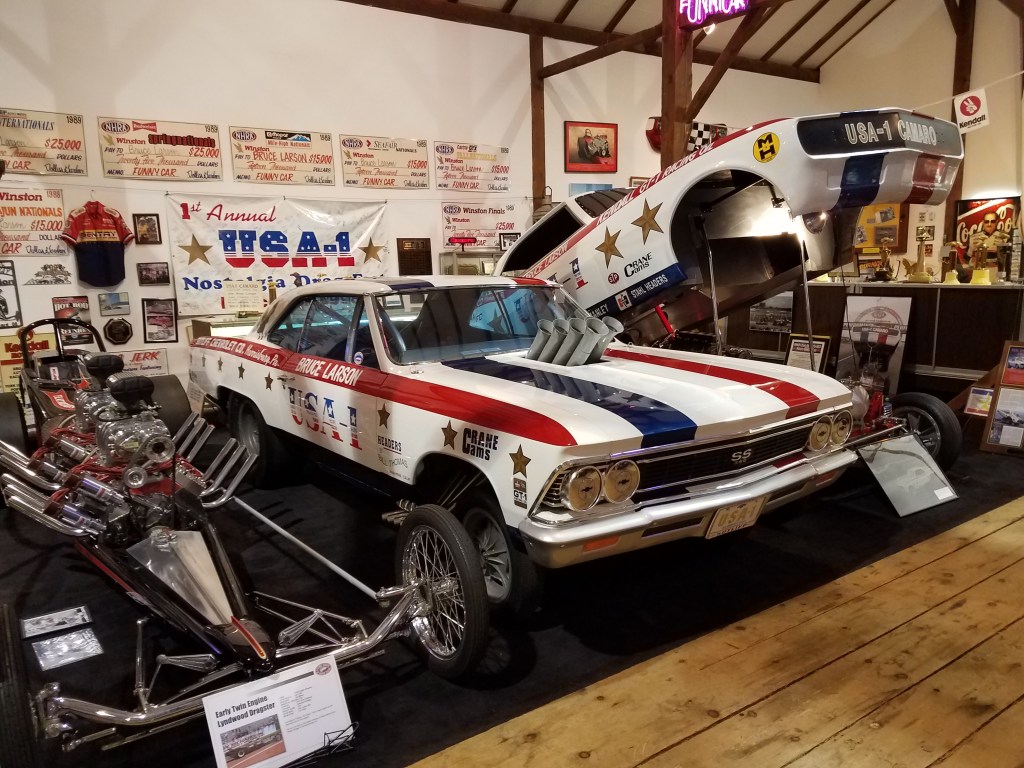
He continued racing and in 1965, found himself in a 289-cu.in. Shelby Cobra, running in the NHRA’s AA/Sports Car category. That year, Bruce won three NHRA national events, including the U.S. Nationals at Indianapolis, while taking the national class record away from another Cobra fielded by Carroll Shelby himself. Around that same time, Bruce was working at Sutliff Chevrolet in Harrisburg, whose boss figured (correctly) that being involved in motorsports would help to sell new cars. At the time, the NHRA had a class called Factory Experimental that allowed racers to do all sorts of crazy things to stock-bodied drag cars that weren’t legal in other categories. Sutliff’s entry was an altered-wheelbase 1966 Chevelle motivated by a fuel-injected Chevrolet big-block, but the car had a major difference: It was the first A/FX car in the United States with a full fiberglass body. It became the template for what the NHRA later renamed its Funny Car division. The Chevelle’s in the middle of the next photo, and now is a prominent exhibit at the Don Garlits Museum of Drag Racing in Ocala, Florida.
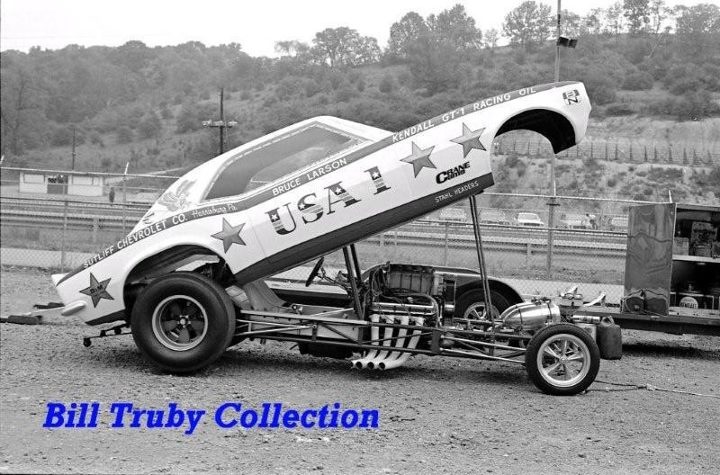
By this time, Bruce has adopted the name USA-1 for his race cars. After a couple of successful seasons with the Chevelle, the Funny Car was firmly implanted as a new, wildly popular category of drag racing. Technologically, it was evolving rapidly. The hot ticket was to have an all-fiberglass body like the Chevelle, only one that was hinged at the rear, for driver and mechanical access, and located atop a purpose-built tubular steel chassis. The dominant chassis builder in the new class was the Logghe Stamping Company of Detroit. Still with Sutliff backing, Bruce commissioned a new USA-1, with a fiberglass Chevrolet Camaro body atop a Logghe frame. Bruce still has this car, too, which grabbed part of the NHRA national record by running 7.41. The car actually has a functional driver’s door. As Bruce explained, “I wanted a fliptop, but I was a little afraid of fire, and we hadn’t thought about having a roof hatch at the time.” Bruce used this car to score what he considers to be his most rewarding win, at the 1969 Super Stock Nationals held at York U.S. 30 Dragway in Pennsylvania. He bested another Funny Car legend, the late Dick Harrell, to win the race.
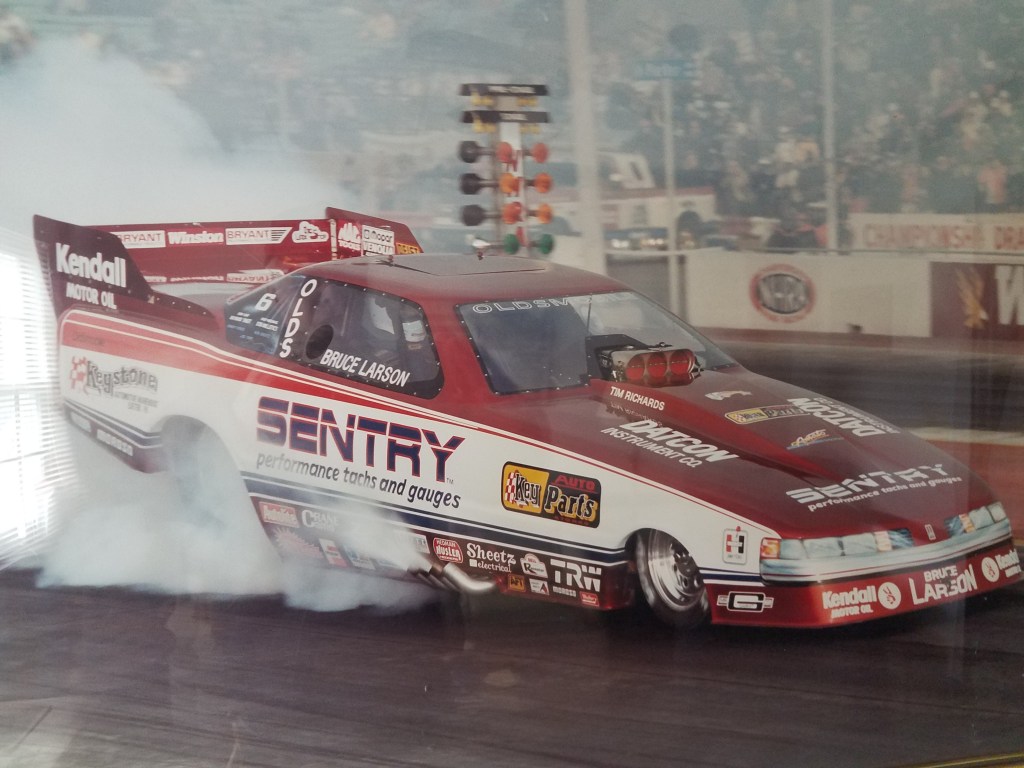
A second Camaro-bodied Funny Car followed, which was destroyed in a 1972 fire, something that encouraged Bruce to try his hand at Pro Stock. The Funny Cars still beckoned, and by the mid-1980s, Bruce was back under fliptop fiberglass and running under an alliance with fellow Pennsylvania nitro racer Joe Amato, which produced Bruce’s first NHRA national win in Funny Car. For 1989, Bruce had backing from Oldsmobile and a sponsorship deal with Sentry automotive instruments. He also hired Maynard Yingst, a former Sprint car driver from Pennsylvania, as his crew chief. They won Funny Car first time out at the 1989 NHRA Winternationals, plus five additional national events, an effort that culminated with the NHRA world championship in Funny Car. He was named Funny Car driver of the year by Car Craft magazine. Sadly, Yingst died of a brain aneuyrism in 1993.
Bruce is indisputably one of Funny Car racing’s earliest innovators and brightest stars. He is enshrined in Garlits’ International Drag Racing Hall of Fame, the Eastern Motorsport Press Association (which also presented him with its Al Holbert Memorial Driver of the Year award) Hall of Fame, the Pennsylvania Sports Hall of Fame, and the Super Stock magazine Hall of Fame. He also holds a prestigious award named for another Pennsylvania drag legend, “Jungle Jim” Liberman. The COVID-19 pandemic forced its cancellation this year, but Bruce ordinarily hosts an annual USA-1 Dragfest at his home base in Dauphin, Pennsylvania.
If you’ve been following this space specifically and the automotive world in general, you know about how some automakers have been making a practice of getting buyers to reserve vehicles before they’re introduced by putting down cash deposits, in the expectation that hordes of buyers are going to run on dealers once important new products are released for sale. Probably the best-known recent example has been at the Ford Motor Company, which experienced success in getting the public to plunk down cash for its coming, all-electric Mustang Mach-E. Now, Volkswagen of America is borrowing a page from that playbook. It’s allowing buyers to get in line for its first electric SUV, the ID.4, which will be revealed on September 23rd.
Here’s the deal: Immediately after next month’s reveal, you’ll be able to access a new portal at the VoA website, which will allow you to build your own ID.4 online and make a refundable $100 reservation to get in the queue. After you’ve gotten a place in line, you’ll be able to lock in your ID.4 configuration and confirm your order by putting down an additional $400. The website will then hand the buyer off to one of Volkswagen’s 600 dealerships in the U.S. to finalize the vehicle purchase and arrange delivery. For potentially hot-selling vehicles, this process eliminates considerable hassle from the ordering process. Thumbs up. Expect to see more of this, given that Volkswagen expects to have sold 26 million EVs globally by 2026.
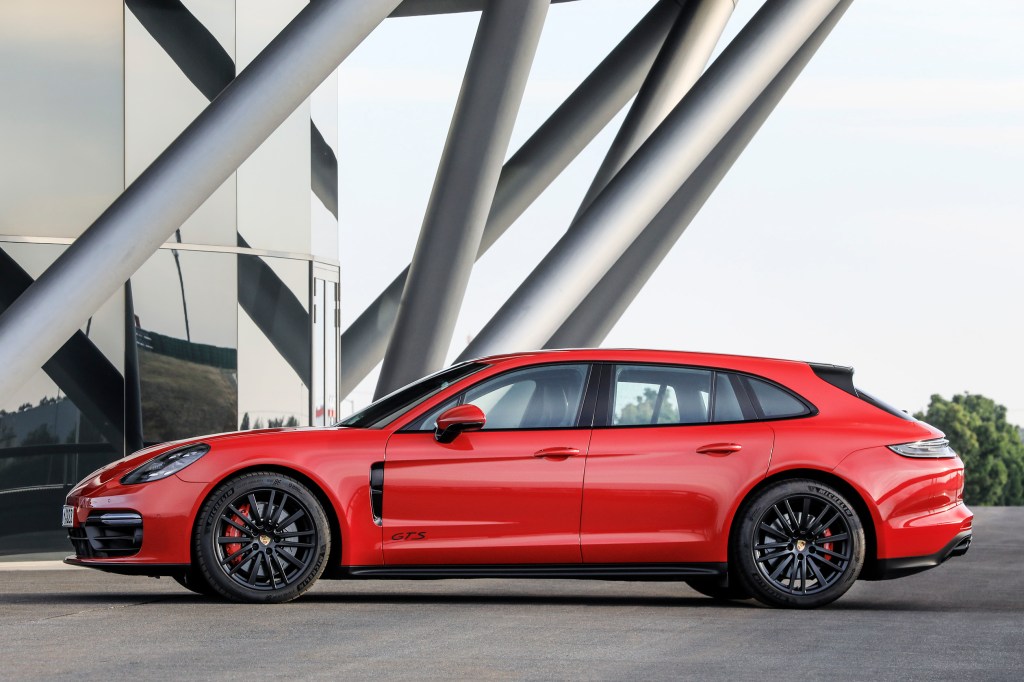
We suppose that some people will never fully warm to the concept of a four-door Porsche, possibly while failing to realize that the Cayenne and Macan SUVs now account for fully two-thirds of Porsche’s global sales. It’s not all about the 911 anymore and hasn’t been for quite some time. The four-door Panamera has been in the Porsche portfolio since 2009. It’s not a huge seller, given that it occupies a pretty price and small niche, that being of a four-door sedan with very direct sports car manners. If you’re familiar with the Maserati Quattroporte, you’re getting the picture. The Panamera has already been through two generations through its rollout, and a realignment of model offerings and considerable freshening will mark this unique sedan (and, sort of, wagon) for 2021.
The Panamera is now produced in two body styles: The traditional four-door sedan and the more wagon-shaped Sport Turismo, with 12 models available across both ranges, including this Panamera GTS Sport Turismo. Porsche is claiming best-in-class performance numbers for this narrowly defined category, with available powertrains, depending on model, ranging from a twin turbo V-6/hybrid combination to a 4.0-liter twin-turbo V-8 making 620 horsepower in the new Panamera Turbo S, which will replace the previous Panamera Turbo, rated at “just” 550 horsepower during its run in the market. The turbo V-8 boasts a revised crankshaft, connecting rods, timing chain and torsional-vibration dampers. Using launch control, this powertrain, which includes all-wheel drive, will boot you to 60 MPH in 2.9 seconds, with the Panamera Turbo S’s top speed advertised at 196 MPH. Prices will be set later.
Even when you’re charging millions, literally, for the cars you build, they’ve still got to begin with an underlying chassis, or at least the basis for one. At McLaren Automotive, which builds some of the world’s most extreme performance automobiles, that means an underlying structure molded completely from carbon fiber. McLaren has used carbon fiber exclusively in crafting the substructure of its roadgoing supercars ever since it rolled out the world-beating McLaren F1 in 1993, a car that became the global gold standard for truly horizon-stretching performance. Carbon fiber has long been a preferred composite material in global motorsports, although it’s widely used in building everything from spacecraft to high-tech sunglasses. What, you ask, is carbon fiber? In this context, it’s a composite material that’s essentially a formed plastic reinforced with threads of carbon atoms spun to diameters of five to 10 micrometers, a fraction of a human hair’s thickness. The resulting composite has a strength-to-weight ratio that’s among the best of any man-made material. On the average, it’s five times stronger than steel, has double the tensile stiffness, is highly heat-resistant and enjoys low thermal expansion. Given all that, it’s an extremely attractive, albeit very costly, strategy for crafting a performance vehicle’s basic platform.
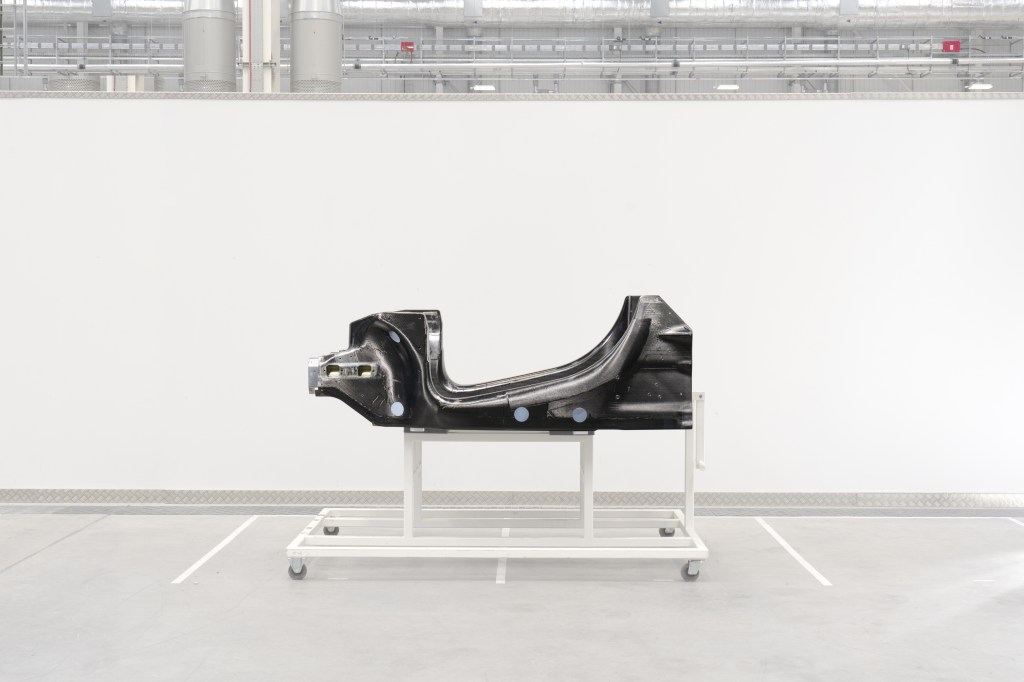
The structural component on the rolling stand will form the basic component to which the suspension and powertrain of future McLaren road cars will be attached. It’s one piece, and while its exact weight and tensile strength hasn’t been disclosed, this part will form the architecture of the next generation of McLaren supercars, which will eventually be 100 percent powered by electricity, starting via hybrid drivelines. McLaren says that newly developed, first-in-the-world processes, which also presumably remain classified, were used to strip out excess mass and weight from the carbon substructure. Again, the weight of this piece wasn’t disclosed, but we’re confident that two guys – or even one – could easily pick it up and carry it away. That’s the beauty of this stuff.
Need a trivia contest for your next socially distanced gathering? How about challenging your guests to describe the differences between the Chevrolet Volt and its electron-powered stablemate, the Chevrolet Bolt. Since you’ll be the contest organizer, here’s a cheat sheet: The Volt is a five-door compact hatchback, built in two generations beginning with the 2011 model year, that has a plug-in hybrid powertrain. The Bolt, on the other hand, is an all-electric vehicle, a hatchback that competes in the subcompact market. Also known as the Bolt EV, it’s been in production since late 2016, succeeding the previous Chevrolet Spark EV. Despite its resemblance to the gasoline-fueled, Gamma-platform Spark, and the fact that they’re built on adjoining assembly lines in Lake Orion, Michigan, the Bolt and Spark don’t share most components. The Bolt is due for a freshening, and a line expansion, that’s coming to market next summer.
Chevrolet has chosen to share an image of what’s going to be the biggest Bolt from the future once the line gets its 2021 redo, a new Bolt EUV, essentially a very compact SUV that’s kind of like another General Motors product, the hydrocarbon Buick Encore/Chevrolet Trax, at least in terms of packaging. Aside from the larger-capacity body, the Bolt EUV will be most noteworthy for offering Super Cruise, which GM touts as the first true hands-free autonomous driving package suitable for use in highway traffic.
America’s got things like the Corvette C8, the Hellcats from FCA and in the past, muscle cars with outrageously big-displacement engines. Japan, on the other hand, has cars like this, and for a long time, we were barred from sampling the best of them. That’s largely changed because now, you can buy things stateside like the Acura NSX, Subaru WRX STI and Toyota Supra. Nissan, too, has its own drool-inspiring lust object for drivers who can simply never go quickly enough. It’s the Nissan GT-R, what used to be called the Skyline GT-R, and it’s justly one of the most famous and potent high-performance cars that’s ever screamed out of the Far East. Nissan finally bowed to untold years of pleading and supplication, and as of 2008, this powerhouse has enjoyed a place of honor in Nissan’s lineup of vehicles sold in North America. It’s offered for 2021 in a pair of guises that are perhaps best described as insane and then totally off-the-cliff crazy.
Even what stands as the base model, the GT-R Premium, is certifiably nuts as far as performance cars go. The 3.8-liter twin-turbo V-6 in the Premium edition thumps out 565 horsepower, and fortunately has standard all-wheel drive to keep those ponies planted. It’s primarily positioned as a high-end, high-luxury GT with outrageous performance capability. For some, that’s not enough. Which makes everyone happy, we say confidently, that Nissan also offers the GT-R NISMO for those who demand the absolute most in terms of velocity potential. Each GT-R NISMO has a hand-built engine with model-specific turbochargers that boost – pun intended – its output to 600 horsepower, giving the car an actual top speed of 186 MPH. All-wheel drive, carbon ceramic Brembo brakes and Recaro seating are part of the package. Prices for the GT-R Premium will start at $113,540, while the GT-R NISMO begins at $210,740. Go ahead, it’s only money.
If you like old cars, and all kinds of cool information that applies to them, you really ought to be reading The Old Motor. It’s an online vintage automobile magazine that’s updated every day by its creator, David Greenlees, who lives in Brattleboro, Vermont. David is one of the automotive hobby’s really good guys, and is acclaimed restorer of veteran vehicles, including a Duesenberg race car that took part in the Indianapolis 500 during the World War I era. There’s always something fantastic being reborn in David’s shop, and you’ll also find all kinds of wonderful stuff on his website. As one example, we offer this unusual vehicle, and its even more curious history.
For the record, this is a customized 1938 REO tractor pulling a Curtiss Aerocar travel trailer of about the same vintage. The luxurious land yacht was commissioned by Dr. Hubert Eaton, a businessman whose holdings came to include Forest Lawn Memorial Park in Glendale, California, the last stop for any number of silver screen icons and other Hollywood celebrities. The REO power unit was custom-built by Standard Carriage Works of Los Angeles, resembling a design for another lavish transcontinental traveler designed by Brooks Stevens, of later Studebaker and Excalibur fame. The trailer comes from a firm founded by the American motorcycle champion and aviation pioneer Glenn H. Curtiss of Hammondsport, New York, who’d been building early travel trailers since about 1920. Curtiss eventually shifted into Florida realty development with his friend, Indianapolis Motor Speedway co-founder Carl G. Fisher. A firm to manufacture Aerocar trailers was set up in Coral Gables, Florida, just before Curtiss died in 1930. According to the Coachbuilt website, private owners of Florida-built Aerocar trailers also included chewing gum magnate Philip K. Wrigley and the noted bon vivant William K. Vanderbilt II. Eaton’s Aerocar featured a tall cupola for sightseeing, reminiscent of the Vista Dome passenger cars that were later a common sight on crack passenger trains. The Eaton rig was in regular service at Forest Lawn until 1991 and now resides, in largely original condition, at the Petersen Automotive Museum in Los Angeles.
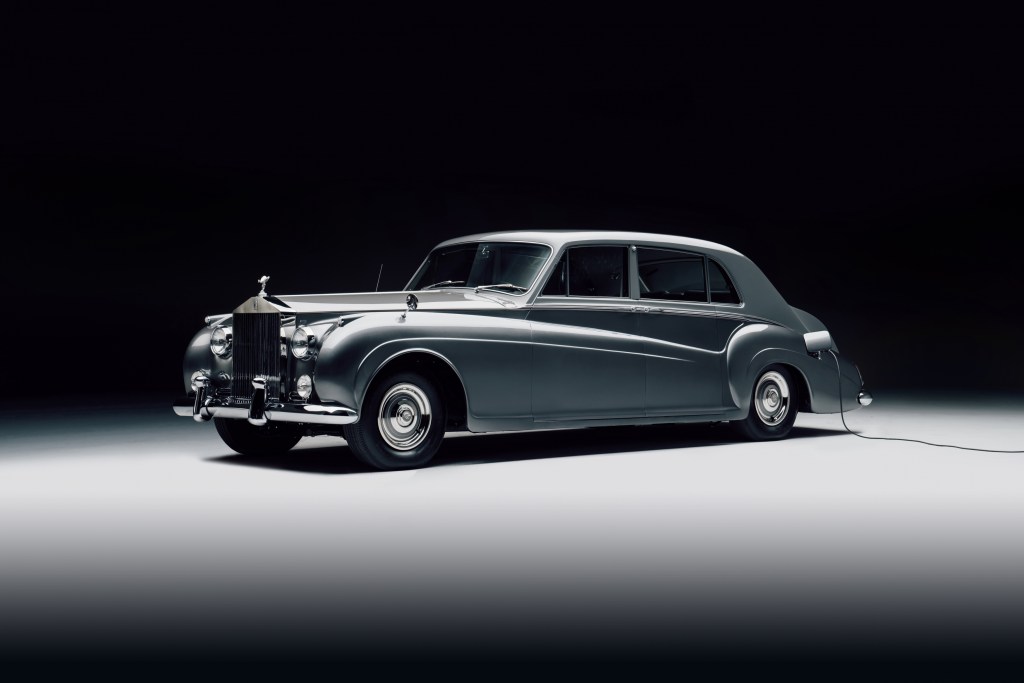
Look at the photo, and try to grasp that there’s indeed an electrical cord plugging inside the fuel door of this car, rather than a rubber hose attached to a gasoline pump. At some point, and it’s coming quicker than you may think, the world of cars is going to execute a tectonic shift from hydrocarbon to electrical power. For almost all of us, that conjures mental pictures of efficient sedans, hatchbacks and SUVs whispering down the road without emitting fumes. There are those who believe that the world of collector or historic vehicles is going to make the same kind of swerve, and are working in anticipation of that change. This car is an extreme example of what we mean, and it’s actually available to buy. The car is a Rolls-Royce Phantom V, one of the United Kingdom’s most venerated motoring icons.
If you’re unfamiliar with the lineage here, allow us to explain that the Phantom V is one of the most august, esteemed cars that Rolls-Royce has produced in its long and distinguished history. It’s a huge limousine, powered by a 6.2-liter V-8 coupled to a General Motors Hydra-Matic transmission. Just 832 were produced during its lifespan, which lasted from 1959 through 1968, the majority with Park Ward coachwork, with James Young furnishing the bodywork for the remaining cars. Owners have included Queen Elizabeth II, the Shah of Iran, John Lennon and Sir Elton John. In Great Britain, a Phantom V ranks with the holiest of the holy. That brings us to Lunaz Design, a British firm located in Silverstone, one of the hallowed sites of motorsports in England. Lunaz has commenced on a no-excuses, expense-irrelevant initiative to reinvent historic British automobiles, including the Phantom V, to full-electric operation. The Rolls-Royce Phantom V by Lunaz, as it’s called, takes one of these cars (the prototype dates to 1961) down to bare metal and adds a proprietary all-electric powertrain. It’s the first purpose-built, all-electric, chauffeur-driven car in the world. The Phantom V is then refinished with Midland Grey on the upper body and Cinereous Grey below, with new hides throughout the interior plus satellite connectivity. The powertrain transplant gives the car a range of 300 miles per charge, considerably farther than the typical chauffeured jaunt. Lunaz will offer the car in a global markets with a starting price of 500,000 pounds Sterling, which equates to $654,475.01 at today’s currency exchange rate. Lunaz also plans all-electric conversions to other immortal British legends such as the Rolls-Royce Silver Cloud, Jaguar XK120 and the Bentley S2 Flying Spur.






 Jim Donnelly On Wheels