Ford returns to the Sprint car wars with a new 410 engine

Ever since Parnelli Jones and Jim Hurtubise first towed east from California with their Corvette-powered Sprint cars in the early 1960s, this stirring, elemental genre of motorsports has been the nearly exclusive province of the small-block Chevrolet V-8, which pushed the eternal Offenhauser racing engine into obsolescence. Under the Ford Motorsports banner, Dearborn took a crack at offering a 410-cu.in. engine assembly back in the 1990s, but it failed to make a major dent in the market. That’s due to change. Ford has announced a partnership with Tony Stewart/Curb-Agajanian Racing, known colloquially as Tony Stewart Racing, and Durham Racing Engines of High Point, North Carolina, to build and sell new 410 engines for competition with the World of Outlaws and other Sprint series.

Stewart has returned to his roots as an open-cockpit stud since retiring from his driving career in NASCAR. This Jason Brown image shows Stewart standing on the loud pedal in his Ford-powered TSR Sprint car. The engine, known as the FPS (for Ford Performance Stewart) 410, made its debut in mid-August at I-96 Speedway in Lake Odessa, Michigan, and it scored its first win two weeks later at the Plymouth, Wisconsin, Dirt Track with Stewart in the hot seat. Stewart-Haas Racing switched from Chevrolet to Ford in NASCAR, plus Stewart not only owns the historic Eldora Speedway in Ohio, but also took over the All-Star Circuit of Champions series for Sprint cars. That makes him a fully fitting partner for Ford Performance in the engine project. He runs so many Sprint races now that Ford engineers were able to use his input at the track in evaluating the engine design. Like all 410 engines, the FPS 410 is fed by mechanical fuel injection, utilizes dry-sump lubrication and produce around 900hp. Andy Durham comes to the program having built engines for Roush-Yates, plus winning power in both the World of Outlaws and Lucas Oil Dirt Late Model series.

Texas goes all-in for big pickups. This time, it’s the Nissan Titan

Just to repeat, the Texas State Fair is a big event, drawing more than 2 million visitors every year. And it’s worth making clear that Texas is, was, and always will be about pickup trucks. Big, brawny ones. So while Chevrolet selected the fair as the venue for rolling out a couple of Silverado special editions, Nissan wasn’t about to be left a wallflower. It chose this celebration of country living and chicken-fried steaks to unveil its redesigned 2020 Titan full-size pickup.

The 2020 Titan advertising campaign centers around its new theme of Powerful Warrior, which emphasis its solid-beam, ladder-frame construction and what Nissan bills as best-in-class horsepower and torque figures, as generated by its 5.6-liter Endurance V-8 that produces an even 400hp, which for 2020 is mated to a new nine-speed automatic transmission. The 2020 Titan is visually distinguished by its new trapezoidal-shaped LED headlamps and double-boomerang LED DRLs, plus three different grilles and five wheel choices – but hey, do we detect just a hint of Ford F-150 cues in the overall package? The Titan’s interior is fully redesigned, based around a seven-inch programmable information display, mated with a flexible smartphone holder and charger. Nissan Intelligent Mobility technologies abound, including Automatic Emergency Braking with Pedestrian Detection, Blind Spot Warning, Rear Cross Traffic Alert, Lane Departure Warning, High Beam Assist and class-exclusive Rear Automatic Braking, plus Intelligent Forward Collision Warning, standard Blind Spot Warning, Rear Cross Traffic Alert and Intelligent Around View Monitor. Other systems include Intelligent Cruise Control, Intelligent Driver Alertness, Traffic Sign Recognition and Rear Door Alert.

Chevrolet returns with Midnight and Rally editions for Silverado

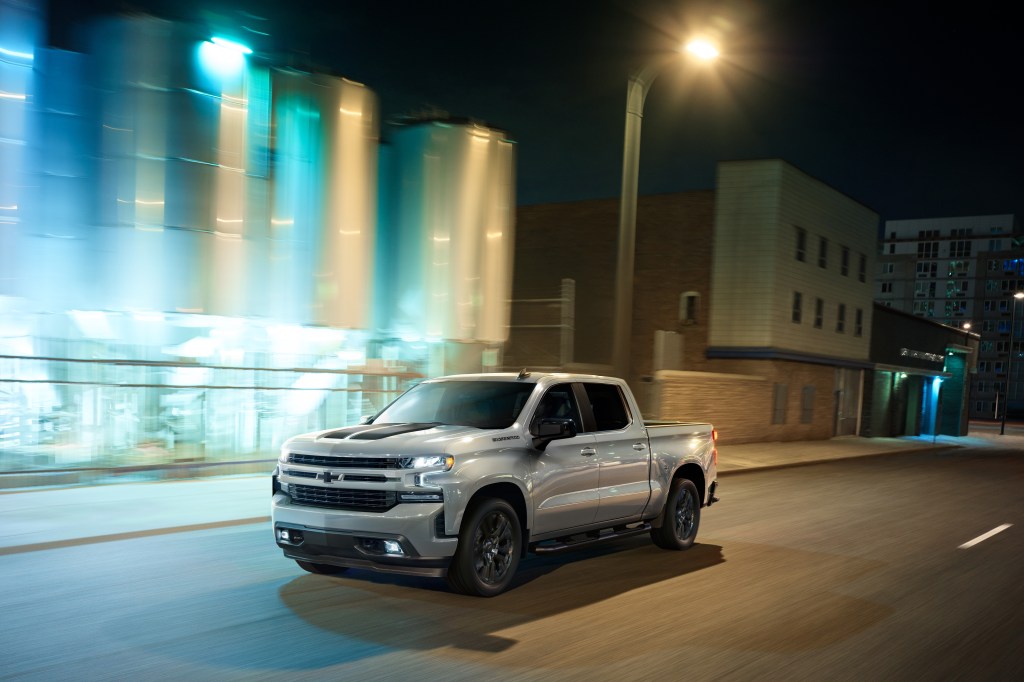
In addition to being a truly great take on the full-size American pickup, the Chevrolet Silverado is returning for the 2020 model year with a pair of strongly popular special editions. Chevrolet picked last week’s Texas State Fair in Dallas – a massive shindig where you can sample the likes of deep-fried bubble gum and, yes, fried beer – as the wholly apt locale for reintroducing buyers to the latest version of these trucks. One special edition is off-road oriented; the other is a pure street fighter.

Aimed at those who enjoy getting dirty, the Silverado Midnight Edition is offered for 2020 on the LT Trail Boss and Custom Trail Boss trim packages. It’s built, quite literally, around a two-inch suspension lift from the factory and the popular Z71 Off-Road Package, whicht makes use of Rancho monotube off-road shock absorbers, an automatic locking rear differential, skidplates, 18-inch black-finished wheels and Goodyear Duratrac off-road tires. All-black accents and badging complete the model. For those who prefer to strut down the street, the Silverado Rally Edition, pictured above, is offered on the Custom and RST trim packages and is based upon high-impact visuals in four colors with blacked-out accents. Engines: The Midnight Edition can be ordered with a 5.3-liter V-8 coupled to a six-speed automatic transmission, or a 6.2-liter V-8 with a 10-speed automatic and up to 420hp. The Rally Edition starts out with a 2.7-liter turbocharged inline-four mated to an eight-speed automatic, with the two V-8s optionally available.

Midship power comes into vogue again in the house of Porsche

We’ve pointed out here earlier that 2019 marks the 50th anniversary of what’s usually been a hugely underrated and underappreciated car, the Volkswagen-based Porsche 914. It had decidedly plebian origins, and its angular, appliance-like styling didn’t appeal to everybody, but the 914 was a genuinely transformative sports car and gave Porsche something of a new identity. Before the 914 was introduced, the only way you could experience a true mid-engine Porsche was to shriek down the Mulsanne straight at 240 MPH in a 917 prototype.

That’s why it’s so pleasing to know that midships-mounted power is still percolating very nicely at the storied Stuttgart manufacturer, following a hiatus that stretched for some 20 years. The blazing yellow car on the right is the Porsche 718 Cayman GT4 coupe, which has received a significant horsepower boost for 2019. Its layout, with the engine ahead of the rear transaxle, dates to 1996 when its forebear, the Boxster roadster, was first introduced. Its engine positioning was chosen to differentiate the Boxster from the eternal, sainted 911. The Cayman followed as a coupe variant of the same engine-transaxle orientation, and like the Boxster, it’s been a major success in the marketplace. There’s now enough room behind the transaxle to allow the placement of a diffuser at the rear of the car, which would look very much at home at Le Mans. While the Boxster was traditionally a four-cylinder car, the Cayman GT now makes full use of a 4.0-liter flat six that produces 420hp, and allows shutdown of half its cylinders during steady-state cruising for improved fuel economy.

Just like Hulk Hogan, the new Aston Martin SUV is jacked

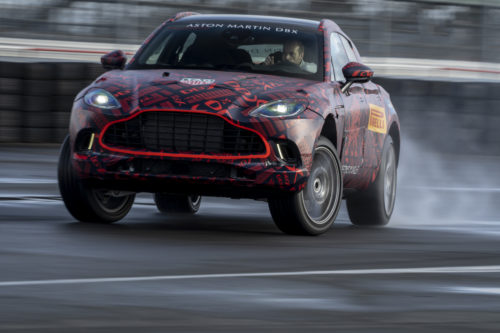
It hasn’t even been formally introduced yet – that’s not supposed to happen until December – but the Aston Martin DBX is still undergoing some pretty intensive evaluations. The iconic British producer’s first SUV is getting a pre-production wringing out at Aston Martin’s two engineering centers, at the historic motorsports venues of Silverstone in England and at the Nurburgring in Germany. And believe us, this thing is making some very big noise.

Behind that unforgettable grille opening is the main weaponry of the DBX, a twin-turbocharged 4.0-liter V-8 produces the equivalent of 542hp in street trim, which, incredibly, is higher output than either the Aston Martin Vantage or DB11 sport GTs can manage. The DBX has already bested 180 MPH in testing, boasts a shorter braking distance than the DBS Superleggera GT, and has lapped the fabled Nordschleife circuit at the Nurburgring in less than eight minutes flat. So this is very serious stuff, just the ticket for taking the typical Porsche Cayenne down a notch or two. No MSRP has yet been announced.

Sharp looks, new goodies for the 2020 subcompact Mazda 3

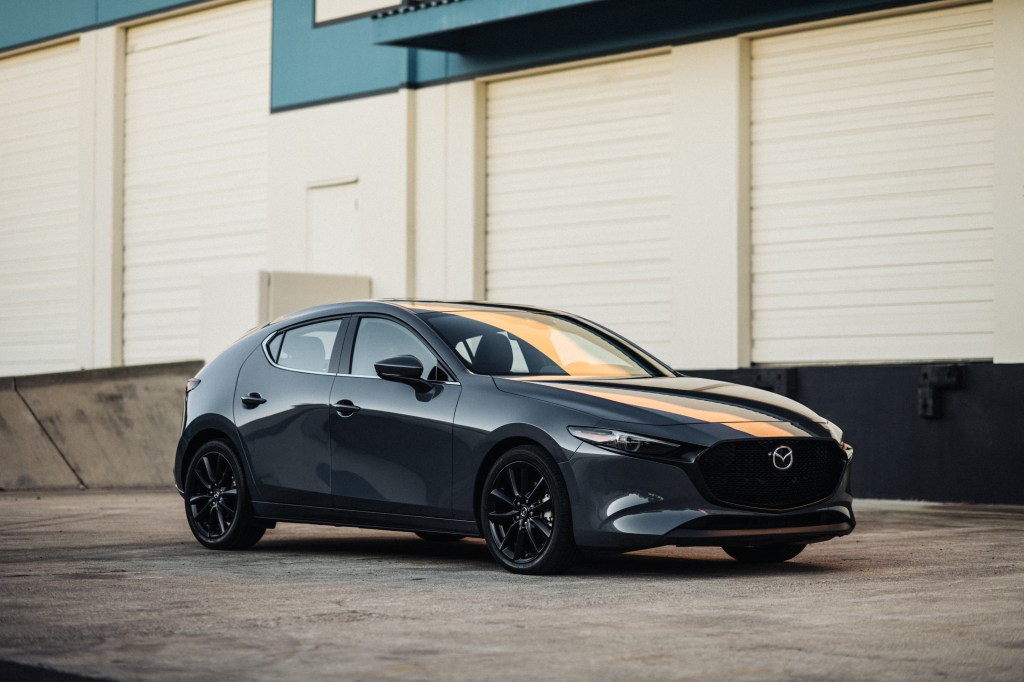
Expensive cars tend to get the bulk of media coverage, so it’s refreshing to take a break and look at something that most everyone can afford. That’s certainly the case with Mazda’s entry-level product, the Mazda 3, which is coming off a full restyling for 2019 with the latest iteration of the automaker’s Kodo body architecture. For 2020, the edgy little subcompact is being treated to a complement of interior accoutrements that give it a premium presence.

Key among those changes is the adoption of an 8.8-inch in-dash screen with touch-sensitive Mazda Connect interactivity, which can now be operated through voice command. A seven-inch digital dashboard presents virtual gauges of analog appearance. There’s a whole range of features for 2020 that you’d expect to find on more expensive cars than this, including Radar Cruise Control with a stop-and-go capability, Driver Attention Alert, power folding side mirrors and one-touch power windows. Speaking of power, the Mazda 3 gets motivated by the Skyactiv-G 2.5-liter inline-four with cylinder deactivation – sizable displacement for this size automobile – which is rated at 186hp of output, and a 12-speaker Bose premium audio system is offered for those who like to feel their eardrums throb.

Cadillac rolls out a new 2020 offering, and it’s a sedan

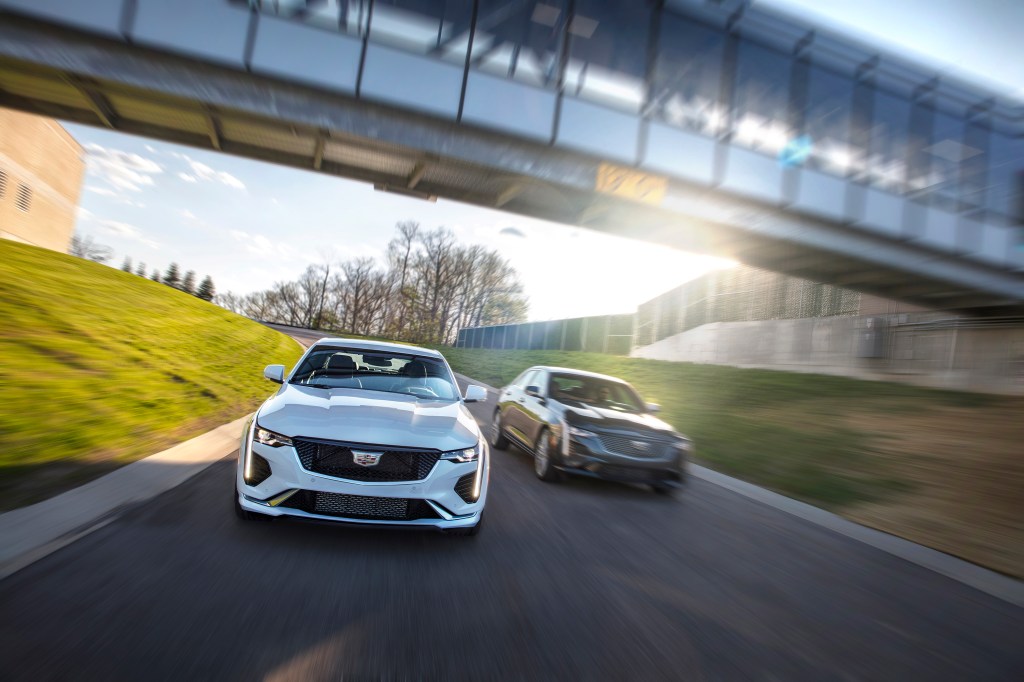
In the greater automotive world, sedans are becoming an endangered species, sent tumbling by the tsunami of trucks and SUVs that have become the primary choice for millions when it comes to buying a “car.” Except at Cadillac. The august General Motors brand is realigning its product lineup that remains sedan-oriented, the massive Escalade notwithstanding. That process advanced with the announcement of the 2020 Cadillac CT4, its entry-level sedan, which replaces the ATS in the Cadillac lineup but still shares its platform.

Not only is the CT4 a sedan, but it rides on rear-wheel-drive architecture and boasts an all-turbocharged selection of engines. Beyond that, all-wheel drive is available on every version of the CT4. The base CT4 engine is a turbocharged inline-four that displaces 2.0 liters and produces 237hp. It’s mated to an eight-speed automatic transmission. Opt for the CT4 Premium Luxury version and the displacement goes to 2.7 liters, with 309hp and a 10-speed automatic. If you’re a really committed driver, you can go all the way to the CT4-V performance model, where the 2.7 rates 325hp when coupled to the 10 speed. That model also gets a limited-slip rear differential and Brembo front brakes with four-piston calipers. All the engines make use of a three-stage sliding camshaft design, active fuel management and automatic start-stop. And in calendar year 2020, you’ll be able to select Cadillac’s Super Cruise option, which allows for hands-free motoring.

Kia’s milestone: 3 million vehicles assembled in the United States

We’ll bet you don’t even know about this one. Quietly, much more so than its corporate parent Hyundai, Kia has been making deep inroads into the United States market. Those who follow it know that Kia is a producer of affordable, high-content vehicles sourced in its native South Korea. But how many of us know not only that Kia operates a vibrant U.S. assembly plant, but that it also cranked out its 3 millionth vehicle just last week after only about a decade of existence?

It happened in West Point, Georgia, where Kia Motors Manufacturing Georgia Inc. operates a sprawling final-assembly facility that builds the Sorento SUV, the Optima sedan and the new Telluride premium SUV. It was the latter model that achieved Kia’s production milestone, as a white 2020 Telluride SX Prestige rolled off the line and headed for Kia’s dealership network. Kia sank more than $1.1 billion into the plant, which produced its first vehicle in November 2009. That means it took Kia less than 10 years to reach the 3 million mark, a remarkable record of success. The Telluride has been finding buyers in a hurry, so by no means will the be the last one rolling out of Georgia.

These people really were part of the Greatest Generation

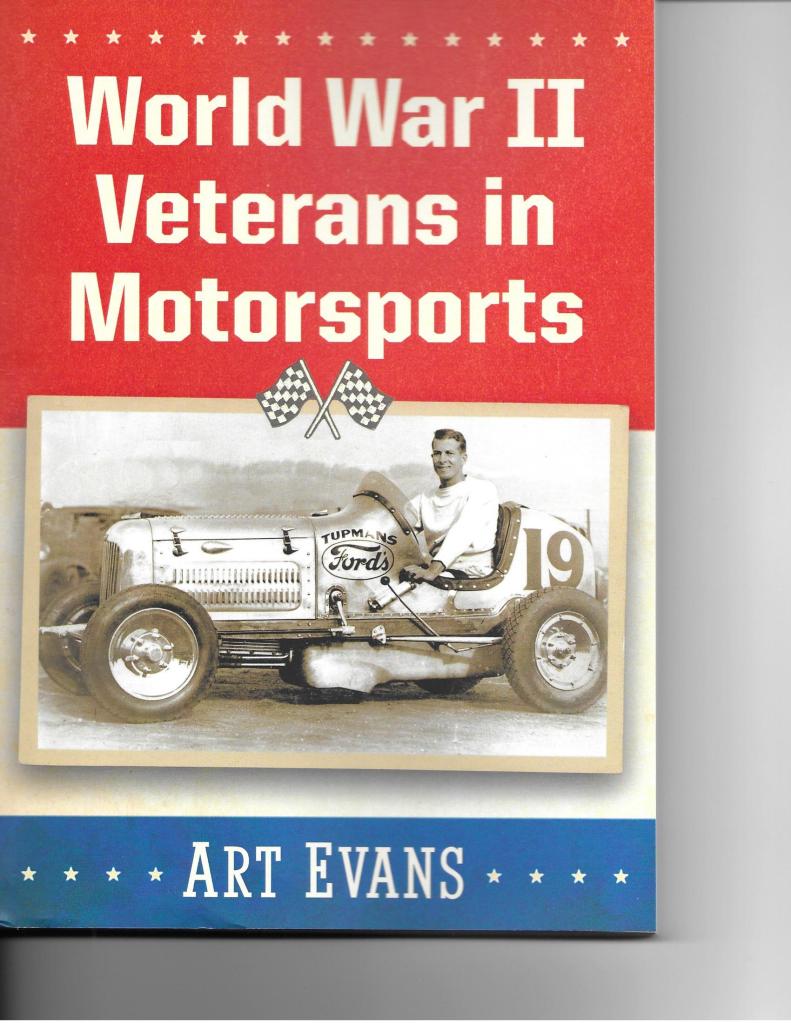
We told you a little while ago about McFarland Publishing and the fascinating array of books on transportation subjects that they produce. Here’s another one, brand new, and the work of the widely respected Southern California racing historian, Art Evans. World War II Veterans in Motorsports is about men (and two women) who returned from combat and defeating tyranny to learn that the pastoral, relaxed reality of life in the unfolding Fifties wasn’t really for them. Instead, they turned to fast cars in a world of racing had exploded out of nearly nothing.

A former racer himself and a onetime production executive at Paramount Pictures, the author is responsible for innumerable books and magazine articles on early competition history. He focuses here on people who traded warfare for a whole new kind of combat: In the book’s 196 paperback pages are the stories of Dan Gurney, Steve McQueen, Rodger Ward, Bill Stroppe, Paul Newman, Johnny Von Neumann, Max Balchowsky and a gentleman I got to know well late in his life, the international racing star John Fitch. Most of them experienced the Southern California racing scene in its earliest, formative years. The book focuses on closed-circuit racing, bypassing the revolution in drag racing, which involved a lot of people who were veterans or worked in the defense industry, that was going on at the same time. No matter. Any work that salutes the lives of World War II veterans is worthy, and this one tells compelling stories. The retail price is $39.95. You can order it from the publisher or else pick it up at Autobooks-Aerobooks in Burbank, California, which is always worth a visit when you’re in Los Angeles.

Volkswagen does it with unveiling of all-electric ID.3

Also in Frankfurt, Volkswagen was doing its own rollout, albeit involving a vehicle it has no current (pun intended) plans of selling in North America. Volkswagen this week debuted the ID.3 subcompact, the first vehicle to be built on its MEB platform for electrically powered vehicles. Depending on variant and optioning, the ID.3 will be able to deliver driving ranges of 330 to 420 kilometers on a single charge.

Among the car’s technological capabilities are Volkswagen’s assurance that the ID.3 can store enough energy for a 290-kilometer drive with only 30 minutes’ worth of charging. The German giant will further guarantee that the ID.3’s battery pack will last for eight years or 160,000 kilometers. With an anticipated starting price of less than 30,000 euros when it goes on sale in mid-2020, the ID.3 will attempt to replicate the original Beetle’s massive success in creating a whole new mode of personal transportation. The car is no larger externally than the conventionally powered Golf, yet boasts the largest interior dimensions in its size category. Volkswagen reckons that government subsidies for zero-carbon electric vehicles in its home market, combined with charging stations at all 4,000 Volkswagen dealerships in Europe, will assure the ID.3’s success with buyers. So, the plan goes, will be Volkswagen’s intention to establish 400 ultra-fast charging stations along major European express highways among the more than 100,000 charging points linked to Volkswagen’s WeCharge network throughout Europe. No matter what some individuals in the United States might have you believe, this is the future of driving for many of us folks.