On Dasher: Remembering an underappreciated Volkswagen

We’ve all been finding solace in nostalgia of late. Volkswagen, which spends a lot of effort discussing its EV transition nowadays, decided to look back at some of its earlier models as examples of platform sharing when that first became a cost-saving industry strategy. The first case of it, naturally, involved the Beetle, which begat the T1 bus of 1950, the three-box 1500 of 1965 and the largely unloved 411 that first appeared in 1971. Three years later, in 1974, Volkswagen executed the greatest product transformation in its history, with new lines of cars that utilized water cooling and front-wheel drive. The most significant, obviously, was the first Golf, which was called the Rabbit in the United States and built for a time in New Stanton, Pennsylvania. But we shouldn’t forget Volkswagen’s lineup of larger front-drive cars, known internally as the B1 or the Passat, which first appeared in late 1973 as 1974 model. In the United States, this car was first known as the Dasher.
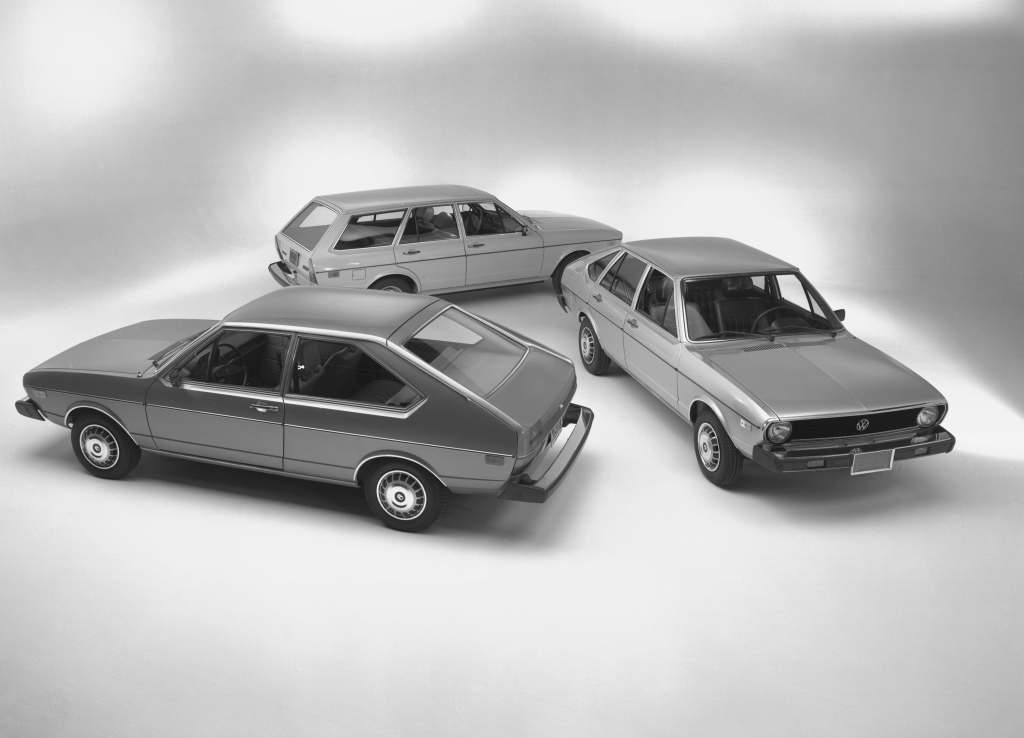
We figure that we can say with pretty high confidence that the Dasher, for all its significance, is largely a forgotten car, which is too bad. It was a fastback and wagon version of the Audi 80, introduced the previous year, which became known here as the Fox. At that point in time, the Dasher was a cutting-edge car, its lines created by the famed Italian designer Giorgetto Giugiaro, who also penned the original Golf. The Dasher replaced the 1500 and 411 in Volkswagen’s lineup, and boasted a longitudinally mounted front-drive powertrain plus a MacPherson strut front suspension, which was very contemporary at the time. In 1974, the only other European cars of similar size to feature front drive and a hatchback body design were the Renault 16 and the Austin Maxi. Sales of the Passat expanded globally and in 1981, a second-generation version was introduced and dubbed the Quantum in the United States, with optional five-cylinder Audi power. Once such vehicle that I got to experience was a tasty item called the Quantum Syncro, a B2-platform wagon that combined five-cylinder power with an early version of Volkswagen’s 4Motion all-wheel-drive system. It loved wet roads and would click along at 85 MPH while averaging 35 MPG. The Passat went through eight iterations before being relaunched for 2012 aboard the NMS (New Midsize Sedan) platform, jointly developed with Shanghai Volkswagen Automotive. This generation incorporated the original Volkswagen CC – if you’re wondering, its stands for “Comfort Coupe” – an oversized Passat with four-door coupe bodywork. Last year, Volkswagen essentially split the Passat line in half: For the U.S. market, the Passat remains on the NMS platform with an extensive restyling and interior upgrade for 2020, and is built in the Chattanooga assembly plant. The China-market Passat now rides on Volkswagen’s modular MQB platform (it stands for Modularer Querbaukasten, which is German for Modular Transverse Matrix), developed at a cost of $60 billion, which encompasses nearly 50 vehicles for various markets from Volkswagen, Audi, SEAT and Skoda. That lineup also incorporates the Volkswagen Arteon four-door coupe, which debuted in 2017 and replaced the CC in the U.S. model range.

On its 56th birthday, the Mustang flexes newfound global muscle

A couple of very significant automotive milestones were achieved last week, in case you happened to be looking elsewhere. Last Friday, April 17th, marked the 56th anniversary of the Ford Mustang’s initial rollout as a 1964 1/2 model, rolled out just too late to beat the Plymouth Barracuda to market as America’s first pony car, but just in time to pace that year’s Indianapolis 500. The Ford Motor Company marked the occasion by claiming some genuine bragging rights: First, the recognition that the Mustang is officially the world’s top-selling sports car, and also its fifth consecutive year as the best-selling sport coupe on the planet. While most of us have paid attention to things located closer to home, the Mustang has gone positively international.

2020 Mustang Shelby GT500

If you’re old enough, you may remember when the Mustang, born of the most plebian compact origins, made its first tentative steps into road racing and rallying. That was before Carroll Shelby upended everything by unleashing the full-race G.T. 350R in 1965, which broomed the world of SCCA semi-pro road racing. Understandably, a lot of attention has been focused lately on the forthcoming Mustang Mach-E crossover EV, but traditionalist Stang-ism has never been stronger. Ford now offers a global lineup of a dozen performance-themed Mustangs, including the Shelby-badged models shown here. And the market for Mustang indeed reaches around the world: Last year, Ford sold 102,090 copies of the Mustang, far outstripping the Chevrolet Corvette and everything else. That figure reflects an annual model sales boost of 33 percent in Germany, 50 percent in Poland, and a near-doubling of sales performance in France. The results were gleaned from a study of international new-vehicle registrations compiled by the research firm IHS Markit. So in 2020, the pony gallops just about anywhere you can name.

A beauteous volume of rallying history from Great Britain

You’ve got to hand it to our cousins across the Pond; they’re really exceptional when it comes to recounting the history of the automobile. As a case study, we offer this new volume from our friends at Veloce Publishing Ltd. in the United Kingdom. The Great British Rally is ostensibly the 75-year heritage of a single event, originally known as the RAC Rally and now called Rally Great Britain. But thanks to the author, this huge, lavish book will stand as not only the tale of one rally, but an excellent overview of this frenetic brand of motorsport’s longstanding practice on the United Kingdom’s hedgerow-lined lanes.

Graham Robson, ably assisted here by former rally navigator Martin Holmes, was uniquely well-suited for this project. Robson is the author of more than 160 books on motoring history, in addition to holding staff positions at Autocar and with the managment staffs of both Standard-Triumph and Rootes. This hardbound history runs to 224 sidebar-laden pages, utterly rich with both results (there’s an appendix chapter listing all winners) and historic period photos. It’s excellent work, and Veloce’s stocklist is chockablock with titles on rally events, cars and British marque histories. Staying inside, we hope? This title will help enormously when it comes to making the time pass. We highly recommend any title from Graham’s body of work. You can find and order this book stateside by pointing your browser to our friends at Quarto, which also boasts plenty of other motoring-related books. The U.S. price is $60.00 and the ISBN is 978-1-787113-68-8.

A fallen officer is remembered in massive IMS memorial service

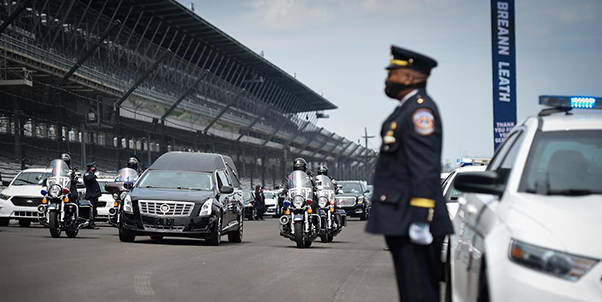
Normally, the sprawling expanse of the Indianapolis Motor Speedway is all about superhuman achievement. Keep that in mind while we explain what happened at the now-silent track this past week. Hundreds of thousands jam the property every year to observe the world’s most prestigious automotive competition, the Indianapolis 500. Winning that race will make you a legend for eternity, guaranteed. Last week, however, the speedway played host to a very different kind of public event. For the first time in IMS history, which dates back to 1909, the speedway hosted a funeral procession. It marked the passing of Officer Breann Leath of the Indianapolis Metropolitan Police Department, an armed forces veteran who achieved her life’s goal of working in law enforcement. She was 24 years old when she was fatally shot while answering a call for a domestic disturbance.

The image, courtesy of IMS, gives you an example of the scope of her memorial service. The hearse bearing Officer Leath’s remains was flanked by two columns of IMPD motorcycles and patrol cars, ferrying a total of 1,900 Indiana police officers. The officer received a 21-gun salute before a final 10-42, the IMPD radio signal for end of watch, was broadcast over the department’s frequencies. We are all coming to grips with our mortality during these difficult days. Over the past week, COVID-19 has claimed former Indianapolis 500 rookie of the year Bob Lazier (his son, Buddy, heroically won the 1996 race while driving with a broken back), the East Windsor Speedway and New Egypt Speedway stock car star Ron Jon Koczon, and my friend John-John Lane, an award-winning third-generation motorsports photographer. Let’s please be careful and pay close attention to the medical realities of this pandemic, because it’s going to be with us for a long time.

Give us a gear lever, not those paddles on the wheel

We won’t say it’s disappearing, but the conventional idea of a manual transmission for sporting automobiles has undergone some revision in our recent lifetimes. The once-commonplace notion of an upright shift lever and three pedals has kind of gone by the boards in a lot of places. Instead, your car may be equipped with an automatic transmission that has a manual mode, controlled either by sequentially moving the lever back and forth or more recently, by upshift and downshift paddles on either side of the steering wheel. Some of us long for doing it the old-fashioned way, rowing a shifter through an H-pattern and dancing on the clutch with your left foot.

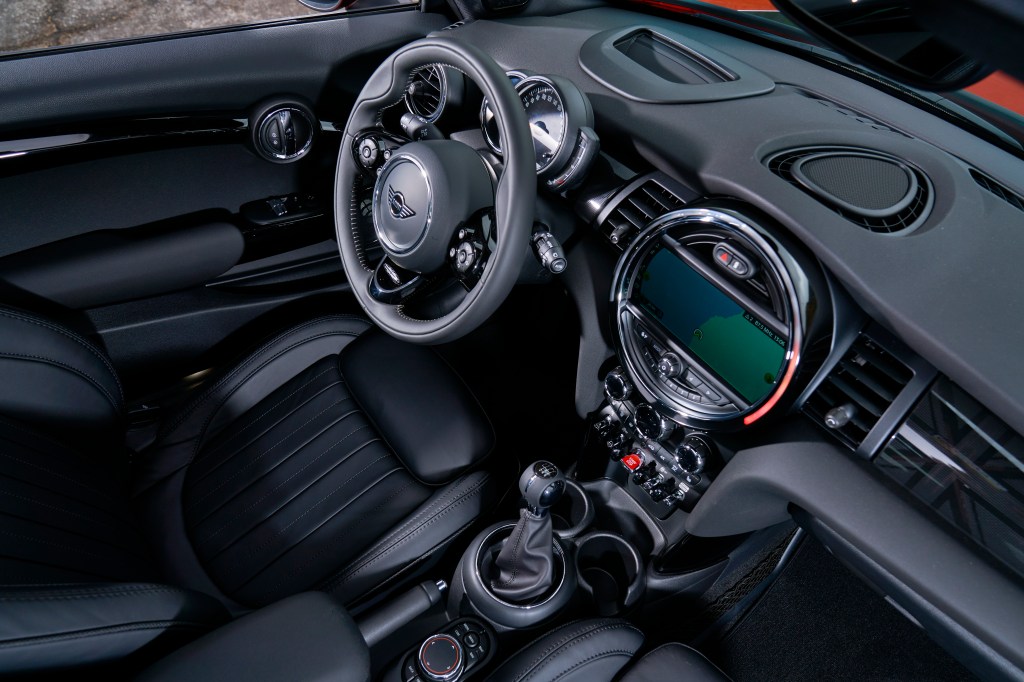
You will undoubtedly be pleased to learn, then, that MINI, the British-cum-German guardian of motoring as it used to be, informs that production resumed last month on its 2021 series of vehicles, including seven models offered with conventional manual shifting. This image of a MINI Cooper S could shows the 2021 dash treatment and the shift lever that’s offered on Hardtop and Convertible models. Manual transmission offerings for the MINI Clubman and Countryman models, the more wagon-like entries in the bunch, will be confirmed as their 2021 production schedule gets underway later this spring. The exceptions to this epiphany for 2021 are the MINI John Cooper Works GP, which comes exclusively with an eight-speed Steptronic Sport automatic transmission that’s tailored to handle the car’s 301hp; and the MINI John Cooper Works Convertible, which exclusively features a standard seven-speed Sport Dual-Clutch automatic transmission.

The sedan lives. Just ask Volkswagen, and you’ll learn

To hear some of the pundits lay it out, you’d figure that the sedan, as an automotive body style, is in the same place as Generalissimo Francisco Franco: Dead and buried. It’s certainly true that the auto industry, especially here, has galloped frantically in the direction of crossovers, SUVs and trucks. But the traditionalist three-box sedan still has its diehard adherents, who can shop from brands ranging from Subaru to Jaguar, and here, to Volkswagen. After digitally redoing the famed two-letter “lollipop” that forms its logo, Volkswagen has provided a market update demonstrating that one-third of its global automotive output, led by the Golf, is still paced by sedans. That total includes more than 1.6 million vehicles sold in China, a figure that reflects the COVID-19 slowdown in the marketplace over there. Speaking of which, Volkswagen also reported that the pandemic is showing signs of easing in China of late, noting that vehicle and component production has now resumed at all of Volkswagen’s sites in China.

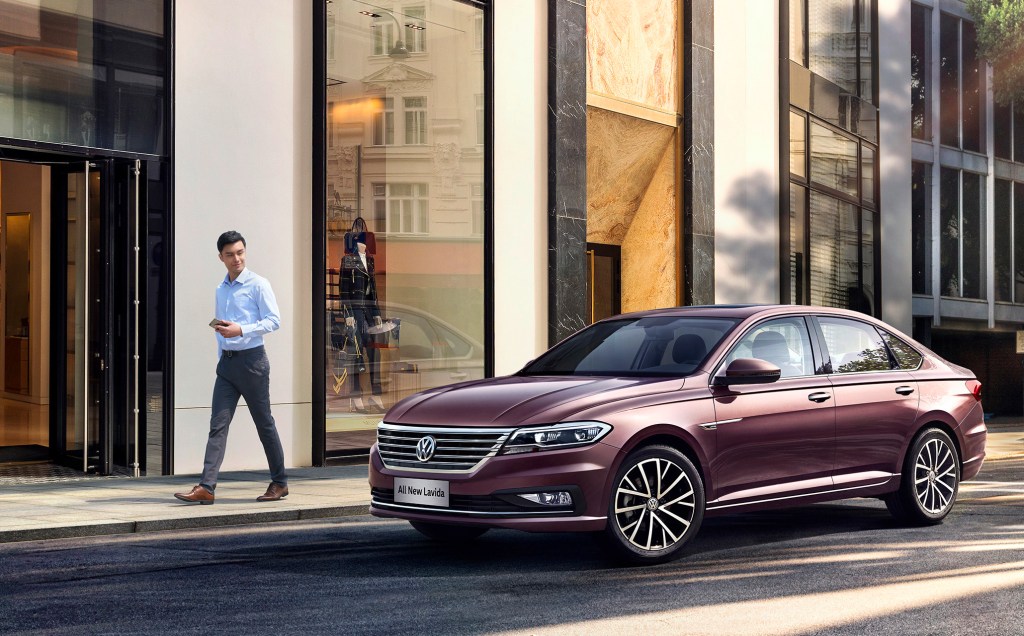
Volkswagen produced a series of vehicles exclusively for the Chinese market, often in alliance with technical partners from the world’s most populous nation. Here’s a photo of one such collaboration. The SAIC Volkswagen third-generation Lavida has been in production since 2018, jointly built by Volkswagen and partner SAIC Motor, which was previously known as Shanghai Automotive Industry Corporation, a state-owned firm that’s one of China’s “Big Four” automakers. The Passat-sized Lavida rides on Volkswagen’s MQB platform, and with 491,000 units sold, it was China’s top-selling car last year. Riding on a 105.5-inch wheelbase, its base power comes from a 1.4-liter TSI inline-four, although an electric version is also available that used the powertrain from the e-Golf. Nice-looking car, huh?

Farewell to Stirling Moss, a royal knight of the roaring road

The automotive world, and especially the world of global motorsports, is a shallower, sadder place today. Sir Stirling Moss, one of the greatest racing drivers of all time and a deserving national hero in England, passed away over the weekend at the age of 90. The British legend had been in failing health in recent years, having been hospitalized in Singapore for a lung infection, fallen down an elevator shaft at his London townhouse, and retired from public events in 2018. Sir Stirling was widely considered the best driver who never won a world driving championship, but he was unquestionably one of the best pure talents that racing has ever known. He was a sportsman, the son of an Indianapolis 500 veteran, and a world-class equestrian. In Formula 1, he won 16 of the 66 events he contested between 1951 and 1961, including three towering victories at Monaco, and was the first British driver to capture the British Grand Prix, driving the mighty Mercedes-Benz W196 at Aintree, vanquishing his teammate and rival, Juan Manuel Fangio.

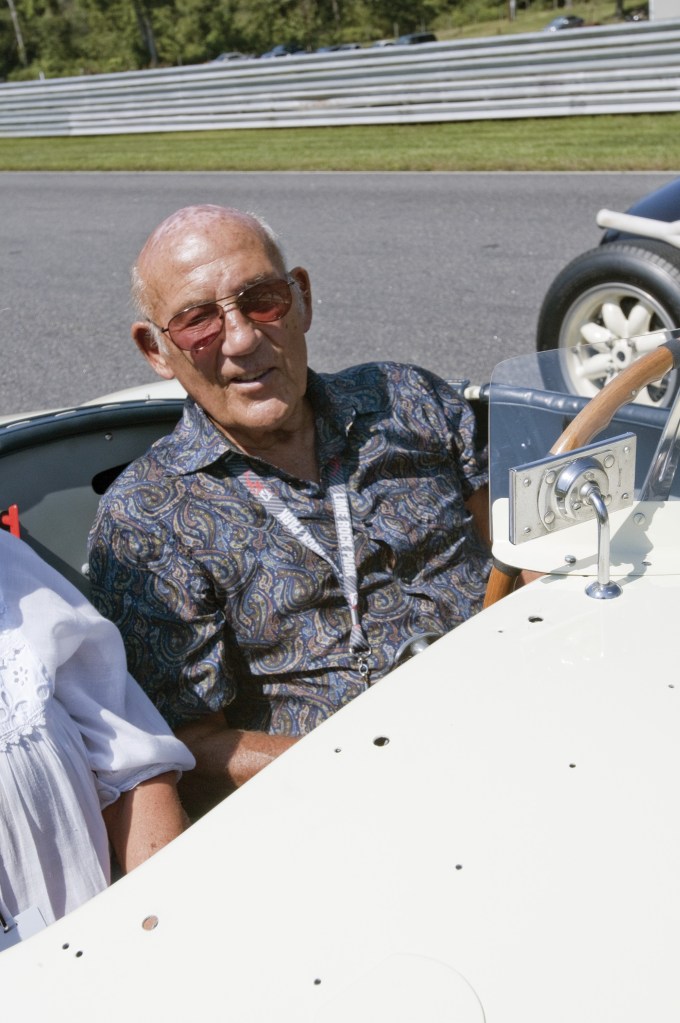
Fangio would go on to win the F1 world title five times during the 1950s. Moss, on the other hand, had started his career in a Cooper 500, and would show a patriotic preference for British cars during his F1 career, most notably Cooper, Vanwall and Lotus, which weren’t always competitive with the purebloods from Germany and Italy. In 1958, he defended rival Mike Hawthorn after Hawthorn was accused of deliberately reversing direction at the Portugese Grand Prix, which allowed Hawthorn to win the F1 title over Moss by six points. When he did drive for non-British marques, though, Moss made magic: In 1955, he shattered the lap record en route to winning Italy’s iconic Mille Miglia road race, teaming aboard a Mercedes-Benz 300 SLR sports car with motoring journalist Denis Jenkinson, who navigated using handwritten pace notes. Moss was in the prime of his career when he had a devastating accident at Goodwood in 1962 that left him comatose and temporarily paralyzed. Moss, who also owned world speed records set at Montlhery and Bonneville, then turned to broadcasting, but continued to participate in vintage racing until he was 81. That’s when I got to know Sir Stirling, having photographed him (as above) and interviewed him when he was guest of honor at Lime Rock Park’s vintage festival in Connecticut. Moss was here about to lap Lime Rock with his wife, Lady Moss, aboard the 1.5-liter O.S.C.A. that he used to win the 12 Hours of Sebring in 1954, despite having no brakes for most of the going. Moss and Susie were profoundly conversational and charming people, and I got to interview Sir Stirling several more times after the Lime Rock encounter. He had exactly two regrets: Never having the opportunity to race against the great Jim Clark, and never getting the chance to race in the Indianapolis 500. Race on, knight of speed.

Owners get a timely break from Hyundai regarding service

We’re going through a national emergency now that rivals the massive mobilization during World War II. Most of us know how the domestic auto industry executed a rapid, total shift toward building tanks, trucks, jeeps, planes and everything else during the all-encompassing war effort. It’s less widely known that because its dealers had no new cars to sell, except under airtight federal oversight, Detroit encouraged them to instead focus on repairing the nation’s fleet of existing cars, some of which dated back to pre-Depression vintage, for the duration. In that spirit, we provide some recognition to Hyundai, which is giving its vehicle owners a break in case they have trouble scheduling repairs to a vehicle due to the ongoing COVID-19 pandemic. One such vehicle is illustrated in the Hyundai photo of the Tiburon sports coupe, which it produced from 1996 through 2008.

Hyundai Motor Company has just extended its factory warranties for more than 1.2 million vehicles worldwide in recognition of restrictions on travel, business operations and social distancing imposed in response to the virus. In the United States, Hyundai owners with a five-year/60,000-mile new vehicle limited warranty or a 10-year/100,000-mile powertrain warranty expiring between March and June 2020 will have the warranty coverage extended to June 30, 2020. All eligible customers will be contacted in the coming days, with more details about the warranty extension program. In most locations across the country, vehicle maintenance has been classified as an essential business under current COVID-19 restrictions, so most Hyundai service departments have remained open. They can provide vehicle pickup and dropoff, and allow for e-signatures and digital communication so customers can remotely grant approval for needed repairs. Globally, Hyundai vehicles in 175 countries will be eligible for warranty extensions of up to three months, depending on the locality.

Four decades of quattro grip marked at Audi

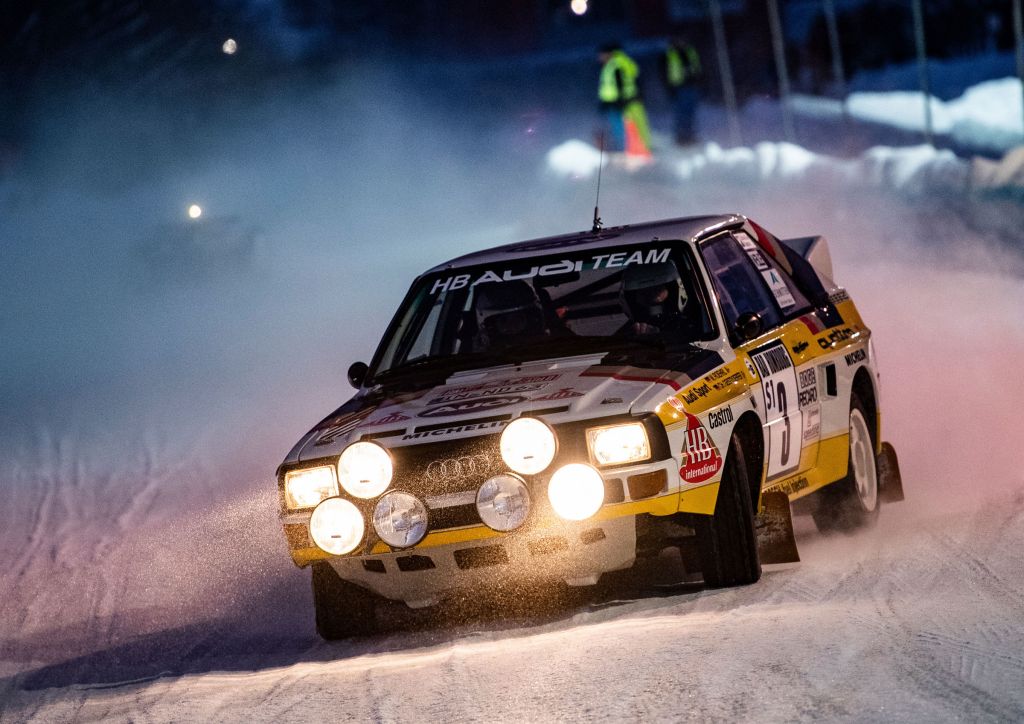
As the 1970s drew to a close, two efforts were taking place on parallel but independent courses in then-West Germany that would fundamentally transform how drivers approached their craft, especially in bad weather. On one such track, Daimler-Benz was working closely in conjunction with Robert Bosch AG to develop equipment that would maintain steering control during conditions of limited traction, a process that led to the first workable antilock braking systems for road vehicles. Elsewhere, Audi was planning a new technology that would allow it conquer the frantic world of European performance rallying, while transforming its entire lineup into something it had never been, a range of performance cars with all-weather capability. That was the origin of Audi’s quattro all-wheel-drive system. It was first proven by demonstrations of driving up, not down, ski jumps and mogul runs under full throttle. When it became part of the original Sport Quattro coupe, especially in the hands of rally icon Walter Rohrl, the quattro (lower-case “q” when referring to the system) tech instantly transformed Audi into an unstoppable force in the World Rally Championship, a journey that also say it lock up a slew of Le Mans overall wins with the unbeatable combination of quattro grip and turbocharged diesel power.

The quattro system, a landmark leap forward in the world of vehicle dynamics, turns 40 this year. Audi is one of two global automakers, the other being Subaru, whose products are now defined by superior traction under the worst weather conditions imaginable. The quattro system’s evolution has been the story of its adaptation to advancing vehicle platforms as they’ve progressed from longtitudinal to transverse powertrain orientation. The original ur-Quattro, as the car is known today, had a longitudinally mounted, turbocharged inline-five for power, backed by a conventionally located transmission. This first quattro generation used a trio of differentials to distribute power: One for the front wheels, one for the wheels in the back, and a manually operated center differential that distributed power between both ends of the car as traction conditions dictated. The system’s first major upgrade came in the late 1980s, when Audi adopted the Gleason Torsen center differential, which operated automatically and instantly delivered a 50-50 torque split between the front and rear wheels. When Audi introduced its bite-sized TT sport coupe in 2000, which had a transverse engine between the front wheels, there was no longer any room to mounted the Torsen. Audi reached out to Haldex Traction AB of Sweden, now an operating unit of BorgWarner, which provided its hydraulic-mechanical Haldex coupling for installation just ahead of the TT’s quattro rear differential. The Haldex coupling received power from a propshaft running aft from the TT’s front transaxle. Electronic sensors detecting engine speed, torque and throttle position allowed the coupling to distribute power front to rear. Today’s Audi lineup utilizes no less than five variations of that quattro system, adapted to match the varying platforms on which its vehicles are built, including the e-tron electrics with traction motors on each axle. Current quattro setups are both mechanically and electronically controlled, with additional sensors being employed that now monitor steering angle, stability control, yaw and wheel movements. Default power distribution is now 40-60 front to rear, although the system can make adjustments ranging from 70 percent of power to the front to 85 percent at the rear as conditions necessitate. It’s fair to say that a lot of Audi owners were able to drive their way out of serious trouble since the quattro system was introduced. That adds up to a lot of saved lives. Audi deserves congratulations for that.

Coronavirus and racing: An update with some positive news, for once

I get it that motorsports is trying hard to cope with suddenly being absent, and is working to stay in the public consciousness despite some very real competition from the real world of news. Mainly, it’s been doing it through iRacing, which doesn’t quite cut it for some people. Among that group is likely Bubba Wallace, who lost a sponsor – for real – after he was “crashed” out of the virtual NASCAR race at Bristol last weekend by Clint Bowyer, got up and walked out of wherever he was operating his racing simulator from. NASCAR chimed in on a non-virtual basis by declaring that its Next Gen race car, depicted below in the photo from NASCAR Images, will not make its debut next year as planned, and instead is being held back for 2022.

This is sensible. You never roll in cold on a major racing series with an all-new formula without doing the necessary development work first, a process that can easily consume a year or more. And while the Next Gen obviously bears similarities with today’s Cup car, it’s really an enormous advance from what NASCAR’s running now, arguably a more complete break with the past than the Car of Tomorrow represented when it was adopted following the death of Dale Earnhardt in 2001. The Next Gen car is a marketing-driven technological effort to bring NASCAR’s top series into closer sync with what’s actually being driven on the street today. Among the expected changes are independent rear suspension, a revised body spec with a smaller rear spoiler and raised front splitter, bigger brakes, new 18-inch wheels with single center locking lugs designed by BBS of Germany, and the provision for the eventual adoption of a hybrid powertrain. The drivers who’ve been testing it on-track since last October seem to like it so far. Other recent news comes from the IndyCar side of racing, under its new owner, Roger Penske, which had just released a revised 2020 schedule that determinedly includes 15 races, up one from the original slate. The season will tentatively start June 6 at Texas Motor Speedway, and will now incorporate a third date at Indianapolis, the IndyCar Harvest Grand Prix on the speedway’s road course set for October 3rd. Perhaps the biggest news is the fact that to bring all this about, IndyCar will host two doubleheader race weekends, led by races over two days at the Iowa Speedway (a track I very much want to visit) on July 17th and 18th, and two full races at WeatherTech Raceway Laguna Seca on September 19th and 20th. Hang in there, everybody, we’re going to get through this eventually.