Journalism is my life. I've been at it since the 1970s, starting in news and developing specialties in covering automobiles and motorsport. I hold more than 50 journalism awards for work in both newspapers and magazines. I have developed a global audience during my career.
Seems like it’s been just a couple of eyeblinks since Ford revived the fabled Bronco, but it didn’t take the Dearborn crowd a great deal of time to begin specializing it. Normally, this kind of concept vehicle would hit the stage at the SEMA show in Las Vegas, but COVID-19 took care of that option. Instead, Ford instead selected the big Bronco Super Celebration East in Townsend, Tennessee, as its venue to reveal the Bronco Overland concept vehicle.
The basic ingredient for this recipe is the four-door Bronco with the Badlands trim level and painted in the factory’s Area 51 – you gotta love that – paint scheme. The basic powertrain is Ford’s 2.3-liter EcoBoost turbocharged engine linked to the seven-speed manual transmission. To that, Ford has added a WARN winch up front, mounted to a modular steel bumper. Pod lighting is positioned in a roof bar for forward illumination and addition pods mounted around the vehicle for 360-degree lighting of a campsite. Speaking of which, the Bronco Overland boasts a stove and cooking kit at the rear, plus a refrigerator on a slide-out tray. On the roof, and reachable by stowable ladder, is a two-person Yakima tent. Which begs the question: Who remembers that when Chevrolet introduced a hatchback version of the Nova in 1973, you could buy a snap-on kit that turned the rear cargo area, with the hatch raised, into an impromptu tent with fabric sides? Good ideas have a way of returning.
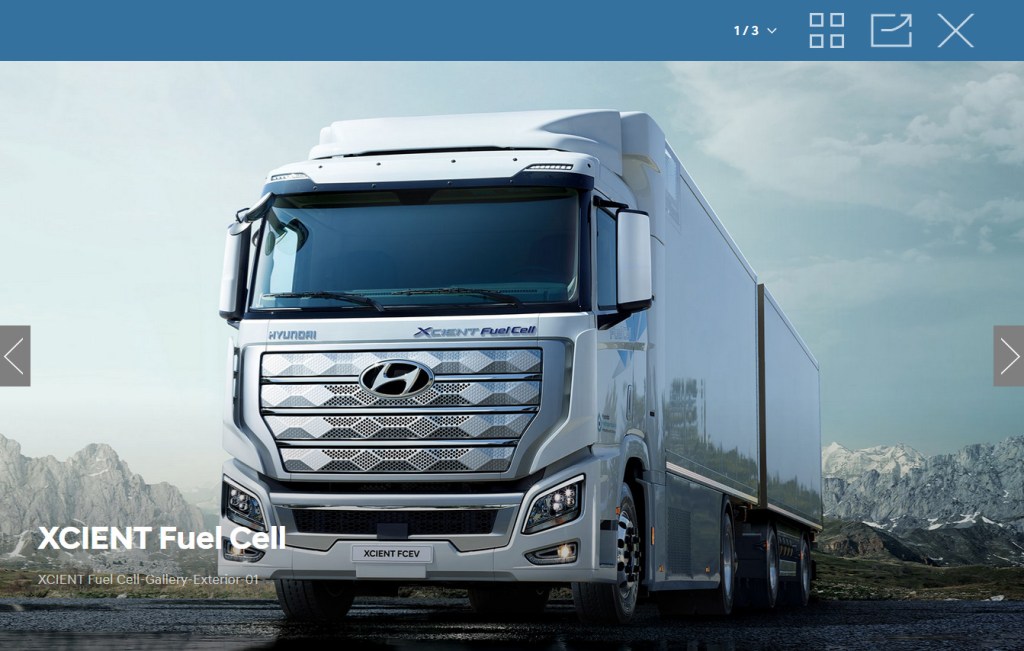
Hyundai’s XCIENT line is the world’s first mass-produced series of heavy trucks utilizing hydrogen fuel-cell technology for clean propulsion. The first seven XCIENT trucks, part of an eventual total of 50 rigs, were delivered this week to customers in Switzerland, which will use the trucks for local deliveries, emitting nothing from their ordinarily sooty exhaust systems except for water vapor. Production of the XCIENT line is expected to reach an annual level of 2,000 units next year, as Hyundai begins to ramp up its production of fuel-cell trucks for further use in Europe, plus anticipated launches in North America and China.
We grabbed a screenshot from Hyundai’s commercial-vehicle site to give you some perspective on the fact that this is indeed a big truck, a full Class 8 rig. Seven major trucking operations in Europe plan to add XCIENT rigs to their fleets by 2025. For the North American market, Hyundai has already unveiled its fuel cell HDC-6 NEPTUNE Class 8 concept, as it organizes a supply chain that will include hydrogen refueling stations, as the South Korean giant aims to sell 12,000 such trucks here by 2030. Hyundai also plans a new, dedicated platform for hydrogen-fueled trucks in the near future, with powered e-axles and estimate range of up to 1,000 kilometers, or about 620 miles, between refueling.
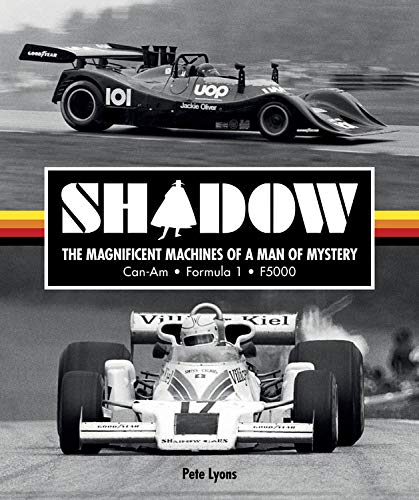
If you were fortunate enough to come of age while following auto racing in the 1960s and 1970s, you have likely heard of Don Nichols. Or if you haven’t, you’re likely familiar with the highly unconventional cars he built for several world-ranked racing series. Nichols, who passed on in 2017, should have had his image in the dictionary next to the word “iconoclast.” A World War II and Korea veteran, who had parachuted into France on D-Day and later was assigned to Army intelligence, Shadow sold Goodyear and Firestone tires in Japan and helped build the Fuji circuit there before returning to the United States and deciding to build cars for the Can-Am Challenge Cup, the fabled no-rules racing series for unlimited sports cars. Befitting his mysterious military career, Nichols appropriately named his cars Shadow. This excellent book of the same name is the benchmark story of the man and his machines, told by a close friend who really cares.
With the high-flying brain of designer Trevor Harris as an asset, Nichols started out in the Can-Am with one of the most insane racing cars ever unleashed in any series. The Shadow Mk. 1 that Nichols’ Advanced Vehicle Systems built in California was literally a go-kart – 10-inch wheels up front, 12-inch at the rear – stuffed with an all-aluminum, fuel-injected big-block Chevrolet engine good for around 900 horsepower. If you think Nichols was crazy, just consider the guys including George Follmer and Vic Elford who actually raced the thing. Before he was done, Nichols won the Can-Am title with Jackie Oliver in the seat, before going on to Formula 5000 and ultimately, Formula 1. Despite the ghastly death of team driver Tom Pryce in 1977, the Shadow team achieved triumph at the pinnacle of racing when future world champion Alan Jones won a soggy Austria round in 1977. Chronicling all of this, then and now, was the esteemed Pete Lyons, a living link to the fabled Can-Am’s history and a cohort of the Shadowman. Nobody buy Lyons, who I was fortunate enough to work with during my Hemmings years, could have pulled off this huge (464 profusely illustrated pages) biography with such authority and affection. This is a great book about the kind of guy this country doesn’t often produce anymore. It’s $99.99 from Evro Publishing and very much worth the admission price.
You can find your way into the Guiness Book of World records by running in place until you collapse, singing “Feelings” at karaoke until everyone in earshot likewise collapses, or by making interminable political speeches until the government you purport to run collapses, too. Not every such attempt at immortality, or at least notoriety, necessarily has to end in calamity. Subaru of America is about to prove as much.
On Sunday, October 4th, Subaru will make a crack at making history when it attempts to hold the world’s largest-ever (longest-ever?) parade for same-make motor vehicles at the 2020 Subaru Tecnica International Subiefest in Costa Mesa, California. Marque-specific rallies like this are a very big deal in Subieworld, and the Costa Mesa happening is one of the biggest each year. Held at the OC Fair & Expo Center in Orange County, the event is aimed to host a one-time parade of more than 2,000 Subarus, most of them owner-customized and -modified. Full disclosure: I drive a Legacy with the Limited package and positively love it after many years of driving Volvos. Sponsored by STI, the performance arm of Subaru, the Subiefest parade is predicted to be two miles long, at least. In lieu of tickets, Subaru is asking attendees to instead donate five bucks, which Subaru will match and then distribute to the Los Angeles Regional Food Bank and to Second Harvest Orange County as part of the Subaru Love Promise. If you’re into the flat-engine flyers, this event’s got your name on it. Learn more, including the full schedule, by clicking here.
A few days ago, I happened to cruise past The Cabbage Patch, a legendary bar among the local Harley crowd. Parked outside was a very early (round taillamps) version of the Volkswagen Transporter pickup, with its drop-down side gates and windshield panels that hinged outward. Without paint, it had received the slammer or lowrider treatment, dragging its rocker panels, fat tires on Halibrand-type “kidney” wheels. It’s an ancient vehicle, produced using technologies of the past. But it’s a Volkswagen, of the air-cooled, flat-four variety, and that means it’s got a following. If you need any more proof that the original Volkswagens still exude magic, here it is.
Volkswagen Beetles and Buses: Smaller and Smarter is a cool way to examine the enduring popularity of this uncommonly cool cars. In 176 hardcover pages, the U.K. motoring journalist Russell Hayes examines the basic history and enduring popularity of the Beetle and its rear-engine siblings. It’s not really an accuracy guide, the kind of book that traces year-by-year changes to the vehicles (like when the Transporter and Kombi switched from round to oval taillamps), but it does a lot to explain the unwavering affection that so many have for this unassuming conveyances. The text broadly tracks product changes, and describes the Beetle’s place in both the counterculture and in motorsport (I once built the EMPI Bug from a Revell glue kit). And any book that mentions both Chuck Poole’s Chuckwagon wheelstander and the green Beetle seen repeatedly in the Bullitt chase scene is good with us. It retails for $40.00 via the Motorbooks imprint at Quatro.
We tend to leave the world of NASCAR for other outlets that cover it on a full-time basis, or close to it, but this is really too big to let pass without a comment. If other considerations have prevented you from considering the moves that our neighbors here in Daytona Beach have been making over the past year, and then some, we understand. What you need to know is that quietly, compared to everything else that’s been going on, NASCAR has been edging some major realignments into place that are going to very significantly transform how it presents this fundamentally American variety of motorsport. If this is news to you, consider the 2021 Cup schedule that was released last week, which includes an abundance of changes in date, locations and format, which, taken alone in any other year but this one, would have been staggering.
Consider the photo above, taken during the 2017 Camping World Truck Series round at Bristol Motor Speedway in Tennessee. Come next year, when the Cup series shows up for the first of its two Bristol dates, the concrete track surface will be covered by a layer of dirt. Yes, the Cup crowd is finally going dirt racing again. How big a deal is this? Put it this way: The last time NASCAR’s top series raced on dirt, Jimi Hendrix was freshly deceased. The final dirt race in what was then the Grand National Series took place September 30th, 1970, when the half-mile State Fairgrounds Speedway in Raleigh, North Carolina, presented the Home State 200. Richard Petty won it in a Plymouth by two laps over the ageless independent Neil “Soapy” Castles and Bobby Isaac, who went on to win the 1970 Grand National championship. Among the 23 starters were J.D. McDuffie, perhaps NASCAR’s most beloved independent racer, who sadly died in a 1991 crash at the Watkins Glen road course. Bristol was dirt twice before, when the World of Outlaws ran on the high-banked half-mile in 2000 and 2001, drawing some 85,000 spectators. Spectator counts at the spring Cup date, where the weather can be iffy, have been on the slide in recent years, which does a lot to explain this move. That leaves the rest of the 2021 schedule: Date losses at Kentucky and Chicagoland, two dates each at Texas and Darlington, the Brickyard 400 moving to the Indianapolis Motor Speedway road course, the All-Star racing shifting from Charlotte to Texas, plus new road course events at Road America in Wisconsin and the Circuit of the Americas outside Austin, Texas. There’s also a new date at Nashville Superspeedway, and a second date is being added at Atlanta, where a major reconfiguration of the speedway (turned into a Charlotte-clone quad oval in 1997) is rumored as the site is prepared for a new casino and shopping complex. That’s a lot to digest, and we’re hearing that FOX Sports had a lot to say about how this schedule turned out. The longstanding criticism that NASCAR resists change now probably deserves to be shelved. It’s been a remarkable year for the France folks, generally well received, especially their COVID-modified schedule of live races and their response to the Black Lives Matter movement, especially as it affected Bubba Wallace, who’s about to go racing with Denny Hamlin and Michael Jordan. Yes, that Michael Jordan. Golly, what a year.
Flax is a fiber crop grown in cooler climates around the world, particularly in Minnesota and North Dakota in the United States. If you crush the seed pods, you end up with linseed oil. The ancient Phoenicians first figured out how to spin flax into linen as a symbol of purity in their society. Most of the time, flax doesn’t get a lot of attention from the general public. But now Porsche has learned a new, highly unconventional way to apply its properties.
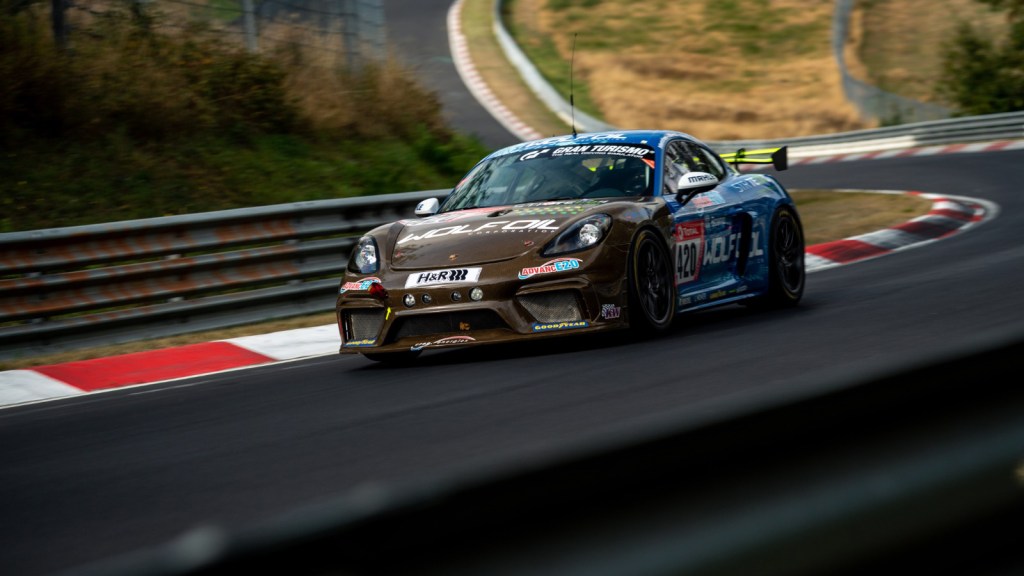
When it competed in last weekend’s 24-hour grind for sports cars at the Nurburgring that we mentioned earlier, the works Porsche 718 Cayman GT4 Clubsport MR hit the historic track wearing doors and a rear wing molded from natural-fiber composite material, with farm-grown flax as the primary ingredient. Unlike carbon fiber, the preferred lightweight, high-tensile material preferred in racing car fabrication, the natural-fiber composite is mainly blended from recyclable ingredients. The natural stuff is comparable to synthetic carbon fiber in terms of the traditional material’s main attributes, stiffness and light weight. Many of the production protocols for both materials are similar. The doors use molded skins wrapped around a balsa core, but the wing is more conventionally formulated by impregnating sheets of natural material with epoxy resin and then baked in an autoclave. If this sounds like radical environmentalism, it really isn’t. Way back when, Henry Ford was a noted acolyte of George Washington Carver, and invested heavily in researching the benefits of soybeans – not peanuts – as a steel substitute in automobile construction. There’s a famous photo of the Old Man bouncing a sledgehammer off the experimental soybean bodywork of a 1936 Ford sedan.
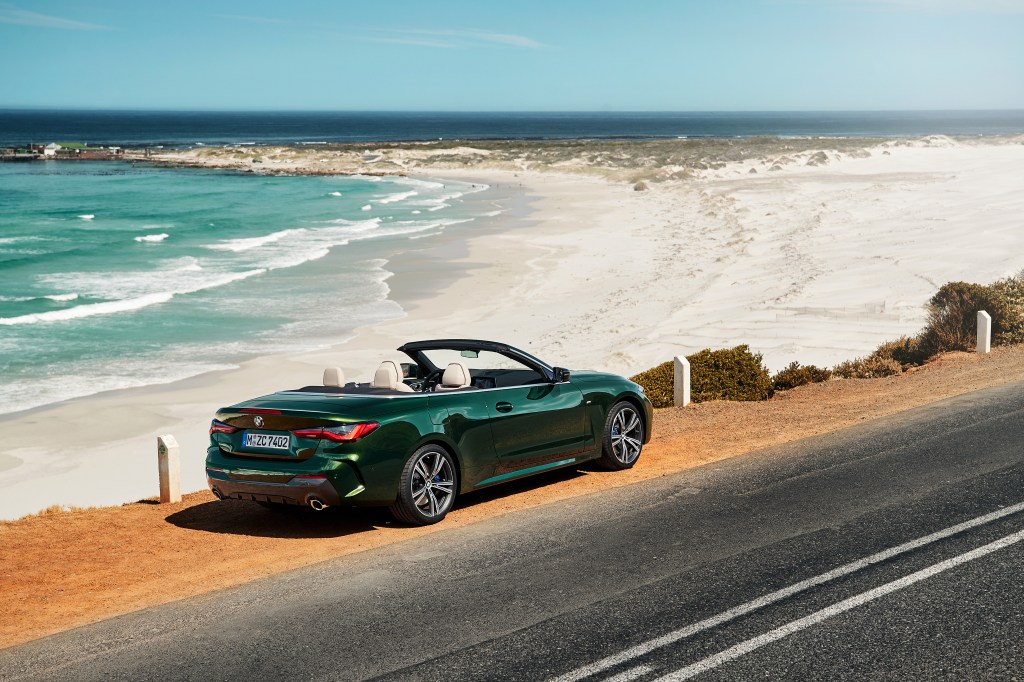
It’s been 35 years since BMW made a declaration about compact sporting convertibles by unveiling the soft-top 3 Series at the Frankfurt Motor Show. So it’s appropriate that we now take note of BMW’s latest interpretation of a bite-size convertible, the 4 Series, starting with the line’s 430i. With the internal BMW model code of F33, the 430i’s folding fabric top chops about 40 percent of the up-high weight associated with the previous-generation car’s folding power cantilever hardtop. The top also features flush-fitting rear glass, multiple layers of insulation (yay!) and a fabric top cover in two colors that pulls stylishly taut once the roof is fully raised. Headroom also is expanded by two inches, and the above-the-beltline poundage reduction also allows for a lowered center of gravity.
The power top mechanism is robust enough that it can be lowered on the fly at speeds up to 31 MPH. With a wider track and longer wheelbase than its predecessor, the 4 Series begins with the turbocharged B46 four-cylinder engine, displacing 2.0 liters and producing 255 horsepower, and ranging up to something we really appreciate, the B58 turbocharged straight-six, capable of generating 382 horsepower with a delicious, muted exhaust tune. Pricing begins at $53,100. Rear-drive models go on sale early next year, to be followed by xDrive variants.
It’s time to make clear that there’s a personal connection to this book review. Back in January, I got to see the car that’s the subject of this book go to auction at the huge Mecum sale down the road in Kissimmee, Florida. The globally ballyhooed sale, which drew a horde of media from everywhere, ended when an undisclosed individual dropped $3.71 million on a severely used-up 1968 Ford Mustang. In the world of gigabuck car sales, this was a huge deal that’s reverberated ever since the hammer dropped. It’s inspired a lot of tribute-type journalism, some of which is shopworn and repetitious. But not this.
Amid the welter of Steve McQueen books that discuss everything from his unflappable gaze to his motorcycles to the filming of Le Mans, this one stands out. As its title implies, Bullitt is a one-stop read for literally everything you need to know about the 1968 detective drama, which boasts the best two-car race ever captured on film. Our expectations were piqued when we learned that the author is Matt Stone, one of the most respected automotive journalists out there. In 192 hardcover pages, he offers a manageable, compact dissection of McQueen’s legacy, the buildup heritage of both Mustangs used in the movie plus the hit men’s 1968 Dodge Charger, a look at other cars in the movie (including the Volkswagen Beetle that shows up at least three times in the chase scene), and the tale of the Mecum hero’s recovery and sale. Proper kudos are given, happily, to Max Balchowsky, the California racing pioneer who prepped the Mustang for combat, and tributes to supporting actors better known for other things such as Georg Stanford Brown (later of The Rookies and Tyne Daly’s husband), Robert Vaughn (The Man from U.N.C.L.E. and later, a stillborn run for governor of California) and Robert Duvall (driving McQueen in the taxi following the chase, before his turn as Tom Hagen). There’s even a map of the chase route in the endpapers. A good job. It’s $42.95 from CarTech; clicking the link will take you straight to the ordering page.
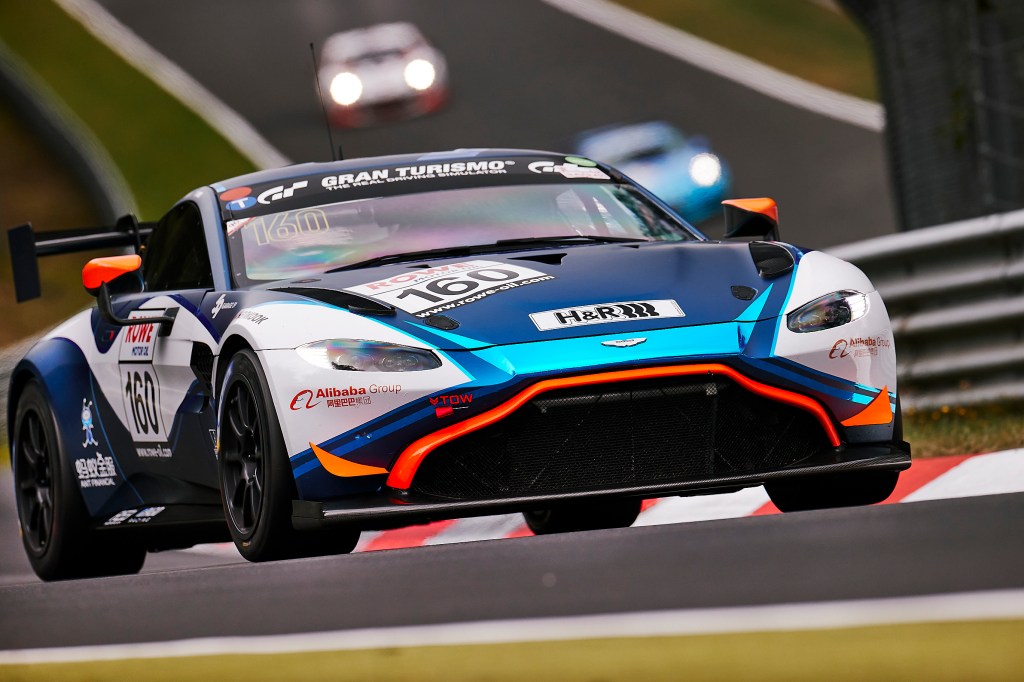
While many of us were glomming on to what exists of college football, production-based racing cars were taking the green on the world’s most challenging natural-terrain road course, the Nordschleife, the original up-and-down circuit through the Eifel Mountains of Germany with three digits’ worth of actual curves. My pal Vic Elford, who’s tasted victory on this historic track, might liken it to New York City: If you can make it there as a driver, or as a racing sports car, you can make it anywhere. That sentiment drove Aston Martin to enter the ADAC Total Nurburgring 24 Hours with its Vantage GT8R, entered by its GT-class racing partner, Garage 59, and competing in the SP8T category. It didn’t win – BMW took the event, interrupted by a 9 1/2-hour rain delay, for its first victory in the round-the-clock ‘Ring race since 2010 – but don’t let that prevent you from considering Aston Martin’s offer.
The GT8R will be produced in a run of 50 customer cars, priced at 225,000 pounds Sterling, or a little more than $287,000 in our currency. In addition to the Nurburgring race, the GT8R is also eligible for the GT Cup in the United Kingdom, Super Takiyu in Japan, the New Zealand Endurance Championship and best of all, the SCCA Trans-Am Series on our shores. It’s compliant with the current SP8T class maximum of 549 horsepower and minimum of 1,450 kilograms curb weight. But get this: If the price is a little daunting, and you happen to already own a Vantage GT4, Aston Martin can sell you a conversion kit to bring your car up to racing spec. Performance-wise, the GT8R is slotted between the GT3 and GT4 Vantages.




 Jim Donnelly On Wheels