Hey, Ahnold! Look, over here!

Here’s a textbook case of both nostalgia and foresightedness sharing an unlikely partnership. Hummer, born of AM General and battlefield glory and redefined by General Motors as a symbol of excess in the era before climate consciousness evolved, is making a comeback as an environmentally responsible vehicle. Honest. We’re not playing this for laughs here. The petroleum-swilling titan that was so beloved of celebrities was rebooted this week by GM, born anew as an off-roader for a world where climate change is no longer just a theory. Reservations are now officially being accepted for the Hummer EV, as it’s now going to be known, with production expected to commence about a year from now at GM’s Factory ZERO Detroit-Hamtramck Assembly Center, an existing plant that is receiving a $2.2 billion upgrade to produce these awesomely profitable vehicles in volume. Initially, the Hummer EV will be offered in a single, everything-included trim level, called the Edition 1, whose attributes will include a six-position tailgate, power rear cab window, power tonneau cover and removable glass roof panels.
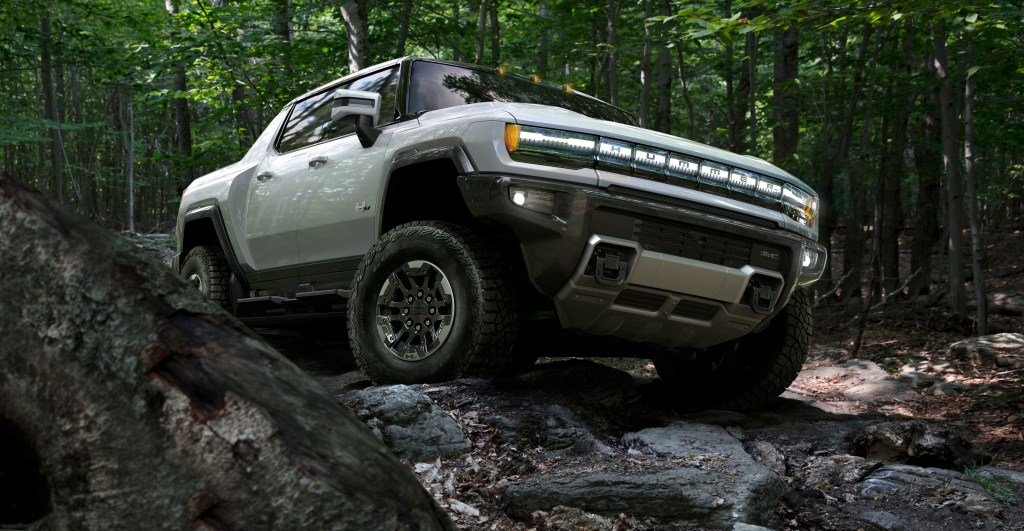
When it rolls out as a 2022 model, the Hummer EV Edition 1 will have a base MSRP of $112,565; you can go here to reserve your own. It’s important to make clear that despite its enormous price, the Hummer EV promises to firmly lead the truck segment in any number of performance categories, despite its all-electric architecture. GM is estimating a best-in-class equivalent of 1,000 horsepower, fed through three traction motors allowing full all-wheel drive, with a 0-60 projection of three seconds flat. The Hummer EV will also boast segment-exclusive all-wheel steering with CrabWalk, which essentially allows the rig to travel diagonally across obstacles. The package also includes Adaptive Air Suspension that provides six additional inches of ground clearance on an as-needed basis, multiple underbody cameras with up to 18 selectable views for obstacle avoidance, a towing capacity of up to 11,500 pounds, and plates to protect the motors and batteries. The Hummer EV will have a range of about 350 miles of normal driving, and feature 800-volt DC fast charging, compatible with 350kW charging stations. Super Cruise technology will also allow for autonomous driving. Will it succeed? Yes, because the economy still produces enough wealth to support this kind of very conspicuous consumption.

How American racing began

I got to know Mark Dill, a native of Indianapolis now living in North Carolina, when I was a workaday editor at Hemmings Motor News. Mark served as a marketing executive for the Indianapolis Motor Speedway, and is the founder of The First Superspeedway, a website that stands as one of the best sources out there for information on the pre-1920 history of motorsports in the United States. People who are into America’s very early racing history know this site, and use it. Among the site’s free downloads are a full archive of all significant auto races between 1894 and 1920, and a biography of IMS co-founder (and champion of the Lincoln and Dixie highways) Carl Graham Fisher. Mark has been chasing this sort of obscure heritage for a long time now, and has just gathered this history in what can best be described as a historical novel, which summarizes the first decade of American racing through the eyes of the country’s first true national sports hero, Barney Oldfield.

The Legend of the First Super Speedway, two words, is the saga of Oldfield’s raucous life, as he might have told it, in the years leading up to the opening of the Indianapolis Motor Speedway. The story takes place before the Indianapolis 500 had its inaugural running in 1911. The book climaxes before that pivotal race was run, with the story largely unfolding through the barnstorming fairgrounds hero Oldfield, in the years when his exploits meshed with the rise of mass media in the United States. The telegraph and the early wire services seized upon Oldfield’s exploits during speed exhibitions (some of them “worked,” in pro wrestling parlance) to elevate him into exalted status as America’s first true sports superstar, in the years before the same media turned Babe Ruth and Red Grange into household names. The 373-page softcover book is introduced to the reader by Willy T. Ribbs and Al Unser Jr., two guys who can relate to the dizzying blend of spectacle and danger that turned Oldfield into a 20th century folk hero. It’s $25.00, on sale now through BookBaby and for pre-order at Amazon. You can also click here to find other goodies on early racing history.

Imagining a Jeep environment

You may have forgetten, but it’s been nearly 30 years since Lee Iacocca, at the head of Chrysler, green-lighted a new midsize SUV that became the Jeep Grand Cherokee, and which swiftly spun off a Grand Wagoneer edition as the new line’s luxury leader. In hindsight, the ZJ-platform, Larry Shinoda-sketched midsize Jeep wagon became one of Chrysler’s great sale triumph during this era, usually ranked right alongside the T-platform front-drive minivans as segment-flattening sledgehammers. There’s a new Grand Wagoneer concept vehicle that’s been plying the show circuit this year, and while it hasn’t been approved for production yet, be patient. The overall deal looks very appealing and frequently, individual features shown in these concepts frequently make it to the showrooms before the actual vehicle that’s spotlighting them does. We recently had the opportunity to interact with Fiat Chrysler Automobiles creative designer Ludwin Cruz, a Miami native, who was responsible for much of the interior in the Grand Wagoneer concept, and who also has his own line of clothing.

There’s a lot to catch your attention in this view of the Grand Wagoneer’s center console and more, as created by Ludwin. The knurled knob at the lower center is a transmission selector, with a glowing ring, a component that’s seen in other FCA products such as the Chrysler 300 sedan. The console-centric layout encompasses three touchscreens, including the one in front of the passenger that handles navigation and infotainment functions. On top is the McIntosh audio system control screen, while below it is a separate screen that operates the lumbar, bolster and massage functions of the power front seat. Again, there’s a very strong likelihood that these systems will make it to production. As Ludwin explained, “Colors, shapes, and general interactions with the world are my stimulants to keep a creative mind going. Where most simply see crumpled piece of paper, I see the shadow that it casts from the light above, a silhouette of an instrument panel or even the exterior of a car. Everything is an opportunity for inspiration.”

Great things come in threes

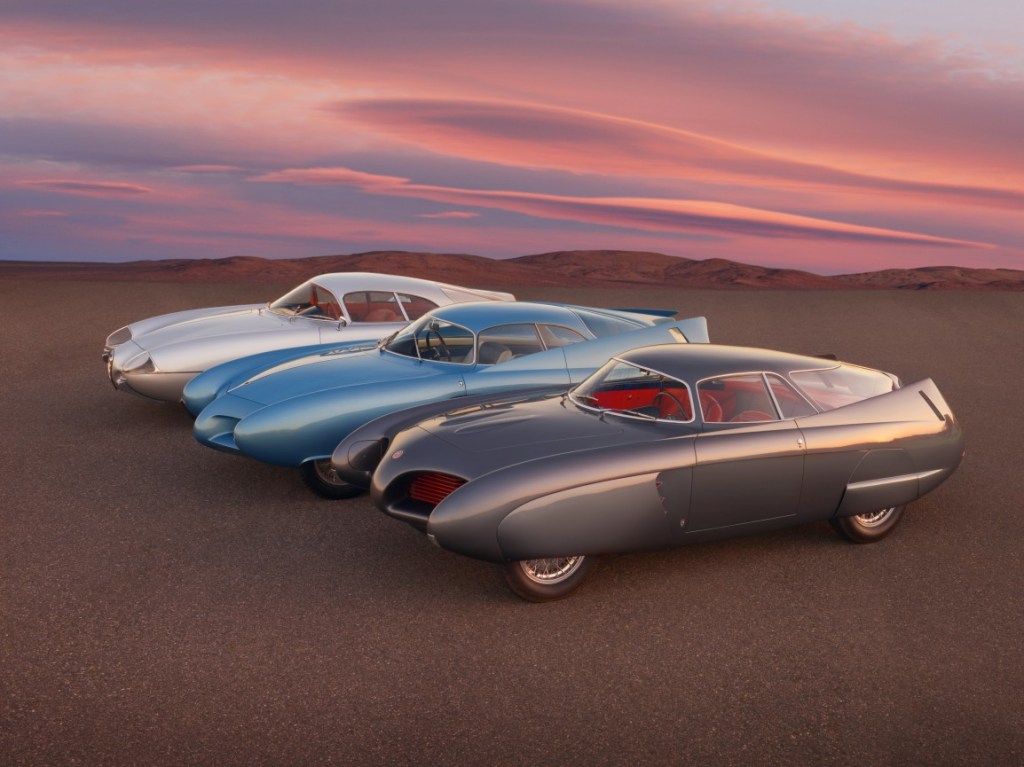
For everything else in the world today, you nonetheless can’t claim that the universe of automobiling hasn’t had its own foundation-shakers this year. Ford reimagined the Bronco and NASCAR banned the Stars and Bars, just for openers. The orbit of collectible automobiles has stood above the fray with some really noteworthy happenings, too, but they’re all likely to pale allongside this one. Later this month, Sotheby’s will offer three of the most vaunted automotive styling exercises of the entire postwar era, and it’s selling them as a single block of three cars. These are the trio of Berlina Aerodinamica Tecnica studies undertaken by Alfa Romeo in cooperation with the Italian coachworks, Bertone, one each built for the Turin auto salons in 1953, 1954 and 1955. Known collectively as the B.A.T. cars, these three Alfas are some of the most instantly recognizable concept cars in automotive history. True story: Not that long ago, I saw all three of them rolling down the street in Monterey, California, just days before they appeared as a group on the lawn at Pebble Beach. Now, you’ve got an opportunity to buy all three of these illustrious automobiles.

Based on Alfa Romeo 1900 mechanicals, the B.A.T. cars, numbers 5, 6 and 7, were penned under the direct supervision of designer Franco Scaglione as studies in maximizing aerodynamic efficiency. Scaglione achieved marked success in that regard, dropping the cars’ coefficient of drag all the way down to .19, a figure that’s still considered fabulous today. It was good enough to give these small-displacement specials top speeds in excess of 125 MPH. All three cars were sold off by Alfa Romeo following their star turns at Turin, and were never seen together again until being reunited at Pebble Beach for the first time in 1989, with styling studio founder Nuccio Bertone presiding over the display. With little fanfare, they’ve been gathered under solo ownership and restored before being consigned to Sotheby’s, which will sell them at its Contemporary Art Evening Sale in New York City on October 28th. Hands down, this will be the automotive auction sale of the year, surpassing even the Mecum hoopla over the Bullitt Mustang back in January. The pre-sale estimate, we should add, is set at $14 million to $20 million.

Wanna race? Here’s a start

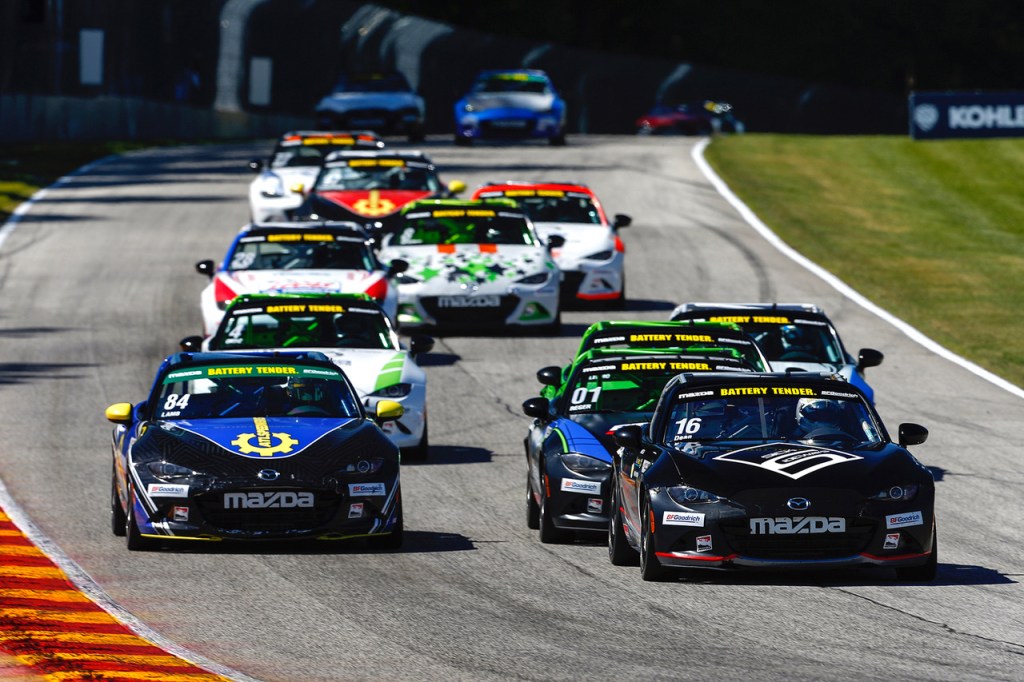
Assuming you can ring up the money and were born with the talent, you can find a variety of ways to get into auto racing as a driver if you’re determined enough. Some guys, including the immortal Ayrton Senna, began in karts. Others opt for schools like Skip Barber’s operation. Off-road racing in the America desert has spawned stars ranging from Rick Mears to Jimmie Johnson. Some guys will knock around their local dirt bullring in a clapped-out Dodge Neon. So options exist if you’re willing to give it a shot. One such avenue is the Global Mazda MX-5 Cup Series, which announced today that it’s picking the NASCAR-owned International Motor Sports Association as its 2021 sanctioning partner. It’s marque-spec racing, the premier element of the Mazda Road to 24, and the series champion gets a $200,000 scholarship.

The alliance will give competitors in the series a plausible path to the IMSA WeatherTech Sportscar Championship, which performs on many of the same venues as the Mazda series. The Global MX-5 Cup matches competitors in MX-5s, the erstwhile Miata, that are shipped from Japan to Flis Performance right here in Daytona Beach, which welds in roll cages and otherwise transforms them with more than 250 race-specific components. The race MX-5s run on slicks furnished by series partner BFGoodrich. They’re powered by factory-sealed Mazda 2.0-liter SKYACTIV engines, ensuring even competitions. The marriage between Mazda and IMSA is logical, given that Mazda is defending winner of the Rolex 24 at Daytona, running factory prototypes in the top DPi category. The Global MX-5 Cup resumes later this month in St. Petersburg, Florida, where it will share the street circuit with the NTT IndyCar series.

Bounces banished by braininess

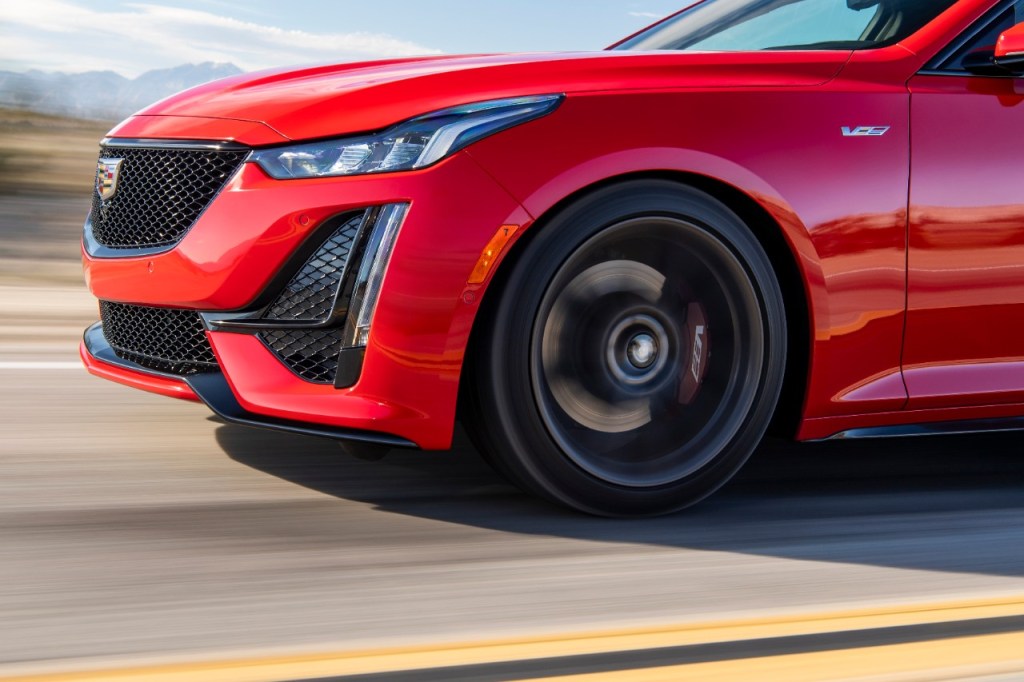
Today, chassis and ride engineers tend to call them dampers rather than shock absorbers, but their function hasn’t changed: They’re designed to smooth out sudden, violent deflections from heaves in the road that can judder a car off its driver’s selected line through a corner, right into opposing traffic in extreme cases. Shortening the eyeblink interval from when a chassis absorbs a bump to when it settles back down and steers the car has been an obsession with automotive engineers for pretty much as long as automobiles have been around. Cadillac, and others, have developed technologies over the past couple of decades that have married sensors and computers to mechanical chassis components to form a type of active suspension, one that actually pushes back against road imperfections rather than muddling for a way to smooth them out after the jolt. Cadillac has just unveiled its fourth generation of this discipline.

Cadillac calls its system Magnetic Ride Control, which doesn’t in any way amount to exaggeration. MagneRide 4.0 utilizes accelerometers at each wheel that measure and update changes in the road surface 1,000 times per second, four times quicker than Cadillac’s previous ride technology. The shocks – dampers, if you prefer – are filled with magnetorheological fluid that reacts to rapid changes in electrical inputs, via friction-reducing fluid formulation, which are controlled by a network of electromagnetics. The shock absorbers can thus adjust instantly between their rebound and compression cycles, aided by temperature-sensitive damper-control mapping and magnetic flux control, as the system’s inertial measurement unit constantly and instantly processes other loadings from heavy braking or abrupt cornering. MagneRide 4.0 will be offered both standard and optionally, depending on model, on the 2021 CT4-V, CT5-V, CT5 Sport and Escalade models.

A vintage Chrysler makes good

Plenty of opportunities exist for people who own well-kept vintage automobiles to exercise them competitively in wonderfully idyllic settings. One such stratagem exists in the United Kingdom in the form of Bespoke Rallies, which organizes very high-end motoring events on several continents. One of them that just concluded was the Highland 1000 across the moors and mountains of Scotland, which just concluded last month. When the field had fully navigated the 60 control points, the team of Andrew and Anne Davies emerged as the overall victors, driving a 1929 Chrysler Series 75 roadster. They outpointed a 1972 Jaguar E-Type entered by Andrew Taylor and Janet Lowe, and a vintage Mini Cooper shared by Edmund Peel and Sarah MacDonald. This was cool, no less so because it provided a reminder of a long-ago episode of another strong American showing in the long history of European motorsport.

This image immediately directed our thoughts to the 24 Hours of Le Mans in 1928, when Chrysler entered a four-car factory team at the Sarthe, with the Grand Prix legends Louis Chiron and Robert Benoist as two of the drivers. The team cars were Chrysler Series 72 roadsters, very similar to the Highland 1000 winner, all of which were powered by L-head straight-six engines displacing 248.9 cubic inches. All four Chryslers were painted cream with black trim, kind of like a New Jersey license plate. Two of the team cars were DNFs, but Le Mans turned into a race-long duel between the surviving Chrysler roadsters and the works team of brand-new 4.5-liter Bentleys, with a single Stutz Black Hawk also in the mix. Bentley emerged with the win, led by “Bentley Boy” (and the marque’s majority shareholder) Woolf Barnato, logging eight more miles than the Stutz, but Chrysler took both third and fourth spots, with the third-place car about 50 miles in arrears. This helped immeasurably in providing Chrysler, which had only been in existence for four years, with an international performance pedigree. If you’ve really got game, Bespoke Rallies has a field of events set for 2021, including rallies in Cuba, the Amazon, Tasmania and a huge competition running through Russia, Poland, the Baltic states and southern Europe.

Literacy, driving blend at Buick

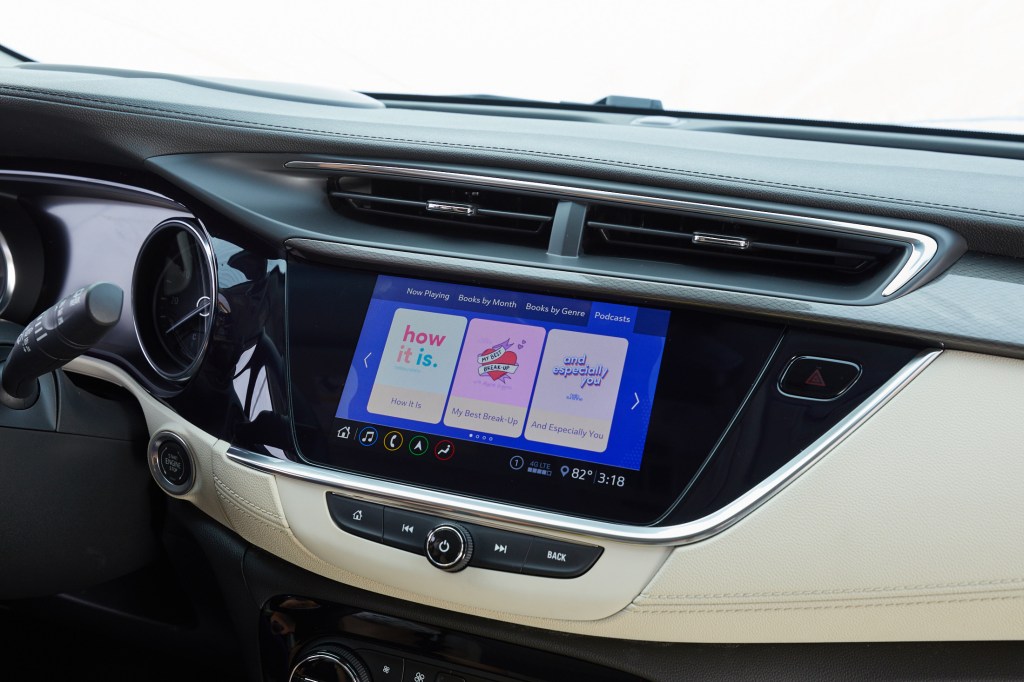
If you’re reading this space, you’ve already basically confirmed that you think reading is cool. Some of us can never get enough of it, evidenced by the stack of books I managed to topple off the desk every couple of days. Many of us are familiar with audiobooks; any number of people have shoved in a cassette or CD on which somebody with a stentorian voice reads the latest by Stephen King or James Patterson to soothe you while you’re stuck in gridlock. With infotainment systems becoming a significant factor in the decision-making of car buyers, it was predictable that the audiobook would evolve as time passed. Buick, with some key celebrity assistance, is making that happen right now.

If you take delivery of a new Buick Encore GX crossover, you can use your new vehicle’s touchscreen app to access Reese’s Book Club, founded by the actress and entrepreneur Reese Witherspoon, which she co-owns with Otter Media through their joint media venture, Hello Sunshine. The app will allow Encore GX drivers to access the full range of audiobooks and podcasts offered by the book club, which has a largely female reader base, and commands some 1.7 million followers on Instagram. The deal will also provide for Buick placement into Hello Sunshine’s menu of TV and film projects. The touchscreen capability for Reese’s Book Club is integrated into the Encore GX’s suite of infotainment and driver aids, a networking that will integrated into other Buicks during the 2021 model year.

Coming: A premium car magazine

For those who’ve never had the opportunity to do it, launching a new magazine on automobiles can be scary. In the back of your mind, you’re always hoping that everything goes right. When you decide to practice automotive journalism, you accept the fact that you’re going to be working to satisfy a dedicating, knowledgeable audience, which will immediately realize whether you’re delivering the goods or not. It’s daunting, and challenging, but if you get it right, the satisfaction is almost beyond description. That’s what this new magazine, now being assembled, is going to be all about. With the working title of Classic & Sports Car Quarterly, this book will be a definitive, no-compromises, premium-quality examination of American automotive history in all its iterations.

This magazine is the brainchild of my friend and longtime colleague Richard Lentinello, the former editor-in-chief at Hemmings Motor News. During our tenure on the Hemmings staff, we were involved in launching three new monthly magazines from scratch. That means we can both relate to the long hours of detailed work that go into creating each issue, and the pride that comes with putting a good issue to bed. It’s always, always, about the relationship between the magazine and its readers. And I can assure you that this title will never be any less than the very best in research, story crafting, photography and graphics. If you haven’t figured it out yet, I’m going to be one of its writers. The lead story in the inaugural issue tells the tale of the only Tucker 48 restored with the direct input and active participation of Preston Tucker’s descendants. Besides myself, the lineup of writers includes such A-listers in the world of automotive history and journalism as David LaChance, Ray Bohacz, Walt Gosden and Milton Stern. We’ll keep you up to date with particulars such as subscription information and a launch date as they develop. For now, place your trust in the truth that this magazine is going to be a very good ride for all of us.

The tale of a great short track

It’s not easy to run a local speedway today. Trying to run a business that can only realistically operate for half a year, while paying 12 months’ worth of taxes, can be economically challenging. The number of weekly racing venues seems to dwindle a little bit every year, sand slipping through the hour glass. But if we ever find ourselves in the sad situation where only a dozen weekly race tracks still exist in America, it’s a guarantee that Stafford Motor Speedway will be one of them. The Arute family’s showplace of stock car racing in the middle of Stafford Springs, Connecticut, is one of asphalt Modified racing’s holiest places. It’s been buffeted by change but thanks to a genuinely devoted staff, Stafford has survived. The story of how that happened is important. And here now is a book that explains it.

The Asphalt Modified Years at Stafford Motor Speedway is the tale of the years when the full Modifieds, which had few regulatory limits, flourished at the track. The book’s 234 softcover pages bracket the years from 1967, Stafford’s first as a paved speedway, and 1986, when rising costs forced the Arute family to take a major gamble on making a more restricted class, the two-barrel SK Modifieds, their lead division. Time has vindicated the Arutes’ foresight in going with a cheaper weekly lead class, while keeping the wide-open Modifieds as a class for special events, including the famed Spring Sizzler. The author, who witnessed the full Modifieds when they ran Stafford every week, is Phil Smith, a longtime New England racing journalist and former Stafford pit steward. The text is organized into year-by-year chapters, with every weekly program individually broken out therein. The narrative is decidedly fact-oriented, and its chronological nature makes it easy to track the legends who marched through this place for decades. If you’re into the blacktop rockets, and venerate their history, this book will slot nicely into your library. It’s a reasonable $17.95 from my friends at Coastal 181, where this joins a full load of quality books they offer on short-track racing of all sorts.