M-B boosts its Aston stake

Remember how earlier this year, Aston Martin unexpectedly declared it was pulling out of the FIA’s much-hyped Hypercar category being established to joust at Le Mans and other sports-endurance venues? It came as a lot of speculation was swirling about Aston’s future, after Canadian billionaire Lawrence Stroll bought enough Aston stock last year to take over as the British legend’s executive chairman. Aston Martin is preparing to begin production of its stunning Valkyrie supercar, and the Racing Point team in Formula 1, which happens to be owned by Stroll, is projected to rebrand itself under the Aston banner in 2021. So something was clearly up here. A hint of what that may be was dropped last week when Mercedes-Benz announced that it’s upping its existing stake in Aston Martin that will give it a 20 percent share in the company’s ownership. In announcing the deal, the parties involved flatly declared that this is, at its heart, a straight technology-for-equity swap.

2

The most immediate benefit for Aston Martin will be access to powertrain advances at Mercedes-Benz, a necessity given the fact that Aston Martin will be facing increasingly stringent emissions and fuel-economy standards, especially in the U.K. and the EU. It makes sense, given that Aston Martin already uses the AMG-developed Mercedes-Benz 4.0-liter performance V-8, with proprietary Mercedes-Bosch mapping, in several of its existing products. Stroll is already on record stating that he wants to nearly double Aston Martin’s current annual global output of 6,000 vehicles, with a to-be-developed array of SUVs in the mix, and a full EV envisioned by 2025. All of this will cost money, and Mercedes-Benz is considerably more flush than its English partner at this point. Mercedes-Benz has already said that hybrid drive technologies and leading-edge software will be two of the immediate benefits heading Aston Martin’s way.

A Snake’s literary strike

Besides his status of being one of the very best racers ever to assault the quarter-mile, which landed him near the pinnacle of the National Hot Rod Association’s list of its 50 greatest all-time competitors, Don Prudhomme is a complex, thoughtful human being, more so than most people might associate with a person so deeply wrapped in motorsports. For many years, I helped Don put together his column on drag racing for Hemmings Muscle Machines, and came to appreciate the fact that he’s a very serious student of auto racing in all its forms. I mean, the guy traveled to Brazil to visit the grave of Ayrton Senna, and he loves IndyCar. It’s always cool when someone of the Snake’s stature gets to tell his own story, in his own words. It would have been easy to produce an autobiography of Don that simply recounted his early hot-rod days, his ascension as a drag racer, and his legacy in the sport. This newly released book certainly accomplishes all that. But not every such biography puts you inside what it was like to grow up surrounded by cars, in a place that was absolutely nuts about cars, when you were a little bit different from everyone you knew and weren’t quite sure how to handle that. I’m pleased to say that this book accomplishes that, as well.

Don “The Snake” Prudhomme: My Life Beyond the 1320, co-written by motoring journalist Elana Scherr, covers 192 hardcover pages, rich with family illustrated, that will tell you more about this icon of drag racing than even he probably anticipated. Unlike some other such volumes, which devolve into a repetitious recitation of dates and statistics, this book is a highly personal, deeply introspective recounting of the subject’s career. I know this guy, and I can verify that his co-author did a wonderful job of preserving Don’s literary voice in the narrative, which is so essential to a successful autobiography. I’ll leave the biographical details for your own reading. But it’s touching, and utterly timely, that Don discussed what it was like to grow up with a mixed-race heritage at a time when few people understood it and fewer still accepted it. I assure you, this book will not disappoint you. You can find the book here for $42.95 from CarTech Inc., with the first 200 copies autographed by Don. And if by chance you miss out on one of those copies, fret not: Autobooks-Aerobooks in Burbank, California – when the Vipe once prowled the streets as a member of the Road Kings car club with his mentor, Tommy Ivo – will be hosting both authors for a signing on November 14th, with signed copies available through the store’s website.

A sharper Edge for 2021

Ford’s compact Edge SUV enters 2021 with two models in its range – Edge and the more performance-arrayed Edge ST – with some new bites of infotainment advances arranged on its party platter. At the top of the list of changes for 2021 are the adoption of the SYNC 4A system as well standard Ford Co-Pilot360 driver assist features, operating via a biggest-in-class, 12-inch center touchscreen, which also supports optional Connected Built-In Navigation and cloud connectivity with conversational voice recognition. That’s a sizable level of infotainment offerings for a vehicle of the Edge’s proportions and price.

What this means is that the 2021 Edge’s cloud capability combines voice recognition with Internet-based searching power, a circumstance that basically lets you call out, “find me where the best Vietnamese pho is around here,” and let the Ford’s electronics respond to your command by not only finding you dinner, but directing you there. The technology incorporates both Apple CarPlay and Android Auto compatibility. If you have a Sirius XM subscription, the cloud system will let you create personalized audio content, including your own listening channels. Whatever your audio tastes, don’t get too distracted, because the standard powertrain here is a 2.7-liter EcoBoost V-6 with 335 horsepower, linked to an eight-speed automatic transaxle. As you might expect, AWD is standard too.

Toyota Sienna goes all-hybrid

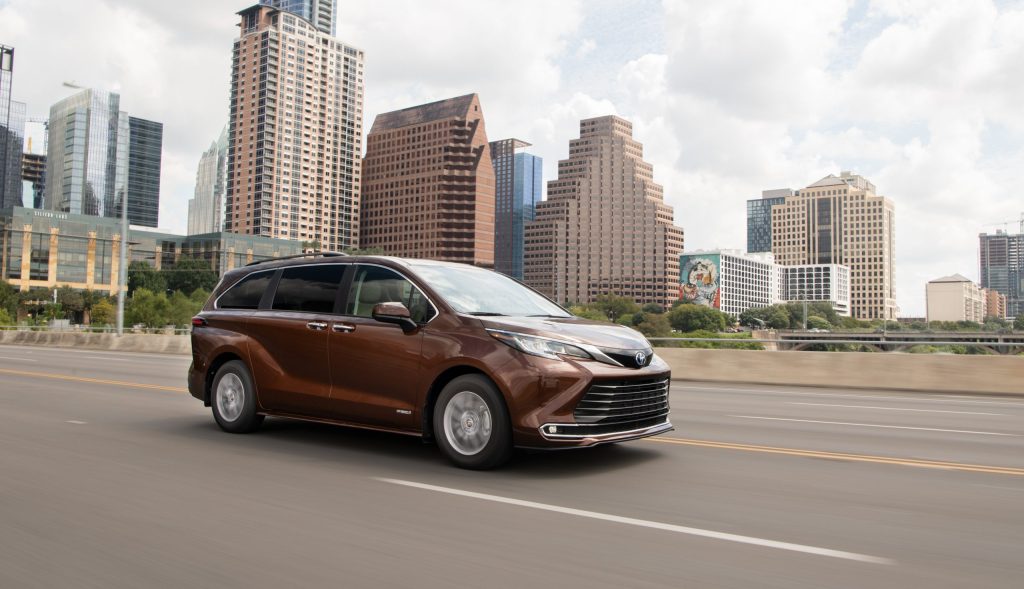
They may have been nudged aside somewhat by the rise of the crossover, but some people still need a minivan to move their brood hither and yon. And for three generations now, you could do a lot worse than selecting a Toyota Sienna for your family-schlepping requirements. Toyota’s minivan is about to commence on its fourth generation, with hybrid power offered standard across every trim level, which accounts for an impressive level of choices. And it can still be had with AWD, a crucial consideration for those of us who have to deal with snow for half the year.

The people we know who own past generations of the Sienna positively swear by them. The newest edition is literally all new, its structure based on the TNGA-K platform, which not only incorporates chassis upgrades but positions the Sienna to better package its hybrid powertrain, such as its battery pack. The lines, which are far from anonymous, were penned by teams at CALTY’s design studios in Newport Beach, California, and Ann Arbor, Michigan. One interior innovation is what Toyota calls its Bridge Console, an elevated infotainment touchscreen and related components that occupy a space in the upper center of the dashboard, which essentially connects the instrument panel to the Sienna’s center armrest. An open storage area exists beneath it. When the new Sienna arrives in a couple of weeks, it will be offered in LE, XLE and driver-oriented XSE models, with Limited and Platinum trim levels available.

A Chevy-based fighting vehicle

It’s been true for a long time that when the world dials 9-1-1, the armed forces of the United States are ready to respond, immediately, anywhere. Rapid mobility is an essential consideration in any sort of armed deployment. In the past, the American military relied primarily on the AM General-built HMMWV, the fabled Hummer, a nameplate that eventually ended up in the portfolio of General Motors. The Humvee, as the guys and girls in green called it, was a breakout star of the first Gulf War. Fast forward nearly 30 years and we can a few things: The Pentagon now divides its lightweight troop-mobility inventory among several types of vehicles, especially those resistant to mines and improvised explosive devices. Moreover, the Hummer’s back, being marketed now by GMC as a high-dollar, mega-power EV pickup. And lately, GM is back in the military business. This vehicle is its first such product since GM Defense was revived as a corporate subsidiary in 2017.

The angular item you’re viewing is GM’s newly introduced Infantry Squad Vehicle, just being delivered to the U.S. Army under a $214.3 million contract that will see GM Defense directly manufacture 649 of the fighting vehicles, while providing production support for an additional 2,065 units over the next eight years. The ISV will carry up to nine troops and their gear. It was designed to be slung below the Army’s prime medium-lift helicopter, the Sikorsky UH-60 Black Hawk, and can fit comfortably inside the cargo hold of the twin-rotor, heavy-lift Boeing CH-54 Chinook. Despite its no-nonsense looks, the ISV is a heavily civilian-based vehicle, based on the Chevrolet Colorado ZR2 midsize pickup architecture. About 90 percent of its components are production-based, including some sourced from Chevrolet Performance. The vehicle also has enhanced rollover protection. What’s most impressive is that GM delivered the ISV to the Pentagon within 120 days after winning the contract to build it. It’s cool that the private sector can match the military’s go-anywhere, can-do credo.

Bronco boosts the bravest

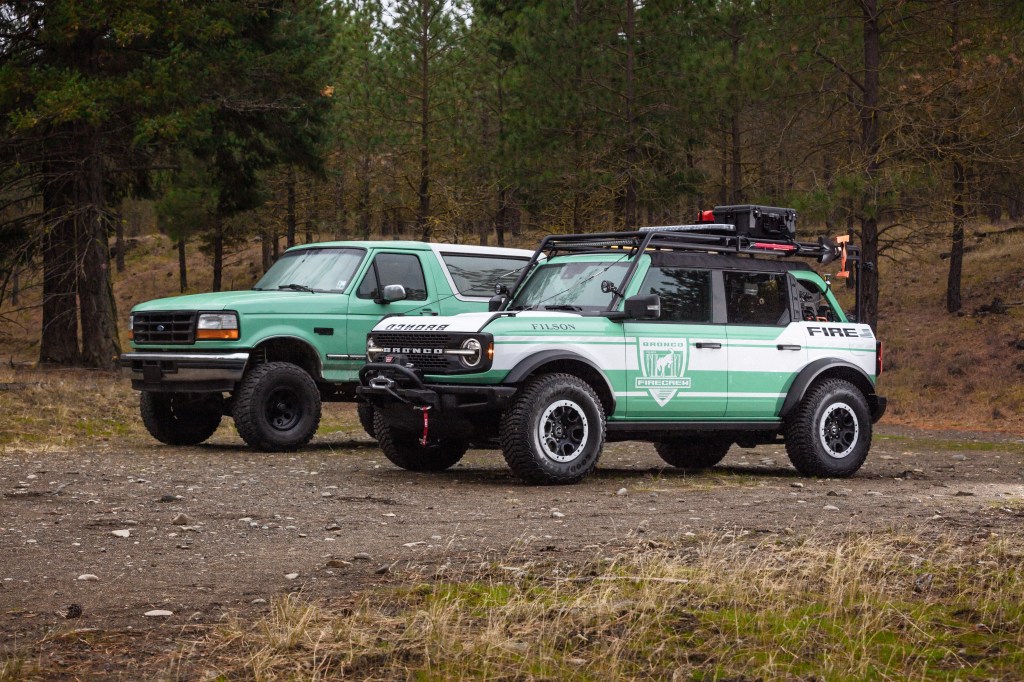
Without assessing blame for what caused the situation, there’s little room for debating that the great rural expanses of the United States are dealing with an accelerating number of wildfires that are increasingly frequent, widespread and destructive. And since they do most of their work out of the immediate public eye, many Americans are only peripherally aware that every fire season, thousands of dedicated wildland firefighters literally get on their hands and knees with very basic tools to prevent these blazes from devouring everything in their path. Head into the American West, and you’ll encounter a lot of fire apparatus bearing the gentle green livery of the U.S. Forest Service. These rigs are fairly common sights across the Green Mountains of Vermont, and can also be spotted in various parts of undeveloped Florida, where wildfires are frequently a serious issue. The Ford Motor Company and its partner Filson, the 123-year-old Seattle-based producer of outdoor and survival gear, have answered the alarm and produced a pair of new-generation Broncos as rapid-intervention vehicles for responding to wildland fire incidents.

The Bronco-Filson Fire Rig, as it’s called, poses above with a 1990s Bronco that was broadly used by the U.S. Forest Service. Built on the four-door version of the new Bronco, the Fire Rig fits a WARN winch up front, adds a RIGID light bar to its roof rack, then adds in water tanks, Pulaski cutting tools, a Hannay hose reel, Kimtek rescue/EMS skid and Stihl chainsaw. Filson has outfitted the Bronco’s interior with branded fireproof ripstop nylon. Are you liking this? The new-generation Bronco, in both two- and four-door models, hits Ford showrooms in the spring.

Two new takes on the MINI

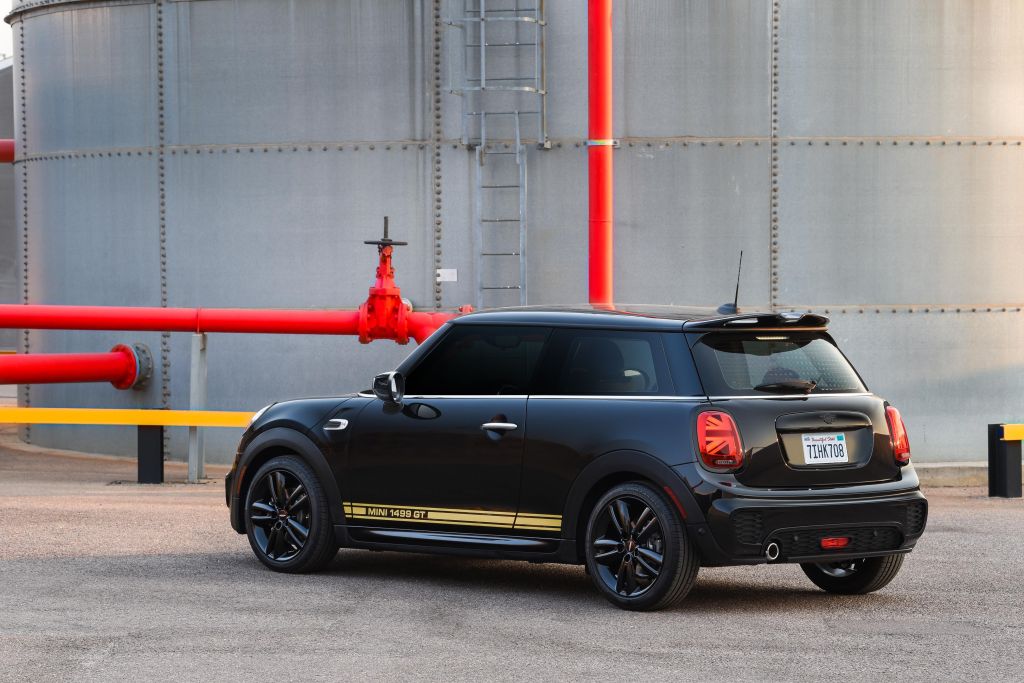
“Bespoke” is popular phraseology in the automotive world. Rooted in the King’s English, it’s a modifier to describe a product that’s made specifically to the needs of one individual buyer, namely you. This used to be the exclusive province of brands such as Rolls-Royce, which historically kept shafts of wood in stock keyed to specific cars, so their owners could exactly duplicate their interior veneers if the need ever arose due to some sort of calamity. Owners and sellers of vehicles as disparate as Jeep, Harley-Davidson and the Ford F-Series understand that there’s real value, and real profit, involved in offering serious personalization options for their customers. It’s guaranteed money. Not everyone realizes it, but MINI, as owned by BMW, has long boasted of some serious chops when it comes to bespoke automobiles, having released a plethora of special editions by taking the basic car, optioning it, then adding stripes and wheels from the MINI “toolbox” and other custom extras ranging from illuminated door sills to specific side scuttles. If you’re different from me and actually enjoyed studying the science of statistics in schools, you’ll appreciate knowing that this practice can lead to 13,544 possible combinations using just the MINI hardtop body. So when it comes to creating highly individualized products, MINI is one of the auto industry’s most accomplished brands. The latest two special editions were revealed this week.

Thematically, the MINI Cooper 1499 GT is inspired by a late edition of the groundbreaking Issigonis-created subcompact when it was still under BMC ownership, the Mini 1275 GT of 1969, which was recognizable by its modernized front sheetmetal and was then considered one of the world’s great performance bargains. The 1499 GT takes elements from MINI’s John Cooper Works styling package and adds in a Piano Black grille frame, door handles and headlight rings, the latter surrounding LED headlamps backed up by foglamps, as well as Piano Black taillight rings surrounding MINI’s model-specific Union Jack LED taillamps. The overall finish is Midnight Black Metallic paint with offsetting gold 1499 GT side stripes. The standard engine is MINI’s 1.5-liter inline-three.

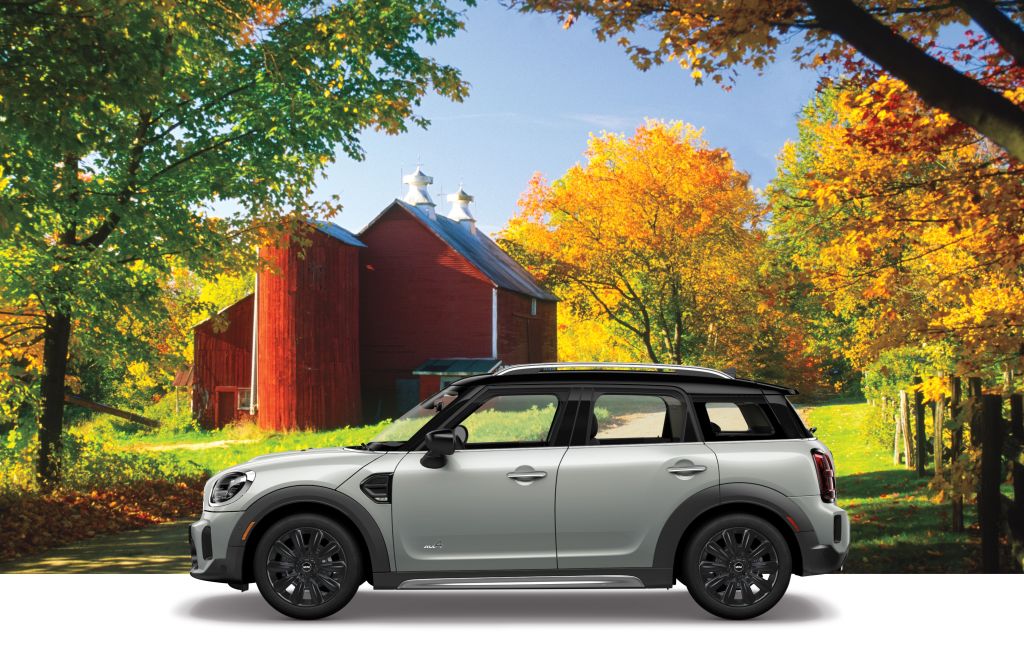
The other new MINI offering, on the larger Countryman body, is the Countryman Oxford Edition. It begins with the Classic Trim accoutrements including leatherette upholstery and an 8.8-inch display with Bluetooth, and adds in LED headlamps, foglamps, the Union Jack taillamps, heated front seats and automatic climate control. The Oxford Edition is offered as either a Cooper or Cooper ALL4 variant, and also includes a rear camera with park assist, panoramic sunroof, and a seven-speed dual-clutch transmission. Base MSRPs for both bespoke editions get underway in the upper 20s. When you shop for a MINI, individual choice is a big part of the purchase experience.

Beat the snow; become a racer

Sure, there are days when I miss living in the Northeast. The ones that come between right now and, say, Easter, aren’t among them. I hate snow and probably, so do you. And if you’re reading this, you’ve already demonstrated that you like cars. Here’s a way to combine emancipation from the gloom of an endless winter with opportunity to go fast legally and have a blast doing both. Come February, my pal Brian Redman, who lives just down the coast from me, is combining with his son James to present his Targa Sixty Six, one of the nation’s premier gatherings of vintage racers and their prized machinery, on the road course at Palm Beach International Raceway, with the dates set for February 19th through 21st. Track time is booked all three days for race cars of the past that are essentially divided into three performance-based groups. There’s a place at this event for everything from a vintage Formula 1 car with a documented racing history down to bathtub Porsches and the odd O.S.C.A.

The James Cucinotta photo of a Ferrari 312 PB built in 1972 – the same car that Brian drove for the SEFAC Ferrari works team when it won the World Manufacturers Championship for sports cars that same year – exemplifies the type of equipment that gets seen, and driven in anger, during a typical running of the Targa Sixty Six. The 2021 edition will mark the event’s 30th running. Guests at the race meets have run from David Hobbs and Hurley Haywood to Richard Attwood and Sir Stirling Moss. To properly work out their racing classics, attendees can look forward to six to eight hours of track time daily at Palm Beach. Go to Brian’s website and you can both reserve a spot for Targa Sixty Six and book a room. If you have more questions than that, James Redman can be reached at James@gorace.com or 772-713-7322.

A trove of racing heritage

If you get to work at automotive history, and you happen to love racing the way I do, it’s probably inevitable that eventually, you’re going to run into a person like my longtime pal Don Smyle. He lives not far from Charlotte Motor Speedway, and has more than 20 years of experience of motorsports marketing, all of it in the humming hive of all things NASCAR. And then some. I got to know Don because part of his business is maintaining the archives of some truly gifted photographers, who wanted to ensure that their work remained accessible to researchers as they got on in years. To that end, I assembled essays of vintage motorsports photography using images from Don’s holdings, including those shot by the late Don Hunter and by the pioneering drag racing photographer Don Brown.

The two Dons, Hunter and Brown, covered their respective branches of racing for literally as long as they’d been in existence. For example, Don Hunter photographed the very first NASCAR-sanctioned race in 1947, just weeks after the organization was formed a few minutes’ drive from here in the bar atop the Streamline Hotel on Atlantic Avenue in Daytona Beach. To learn fully about the sort of marketing, brand development and product awareness strategies that Smyle Media creates, check out its website. But also know that the more than 200,000 images Don manages, from a whole range of motorsport disciplines, will provide you with no end of “holy crap” moments. As evidence, we offer the Don Hunter image you see here, from the 1971 Wilkes 400 at the lamented North Wilkesboro Speedway. Richard Petty is working the outside in a 1970 Plymouth Road Runner, a body style he famously flipped down Darlington Raceway’s frontstretch the previous year. But in the inside lane are, in order, the late J.D. McDuffie, killed at Watkins Glen in 1991; the 1969 Camaro of Bob Williams, one of several pony cars from NASCAR’s short-lived Grand American division that filled out the field at this race (one of which, steered by the great Tiny Lund, took the win); and what is almost certainly the Holman-Moody Ford Torino of Bobby Allison, judging by the Coca-Cola logo on the hood. To me, memories like these are priceless.

Back-dated British royalty

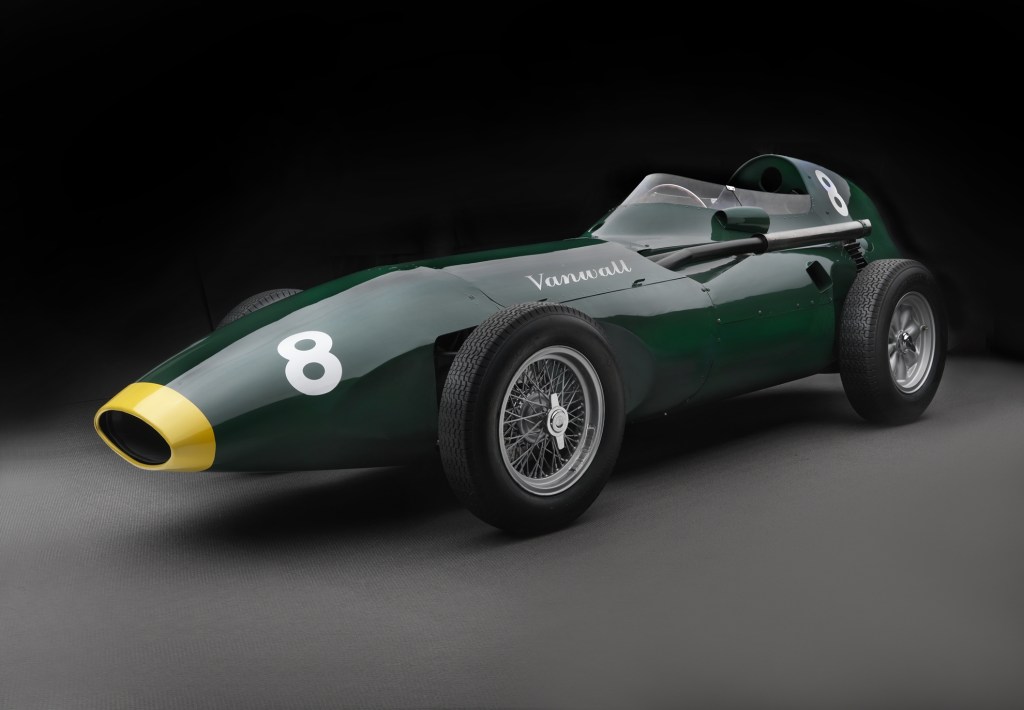
If you got yourself all amped up over our recent report on how Bentley is re-creating its early Le Mans cars of the Bentley Boys era, this news ought to make you swoon. The same sort of back-engineering techniques that Bentley has applied are now being used to re-create an even more famous British racing car. The Vanwall was the spawn of English industrialist and philanthropist Tony Vandervell, who got rich making insert bearings under license in Great Britain. Vandervell was also a patriot, and was determined to take on the grand names of Formula 1 with an entirely British car. He recruited three of British motorsport’s sharpest minds – Colin Chapman, Frank Costin and Harry Weslake – to create a new car from scratch. The Vanwall, as it came to be called, scored six F1 wins in 1958, with Stirling Moss, Tony Brooks and Stuart Lewis-Evans as drivers. It was enough for the Vanwall VW5 to win the newly established F1 Constructors Championship, while Moss lost the Drivers Champsionship to Mike Hawthorn by a single point. The Vanwall also gets credit for establishing British Racing Green as the United Kingdom’s national color in international racing.

These six planned Vanwall continuation cars – you can contact the builder for ordering information – will be priced at 1.65 million pounds each, plus the British VAT. Each will be assembled using parts re-created from the original blueprints, which are now in the custody of company principal Iain Sanderson, a former world champion powerboat racer who more recently built the Lightning GT supercar EV. Each continuation Vanwall will be powered by the same in-house 2,489cc Vanwall engine that Weslake helped design. I recently finished a story on a Tucker 48 that was restored using back-engineered parts created from the car’s original blueprints, much like Vanwall is doing. It’s fascinating to learn how precisely these old faves can be renewed with modern technology such as CAD drafting, 3D printing and precision machining. Imagine showing up at a vintage meet in one of these, a hugely historic British racing car, which represents the closing days of the front-engine F1 era.