Precision 3D printing grows in creating BMW components

Full disclosure: I’m one of the individuals who is involved in the launch of a new premium, quarterly magazine on automotive history entitled Crankshaft. One story slated for the inaugural issue, which will launch in the spring, is about the restoration of a Tucker 48 sedan with help from the descendants of Preston Tucker. Part of the story describes the U.S. of today’s home-based 3D printing technology to create parts for which NOS replacements simply don’t exist, created by making patterns derived from the original Tucker factory blueprints. This process enabled specific, essential parts to be re-created in very small numbers, but with absolute precision. This kind of technology, for making highly limited runs of complex pieces, is increasingly being embraced by volume automakers, such as BMW.
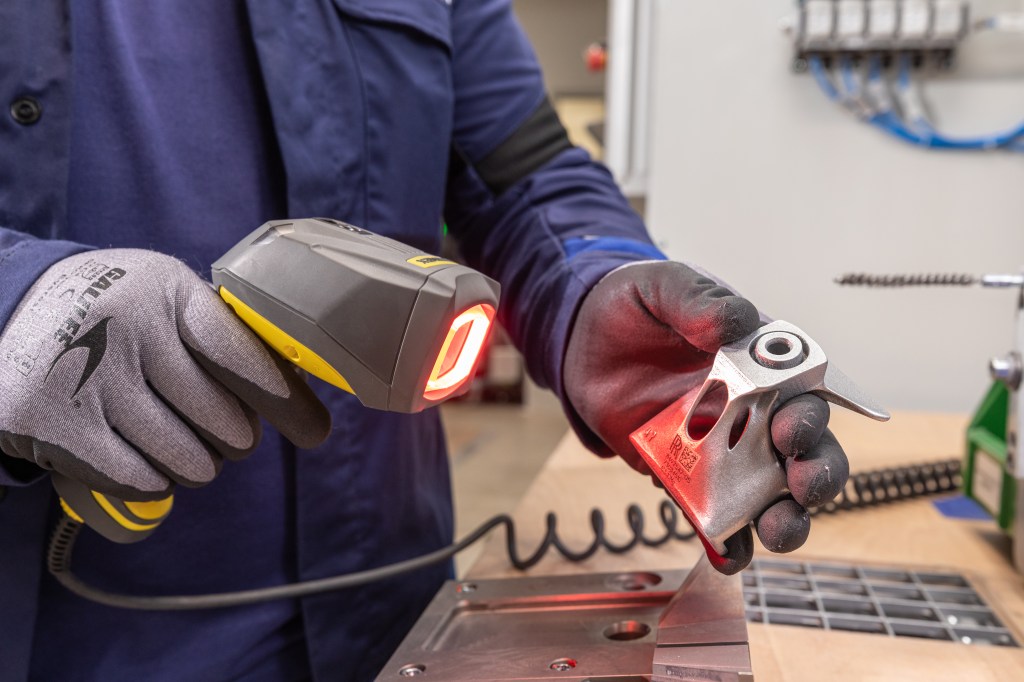
BMW isn’t just about fine German cars anymore; in recent history, it has taken over ownership of both Rolls-Royce and MINI. BMW is scaling up the process of 3D printing to transition it from nearly artisan-level work to the larger scales of mass production, an initiative known as additive manufacturing, which it conducts from a dedicated technology facility in Munich. The idea is to embrace 3D as a way to speed up production of parts needed in small volumes, thereby accelerating product development. Currently, that involves the production of low-volume metal and polymer components for Rolls-Royce. Complicated parts can be patterned by the use of computer algorithms to fine-tune their shapes and dimensions. The photo from BMW shows the next step of that process, arriving at precisely measured dimensions and thicknesses by minutely shaping the printed piece by melting its surface with a laser beam until the piece, from which a casting mold will be created, exactly matches its specification. About 50 such processing systems are in operation at the Munich center, with another 50 being used at BMW production sites around the world.

Barrett-Jackson pushes back Scottsdale auction dates

This is being written as cargo jets fan out across the United States, delivering the first doses of Pfizer’s coronavirus vaccine to health providers for distribution. That is decidedly positive news. It means that there is indeed finally a way out of all this, but it’s still vitally important that everybody understand, the virus is still out there. And until you’re vaccinated, you’re in danger. That explains why Barrett-Jackson, among the collector-vehicle auction industry’s most prominent players, announced it’s pushing back the dates of its signature sale next month in Scottsdale, Arizona. Instead, the big blowout has been reset, at the sale’s longstanding Westworld location, for the week of March 22nd. The current COVID-19 spike was identified as the postponement’s rationale. Health officials are predicting that widespread vaccine administration should be well underway by then, which gives the decision a strong measure of common-sense affirmation.

This is not the first virus-related blowback to impact Scottsdale week. Worldwide Auctioneers has shifted its own Arizona event back to its home base of Auburn, Indiana, where the sale will be online-only. Another major sale, by Gooding & Company, will take place as scheduled next month but will likewise be online-only. When the cork does pop at Barrett-Jackson, Scottsdale’s most prominent sale, the lots will include this item from the collection of B-J boss Craig Jackson. His 1965 Shelby G.T. 350 is one of the last 10 such cars produced, and was meticulously restored by Thoroughbred Restorations, run by Shelby-American Automobile Club chief judge John Brown, after being found abandoned in a barn. Since restoration, the Shelby-stroked Mustang fastback has become the first G.T. 350 from 1965 to win the Triple Crown of competitive judging for these cars, capturing the Mustang Club of America Authenticity Award, the same club’s Thoroughbred Class Gold Award, and SAAC’s Premier Award. Date change notwithstanding, this will still be Barrett-Jackson, and still taking place in Scottsdale, which means that this Shelby will be anything but cheap when it does cross the block.

Hands-off cruising from GM

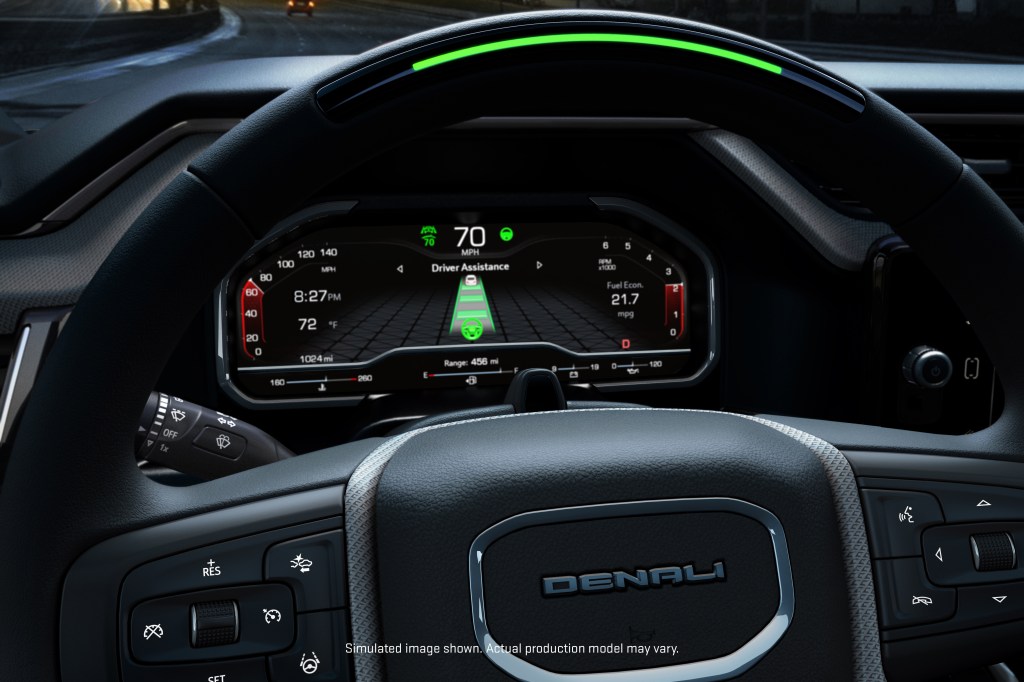
If the notion of hands-free driving is a little bit unsettling to you, read on. Autonomous driving is a technique that’s eventually going to mean the 18-wheeler coming up to pass you won’t necessarily have a human being in the driver’s seat. All manner of fleet operators, from Amazon on down, are seriously considering the adoption of self-driving vehicles, if not actively developing them with a variety of technology partners. The same capability will be coming to civilian vehicles sooner than you likely think. At General Motors, this sort of driver-assistance system is known as Super Cruise, and it will be coming to the GMC Sierra 1500 Denali full-size premium pickup late in the 2022 model year.

As you can tell by the welter of controls on the steering wheel, the Denali is a high-end content package worthy of this new stuff. Most basically, Super Cruise is the domestic auto industry’s first true subscription-based, hands-free assistance system, which will operate on some 200,000 miles’ worth of technology-compatible roads in the United States and Canada. It operates using a driver attention system combined with LiDAR, which stands for Light Detection and Ranging, which continually measures distances to surrounding vehicles and other obstacles. A small camera at the top of the steering column uses infrared lighting to determine where a driver is looking, and will sound an alert if the driver’s been staring in one direction for too long. At first glance, it’s an interesting concept. Equally interesting is the fact that GM accompanied its announcement of Super Cruise with a disclaimer making clear that drivers are still responsible for both paying attention and avoiding phones or other hand-held devices while the vehicle is in motion. Smart move.

The Blower Bentley returns

If you’re fascinated by the history of both motoring and motorsport, especially when it involves British heritage, you know all about the Bentley Boys and the cars they drove, some of which demolished the field at Le Mans with locomotive-like relentlessness. Bentley, which has thrown itself a 100th birthday party that’s the class of the automotive world, has finally done the ultimate recreation of its sporting DNA by unveiling Car Zero, the first Blower Bentley produced at Crewe in 90 years, a Continuation Series automobile created, in part, by creating a laser-scanned 3D model of the supercharged 1929 4 1/2-liter Bentley that was raced by Sir Henry “Tim” Birkin, one of the original Bentley Boys. Using computer-aided design technology and 40,000 hours of intensive work, Bentley created 1,846 parts, using original items or factory blueprints for patterning, that went into assembly of each continuation Blower Bentley.

The re-created car is the one in the foreground. Wherever possible, it was assembled using traditional methods to assemble and finish the new-old components. The chassis is an exact replica in hand-formed, hot-riveted heavy-gauge sheet steel constructed by Israel Newton & Sons Ltd. of Derby, which ordinarily creates boilers for locomotives and steam traction engines. Similar artisanship was provided by the Vintage Car Radiator Company of Bicester, which individually crafted the polished nickel radiator shell and the hand-beaten, steel-and-copper fuel tank. The body was fabricated by Mulliner on an ash frame assembled by Lomax Coachbuilders, wrapped in Rexine, a synthentic leather. The seats are correctly stuffed with 10 kilograms of natural horsehair each. Just a dozen of these cars will be produced, and we regret to disclose that every one has already found a buyer.

Electrifying classic Range Rovers

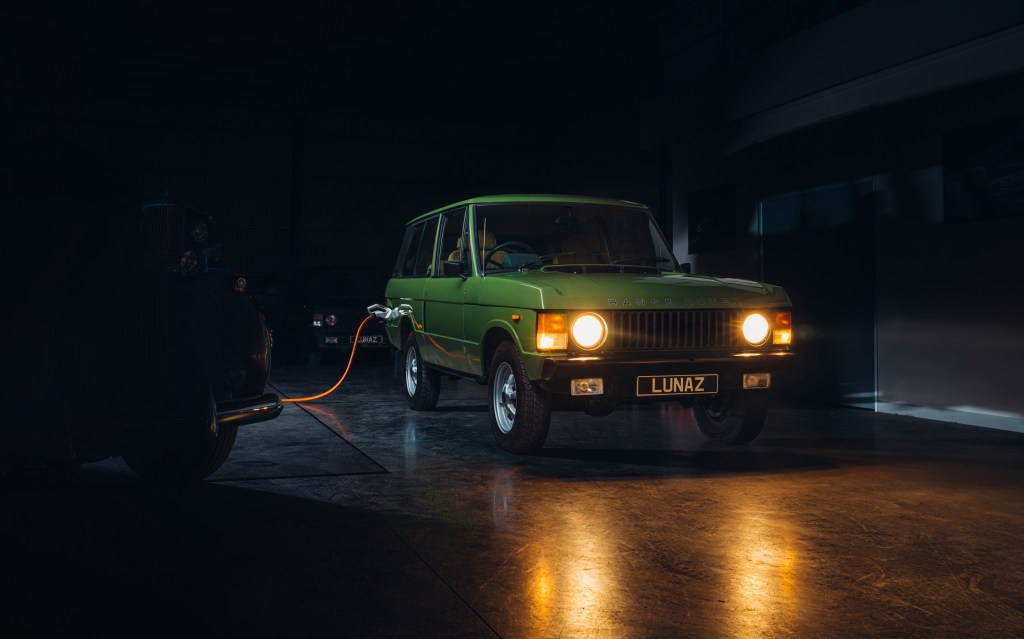
We’ve introduced you in the past to the labors of Lunaz, the boffins based in historic Silverstone, England, who have been converting some esteemed British classics into full-electric vehicles for monied clients with an eye for both environmental responsibility and tweedy tradition. As its latest gambit, Lunaz is commenmcing production of classic Range Rovers – to many, the original luxury SUVs, first produced from 1970 through 1994 – as EVs for both drivers and those who preferred to be driven around by others. A total run of 50 Lunaz Range Rovers is envisioned.

The Range Rovers will be offered with both standard and long wheelbases. Specific models will be offered as Town specification, emphasizing rear-seat accommodations for chauffeured owners, and Country, which will instead be equipped to offer a full off-roading experience. At Lunaz, it’s not just a matter of repowering these British classic off-roaders with the firm’s proprietary electric powertrain. Rather, each Range Rover is taken down to bare metal as part of the remanufacturing process, a process that includes the installation of modern, improve suspension and braking components. The interior outfitting is a bespoke procedure, with a full selection of highly selectable premium-quality materials. Speaking of premiums, the announced price for a Lunaz Range Rover is 245,000 British pound, which translates today to around $327,500.

14 million Nissans at Smyrna

Betcha didn’t know half of this. Lots of us now associate Nissan with Tennessee, it having moved its North America headquarters from southern California (just up Vermont Avenue in Gardena from the fabled speedway, Ascot Park) to Franklin, outside Nashville. That reinforced the Volunteer connection that had dated back to 1983, when Nissan opened its U.S. assembly plant in Smyrna, located in nearby Rutherford County. With an annual production capacity of 640,000 vehicles, Smyrna is the highest-volume auto assembly plant in North America. It has a workforce of more than 7,000. And this week, its workforce hit a milestone by rolling out the plant’s 14 millionth vehicle. This is in a state not known until recently (Volkswagen has more recently set up shop in Chattanooga) as a hub of the auto industry. That makes Nissan’s benchmark glowingly impressive.

The honored vehicle turned out to be a 2021 Nissan Rogue finished in Scarlet Ember Tincoat. Besides the Rogue, Smyrna also builds the Nissan Murano, Pathfinder, Maxima and the Infiniti QX60 premium SUV. Another product from Smyrna is the electric Nissan LEAF, whose onboard batteries are also manufactured on site, as will the EV’s forthcoming second-generation replacement. Nissan trivia: The first vehicle to roll out of Smyrna was a plain white Nissan 720 standard-cab pickup, with the compact Sentra being the first dedicated U.S. vehicle produced there.

Fallen far too young

In his deeply personal introduction to this book, Sir John Young Stewart expresses his belief that had he lived to savor his crown, Stewart’s close friend Jochen Rindt would have retired on the spot after winning it. Instead, as this intimate examination of his life makes clear, Rindt is the only Formula 1 world champion to have been awarded the driving title posthumously. On the monied killing field that was F1 in the 1960s and 1970s, Rindt’s life stands alone as a dazzling meteor: He scored his first f1 podium in 1966, swept 10 poles in 1969 and won his first Grand Prix in 1969. When he died at Monza the following year, newly aboard the revolutionary Lotus 72, he was so far ahead in the points that he clinched the title mathematically over Ferrari lead Jacky Ickx with the final race still remaining. Rindt, supernaturally gifted and blindingly quick, deserved a full, respectful biography and a decade ago, he got it. It’s being reprinted in paperback to mark 50 years since his championship, and has a place in any serious motorsport library.

Rindt’s story is told by the British journalist David Tremayne, whose past works include The Lost Generation, about the fallen British F1 heroes Tom Pryce, Roger Williamson and Tony Brise. This is Tremayne’s 50th book on racing history, and is rich in fact, the narrative running to 496 highly crafted pages. Close to Stewart, the driver closest to Rindt, Tremayne was the ideal author for this retrospective. It’s a title of Evro Publishing, and retails for $19.99.

Yes indeed, it’s an e-Jeep

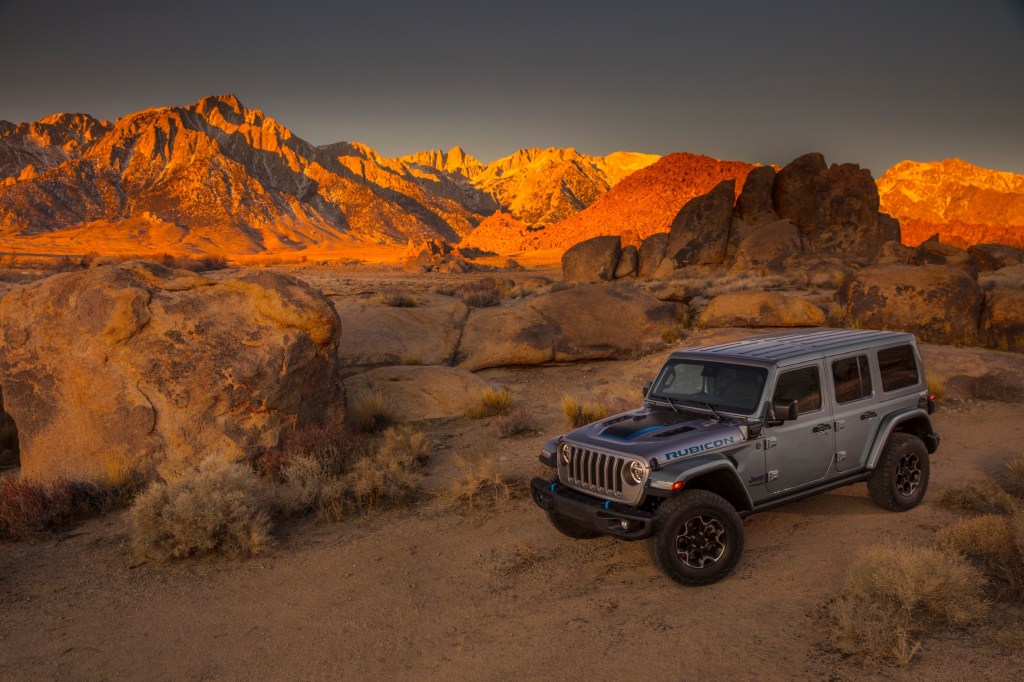
All right, let’s admit that when it comes to naming vehicles that have efficiencies in terms of the resources they consume, Jeep is never near the top of the list. That’s something that may have to change. The ultra-traditional Jeep Wrangler, one of the most instantly recognizable tough guys in automotive history, with almost 80 years of boonie-busting heritage that dates back to the Lend-Lease Program, is going electric. Fiat Chrysler Automobiles is handing its flagship vehicle – that’s a main reason Fiat swallowed Chrysler in the first place, the same reason Chrysler once gobbled up American Motors – a heretofore unimagined identity as a vehicle that’s green in a sense other than olive drab. Jeep even has a name for this, adopting 4xe as its global brand for plug-in hybrid vehicles, of which the 2021 Jeep Wrangler 4xe promises to be only the first.

In the case of the Wrangler, 4xe spells out a 2.0-liter turbocharged four with dual electric motors, a high-voltage battery pack and the TorqueFlite, another fabled name from yesteryear, eight-speed automatic. The driveline is rated at 375 horsepower, and four driver-selectable modes for EV operation, gasoline-fueled motoring or a combination of two. In full EV mode, the Wrangler 4xe has a range of 25 miles between electron replenishment. In combined driving, it can make 50 equivalent MPG. Of course, the 4xe is still a Jeep, meaning a couple of old-fashioned live axles, the ability to ford water 30 inches deep, and final assembly, naturally, in Toledo.

Fresh front highlights VW Arteon

Volkswagen’s Arteon is the successor to the CC in the role of Wolfsburg’s most premium sedan offering, sharing its modular MQB platform with the CC along with a host of other cars from Audi, SEAT and Skoda. The Volkswagen Atlas SUV also is MQB-based. This is a serious potential profit center for Volkswagen, and the Arteon enters 2021 with revisions that include a whole new front end treatment, which can be optionally outfitted with an illuminated bar running across the center of the grille to keep things interesting. The 2021 Arteon is offered in three trim levels, and offers a veritable gondola full of standard connectivity that includes Volkswagen Digital Cockpit, Climatronic Touch, MIB3 infotainment with wireless App-Connect, enhanced voice recognition, USB-C charging, an upgraded navigation system, Car-Net with Wi-Fi capability, and SiriusXM with 360L streaming and satellite content. That’s a lot. The Arteon also lets its driver choose from a palette of 30 interior lighting shades.

The Arteon engine is Volkswagen’s TSI turbocharged, direct-injected 2.0-liter inline-four, a member of the EA888 engine family, whose thinwall cast-iron engine block weighs just 72 pounds, and which produces 268 horsepower. Front drive or 4Motion all-wheel drive are available, with an eight-speed automatic transmission standard. Offered across three trim levels, the Arteon MSRPs begin at $36,995.

Audi R8 Panther drives the rear wheels only

Ever since Audi systematically destroyed the rally world with its first Sport Quattro at the end of the 1970s, its product lineup has been all about all-wheel drive – almost. For the hardcore True Believers of the driving world, the ultimate expression of going fast is a mid-engine car with the rear wheels driven, which can be pitched into the desired attitude by assiduously booting the throttle. This limited-edition GT from Audi is all about that kind of driver-vehicle interplay. Just 30 copies of the Audi R8 Panther edition, the vanguard of the rear-drive R8 model line and are highly individualize to accentuate their exclusivity.

At this level, the profile is as important as the performance, and the R8 Panther positively pounces in this regard. Each car will be finished in Panther Black crystal-effect paint, with matching scarlet-trimmed 20-inch wheels. The full leather interior follows the same theme, its black hides stitched in crimson, an environment that includes shell-type competition seats. The gear selector, headliner, and specific steering wheel with selectable controls are covered in Alcantara. For entertainment, R8 Panther buyers get a standard Bang & Olufsen sound system featuring 13 speakers and 550 watts. Speaking of power, the motivation comes from a naturally aspirated 5.2-liter V-10 capable of 532 horsepower, which can get the Panther to 60 MPH in 3.6 seconds, with a top end of 201 MPH. It goes on sale this month with an MSRP of $183,300.