Crankshaft Issue Two arrives

A 1954 Pegaso, the exquisite Ferrari fighter than was born in Spain. A 1960 Dodge Matador, with the dizzying array of visual scoops and sweets that defined the sheetmetal architecture of Virgil Exner and his team. A 1968 Plymouth Barracuda that became the first race car of any kind to have a now-standard four-link rear suspension. Most car magazines don’t bother doing the sort of due diligence and pure research that’s necessary to discuss these rarely seen automobiles with any level of authority. Then there’s Crankshaft. We’re the quarterly journal on automotive and motorsport history that publishes meaningful, deeply sourced, definitive histories of hugely important cars that most publications tend to ignore, because studying their history requires geniune work. The second issue of Crankshaft is now going to readers, and its pages make clear what this magazine is all about.

Each issue of Crankshaft encompasses 144 perfect-bound pages on rich coated stock, with a textured cover and photography that equals the text. Among the other delicacies in the second issue are a retrospective on Lincoln as it begins its second century, the history of Brooklin Models’ wonderful diecast models of obscure cars, and the saga of the only 1935 Hoffmann microcar ever constructed. We proudly proclaim our respect for motorsport by including at least one major such article per issue; this time, we look at the legacy of Lions Drag Strip in Long Beach, California, where the daring blasted away through the oceanfront evening fog at drag racing’s greatest venue ever. Check us out, and prepare to be highly impressed. You can subscribe by visiting http://www.crankshaftmagazine.com.

A country legend and pretty good race driver drove this Charger

Auto racing is arguably humanity’s most dramatic pastime, and it enjoys a rich history stretching back more than a century, which includes a wide variety of characters who participated with varying success, including celebrities. Most everyone is at least somewhat familiar with the Steve McQueen saga, which culminated last year when Mecum Auctions hammered the hammered remains of the immortal Bullitt Mustang for more than 3 million dollars. McQueen was a global megastar who was uncommonly good with cars, and he wasn’t alone. Mecum, for whom I’ve worked from time to time, is preparing to sell another relic that belonged to a pretty well-known guy who, like McQueen, unquestionably knew how to drive fast. His name was Marty Robbins, he had a Hall of Fame career in country music, and he had an impressive secondary career as a NASCAR competitor, which he took very seriously and approached with genuine, unforced skill. And he did it against some of NASCAR’s undying legends. You now have an opportunity to own an unquestioned piece of intriguing stock car history.

Born in Glendale, Arizona, Robbins zoomed into the public’s consciousness when he won a Grammy in 1959 for his ballad El Paso, which would become his signature song. Relocated to Nashville, Robbins was exposed to stock car racing, which grabbed him hard. By this time, Robbins had the means to indulge his newfound hobby, and got the famed fabricator Cotton Owens to build him race cars to drive, usually sporting number 42 and an impossible-to-miss color combo of magenta and bright yellow. Robbins was no slouch. In a part-time campaign that ran from 1966 to 1982, Robbins started 35 races at today’s Cup level and scored six top 10s, an impressive run against names that included Petty, Pearson and Yarborough. One day after 9/11, I found myself at the Country Music Hall of Fame, which had an affectionate exhibit on Robbins’ racing days including his final race car. a Dodge Magnum. The Robbins car being auctioned by Mecum at its Orlando sale late next month started out as a 1969 Charger 500 being raced by independent James Hylton. Robbins bought the Ray Nichels-built Dodge from Hylton and had it reskinned as a 1969 Charger Daytona by Bobby and Eddie Allison. Its sole race in Daytona skin was the 1970 National 500 at Charlotte. The car is said to be fully authenticated, having been restored by Ray Evernham at his Big Iron Garage in Mooresville, North Carolina, and fitted with a Ray Barton-built 426 Hemi. It’s the real deal, and a good guy, with good chops for driving race cars, made it famous.

Mazda’s triumph at Le Mans, revisited 30 years later

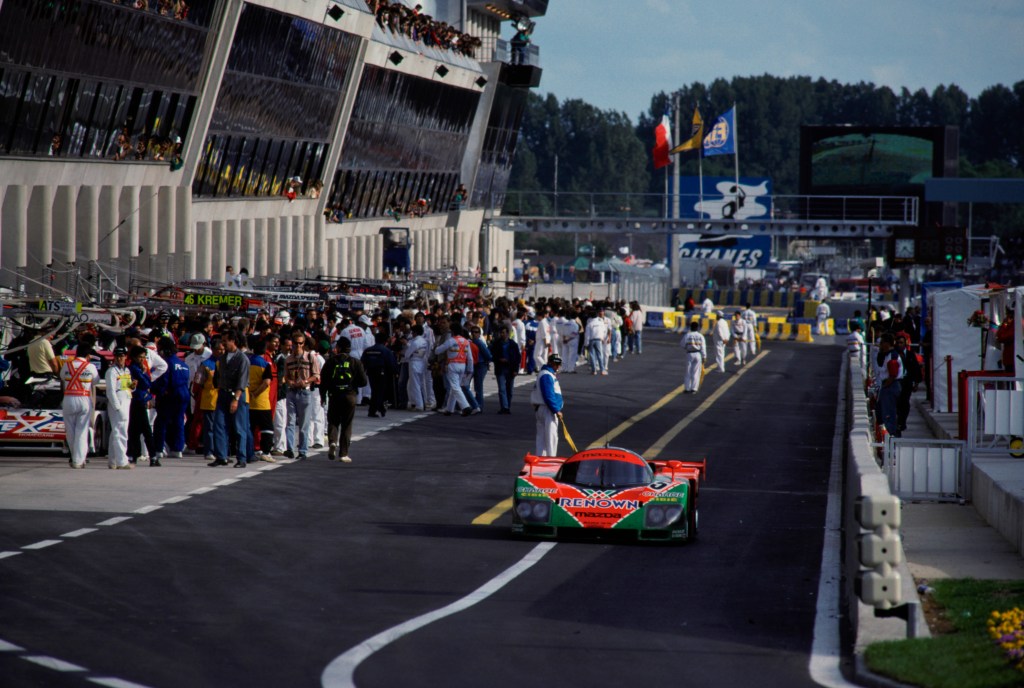
Thirty years ago today, to the day, a moment of joyous history enveloped Mazda, of all car companies, at the 24 Hours of Le Mans. A rules change limiting Group C sports prototypes to 3.5 liters of displacement was mandated in 1991, which ensured that Le Mans that year turned into a wild shootout among several big names in the car world, all of which pulled into town packing brand-new Group C gear, including Mazda, which entered a pair of its 787 prototypes fabricated in the United Kingdom by Advanced Composite Technology, and powered by shrieking 2.6-liter four-rotor Wankel-cycle engines, the kind of powerplant that made Mazda famous on these shores, with natural aspiration and three plugs per rotor. When the tricolor dropped to start the race, the bullet-fast Peugeot 905s came to grief, and the new 3.5-liter cars from Jaguar and Mercedes-Benz failed to make the show. That left Mazda to scream to a nearly uncontested two-lap victory, the first at Le Mans by a Japanese automaker, and the only running of the race won by a non-piston-powered car. Subsequent rule changes all but assure that a rotary-powered car will never run again at the Sarthe.

The winning 787 was shared by Volker Wieldler, Bertrand Gachot and Formula 1 journeyman Johnny Herbert, the last of whom nearly collapsed from dehydration and had to be lifted from the car. In part due to Mazda’s parent firm, Toyo Kogyo, marking its centennial last year, the automaker has unveiled a new website that commemorates the Le Mans triumph, which you can access right here. Among the tastiness it provides is a technical history of the R26B four-rotor engine, which produced output numbers that could match the volume of its deafening exhaust: Try 700 reliable horsepower at 9,000 RPM, without turbocharging. That’s indeed a screamer.

Sweet Home Alabama: Hyundai plant adds new Santa Cruz

At one time, the home of the Crimson Tide was pretty much nowhere when it came to cars except for Talladega Superspeedway and the old fairgrounds oval at Birmingham, longtime fertile ground for the Allison brothers and the ageless Red Farmer, just for instance. Then Mercedes-Benz was lured into the state to build SUVs at a new plant in Vance, and more recently, Hyundai has established a major North American assembly operation in the state capital, Montgomery. If you ever, for whatever reason, have doubted that Hyundai is a for-real player on the American automotive landscape, here’s something to think about: All of the industrial giant’s biggest-selling vehicles are now being built under roof (honest) in Montgomery, exclusively for sale on this continent. This week, Hyundai’s Alabama gang got a little larger in a very significant way.

With this week’s rollout of the new Santa Cruz, which Hyundai refers to as a Sport Adventure Vehicle but is more accurately a tiny front-drive pickup, five critical vehicles are now undergoing final assembly at Hyundai Motor Manufacturing Alabama for distribution to some 820 dealerships across the United States, Canada and Mexico. Expected to cross sabers with both the Honda Ridgeline and forthcoming Ford Maverick, Hyundai’s new trucklet is intelligently packaged for today’s realities, featuring a secure open cargo bed with a lockable tonneau cover for security, along with hidden storage areas in the bed. A four-door crew cab, we like to call it, is standard. Hyundai’s promised segment-buster joins the Sonata and Elantra sedans and Tucson and Santa Fe SUVs as HMMA-built vehicles.

Lambo’s V-12 marks 60 years

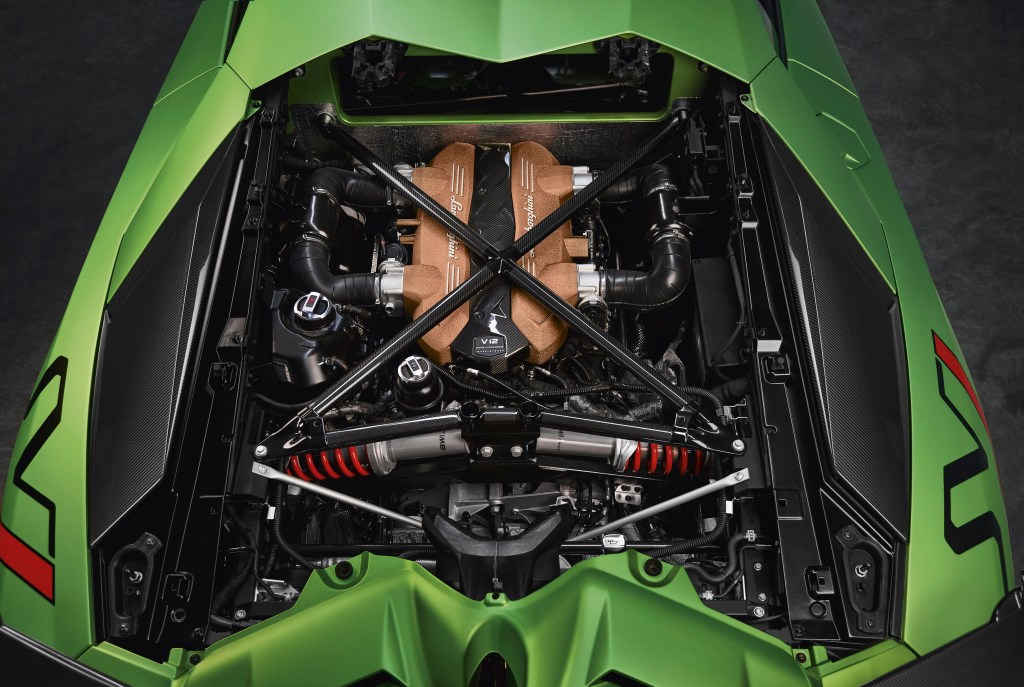
You can make a strong argument that because some of the cars that bear his name today have been so outrageously over the top, Ferruccio Lamborghini has never received the full measure of respect he deserves for simply daring to muscle in on the rarified world of Italian performance that Enzo Ferrari and the Maserati brothers had heretofore had to themselves. If nothing else, Lamborghini, the man, firmly believed in going big, and while Lamborghini cars have only recently acquired a pureblood competition grounding, the founder insisted that regardless, they’d been equal players when it came to mega-dollar exotics. Lamborghini commissioned Giotto Bizzarrini, a guy who also had a major hand in creating the Iso Rivolta GT coupe, to design a proprietary V-12 when Lamborghini was creating its first luxury exotic, the 350 GT, which appeared in 1963.

The engine that Bizzarini designed turns 60 this year. It was a 60-degree V-12 with dual overhead camshafts above each cylinder bank, first displacing 3.5 liters and rated at a robust 320 horsepower when it appeared in the 350 GT, which was the last conventional car the company ever built. From that point, the V-12 grew bigger as its was transplanted into increasingly outrageous sports car, first the Miura with its wildly unique transverse mid-engine powertrain layout that combined the engine and transaxle into a single unit, and then the even more radical Countach, whose only normal attribute was that the driveline was laid out longitudinally. The original Lamborghini V-12 ballooned in displacement to 6.7 liters, its output swelled to 670 for its duty in the Murciélago Super Veloce that debuted after 2001. Lamborghini’s current supercar, the Aventador, debuted a new-generation V-12, a clean-sheet design, which currently produces up to 770 horsepower, easily propelling the SVJ variant to 60 in about 2.5 seconds.

Cayenne wraps ‘Ring record

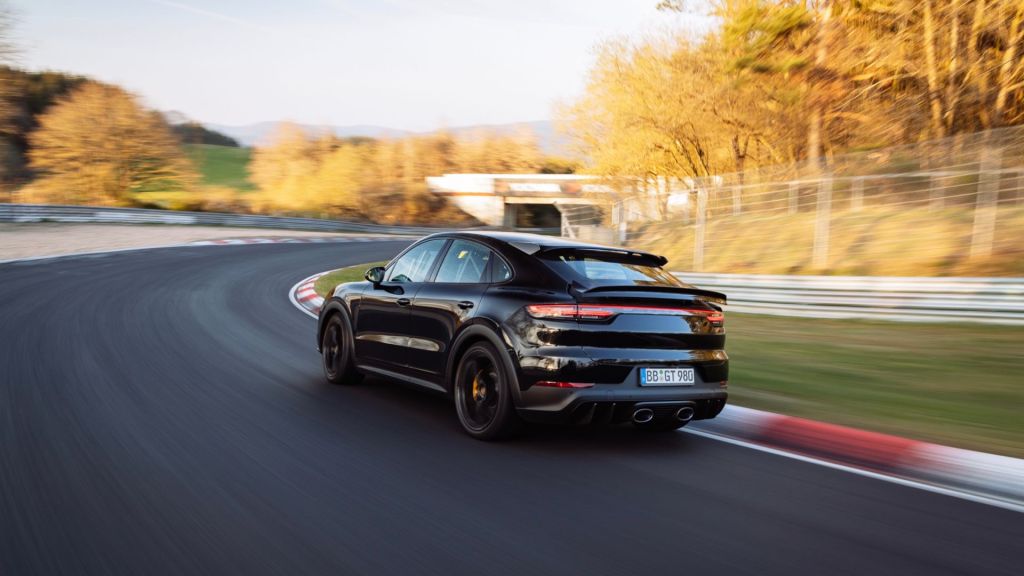
The gag used to go that the SUV craze, which arguably dates to when Ford introduced the first Explorer in 1990, would run its full course and somehow disappear if Porsche ever joined the fray. We all know how that played out. The Porsche Cayenne, built in Slovakia, is now into its third generation and with more than 1 million sold, is among the most commercially successful products in Porsche history – unlike a 911, and just about everything else Stuttgart has ever built, it’s got plenty of room for your whatevers – and helped to establish the conceptual validity of megabuck SUVs from later practitioners ranging all the way up to Rolls-Royce. So stop laughing already. If you need a little more convincing that the Cayenne’s indeed for real, read on.

In a moderately massage rekordwagen based on the production Cayenne Turbo Coupe, Porsche factory test driver Lars Kern whipped around one of the world’s most demanding and historic racing circuits at a benchmark time. Kern took the Cayenne to a certified record lap around the Nurburgring for SUVs, vans and pickups. Around the 14.173 mile North Loop, or Nordschliefe, which incorporates more than 170 distinct corners and some 1,000 feet of elevation changes through the Eiffel Mountains of Germany, Kern hustled the Cayenne to a hot lap of 7:38.925, the SUV outfitted with a racing seat, roll cage and shod with Pirelli P-Zero Corsa performance rubber. This is strong stuff, very impressive for a vehicle that rides on a platform it shares with Volkswagen passenger cars. By the way, if you click on the link for the ‘Ring, you can learn how you, too, can fly to Europe, pay a toll, and get to play Fangio or Stewart on this hallowed blacktop, dating back nearly a century, for yourself. All it takes is money and considerable fortitude.

Polestar EV goes full Palmetto

Looks kind of like today’s styling themes at Volvo, right? That’s no coincidence. Polestar is a name that’s been associated with Volvo Cars since 1996, when it was founded as an independent tuning house for performance cars from the Swedish icon. Since then, Volvo bought the operation outright, was bought itself by Geely of China, renamed its in-housing performance tuning operation as Cyan Racing, and as of 2017, dramatically repurposed Polestar as a Volvo-allied standalone brand for developing premium electric vehicles. Polestar is about to shift operations stateside as it prepares to launch its newest EV, the Polestar 3, which will be built in the Ridgeville, South Carolina, assembly plant that has produced Volvo cars for the North American market since 2018, joining the earlier Polestar 1 and 2 models that are assembled at Geely facilities in China.

For the record, the images shows a Polestar 2 crossover, which makes its use of Volvo styling themes very apparent. When it debuts at a still-undetermined point in 2022, the Polestar 3 will ride on new SUV architecture that’s largely being created by Volvo, which Polestar says will provide industry-leading connectivity thanks to use of the Google-sourced Android Automotive OS software suite. The South Carolina-built Polestar 3 will likely be offered for export once North American demand is satisified. Polestar plans to open the first of its freestanding U.S. retail showrooms, which it calls “spaces,” later this year.

EVs don’t just run on pavement

This isn’t directly about cars, but just consider the subject, because I happen to be a lifelong railfan, and I’ve always been fascinated with the technical systems that allowed railroading to be the most efficient means of moving huge quantities of cargo across the terra firma. Don’t think it’s relevant? You will recall that Big Bill Knudsen used to supervise the construction of steam locomotives in Buffalo before he went to work for Henry Ford and later, ran General Motors. Just saying, because trains are cool, and speaking of which, here’s a way that the GM of today is making them even cooler and more relevant.

This week, GM announced that it will make the Ultium batteries and HYDROTEC hydrogen fuel-cell systems it’s been developing for road vehicles available for use by Wabtec Corporation, which is now one of North America’s two big builders of railroad locomotives, having bought the historic General Electric locomotive works in Erie, Pennsylvania. If you’re unfamiliar with how rail locomotives work, they use a huge diesel prime mover that turns an electric generator, which in turn powers traction motors located on each drive axle that actually propel the locomotive. Pittsburgh-based Wabtec is now developing alternative-fuels locomotives in conjunction with the California Air Resources Board, BNSF Railway and the San Joaquin Valley Air Pollution Control District. The GM systems will be used in projects like Wabtec’s FLXdrive locomotive, now undergoing testing on BNSF’s freight route between Barstow and Stockton, California. The FLXdrive system utilizes 20 racks of lithium-ion batteries set low in the locomotive’s frame, which can either be recharged at a BNSF station in Stockton or else on the fly, using the regenerative or “dynamic” braking process that’s standard in modern diesel operation. With four powered axles, the FLXdrive locomotive can boot the train to 75 MPH along the 350-mile route without needing a recharge, all while reducing locomotive emissions by some 10 percent. This is really good news for both GM and the rail industry.

Charting the 911s that defined the original superstar racing fest

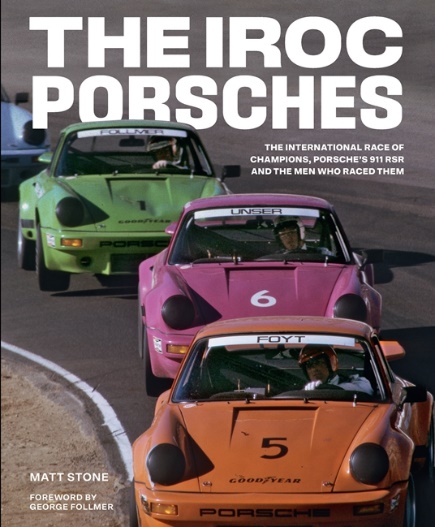
Here, and elsewhere, the Superstar Racing Experience brainstormed by Tony Stewart and Ray Evernham, which made its prime-time debut Saturday on CBS, has been the subject of impressive media focus. It was gratifying to see the organizers publicly salute the series that directly inspired SRX, the original International Race of Champions, which was the offspring of Roger Penske and then-NASCAR executive Les Richter, the former NFL star. When it first aired via tape delay on ABC, the IROC series matched the world’s best drivers from a broad range of disciplines in – at first – identically prepared, rainbow-hued copies of the 1974 Porsche 911 RSR, Stuttgart’s in-house, factory-built production race cars. Those 911s still exist, in very small numbers, and we can tell you from personal observation that they pull enormous prices when they come up for sale at auctions, their Recaro seats having been creased by butts belonging to the likes of Emerson Fittipaldi, A.J. Foyt and Richard Petty, to name some of the IROC participants. So with the hoopla over SRX, it’s no coincidence that a new volume closely examines these straight-up exotic pieces that introduced motorsports to TV as mass-market entertainment.

For their brief time in IROC, which shortly switched to more fixable Camaro-bodied stock cars as the series continued, these 911s are some of the most instantly recognizable competition cars in Porsche history. They’re a fitting topic for this hardcover history authored by one of America’s most accomplished automotive journalists, former Motor Trend executive editor Matt Stone. The IROC Porsches is a 192-page hardcover, prominently illustrated with 200-plus photos, and published by Motorbooks. It’s organized the right way: Each chassis number gets its own mini-chapter with a full race accounting and an update on the car’s present whereabouts. Here’s an example of what we mean: Chassis 0090, finished in orange, is a double IROC winner, the second of which went to IROC star Mark Donohue at Daytona in his final professional victory before he died in 1975 following a Formula 1 testing crash. After post-IROC stints in California, Australia and the United Kingdom, 0090 now occupies an exalted place in a Swiss collection of Porsches. The book, very useful to Porsche enthusiasts, has a lot of detailed info like this, which is always a major plus.

Images of motorsport immortals, by a most respectful observer

If you read this space, you’ve seen us discuss Bill Warner, the founder of one of motoring history’s most acclaimed events, the Amelia Island Concours d’Elegance. More than any other individual, Bill makes this grand happening reality every spring. What most attendees likely don’t know is that before he got involved with showing landmark cars, Bill spent a lifetime photographing them, particularly on the race tracks of the world, which explains why historic race cars get equal billing with roadworthy automobiles at Amelia Island. Growing up near Jacksonville, Florida, Bill first picked up a serious camera at the suggestion of his late sister and commenced on a six-decade run shooting global motorsport at its highest levels, most notably for Sports Car Graphic and Road & Track. This experience gave him the historical grounding he needed to credibly organize a great concours. So Bill, and his images, are enormously valuable as historical resource. For the first time, Bill has gathered them into a book.

The Other Side of the Fence is lavishly produced and encompasses 200 large-format, hardcover pages, broadly organized into the author’s early years with photography, images of action and brilliantly composed portraits of auto racing’s biggest names dating back to the 1960s. An unforgettable image of Mark Donohue, glancing placidly moments from combat, and which I published in Hemmings Sports & Exotic Car with Bill’s commentary, is just the first course in this delicious buffet. Denny Hulme in a Can-Am McLaren, Peter Gregg and Hurley Haywood in the conquering Brumos Porsches, and even Steve McQueen nearly winning Sebring in 1970 aboard a Porsche 908/2 – look it up – are among the magical images herein. All the images are eloquent and wonderfully composed, the portraits encompassing the likes of Cale Yarborough, Jochen Neerspach, Sir Ralph Lauren, and Darrell Waltrip trying to figure out how a Formula 1 Tyrell operates. And any book that recognizes the greatest Indianapolis 500 crew chief of all time, George Bignotti, is in our good graces. It’s a well-spent $100 from the concours offices plus retailers including Autobooks-Aerobooks of Burbank, California; and Pasteiner’s Collectibles and Hobbies on 14 Mile Road in Birmingham, Michigan. Like the concours, the book’s proceeds go toward charities in northeast Florida, including spina bifida. Tell them who sent you.