Journalism is my life. I've been at it since the 1970s, starting in news and developing specialties in covering automobiles and motorsport. I hold more than 50 journalism awards for work in both newspapers and magazines. I have developed a global audience during my career.
When the jetliner banks gently to the west on final approach to Montgomery, Alabama, where some of the world’s best barbecue and gumbo awaits, you glance out the window and all of a sudden, find yourself peering down on a giant Hyundai logo. So big, in fact, that it covers the roof of an even bigger structure, and automotive assembly plant. It’s totally unexpected yet this is it, Hyundai Motor Manufacturing Alabama, the South Korean auto giant’s main assembly facility for the North American market. From Seoul to Sweet Home Alabama, Hyundai’s been cranking out vehicles in Montgomery for 17 years now. It’s now a compass point on the map of domestic automotive production. Fittingly, it’s now achieved an output milestone.
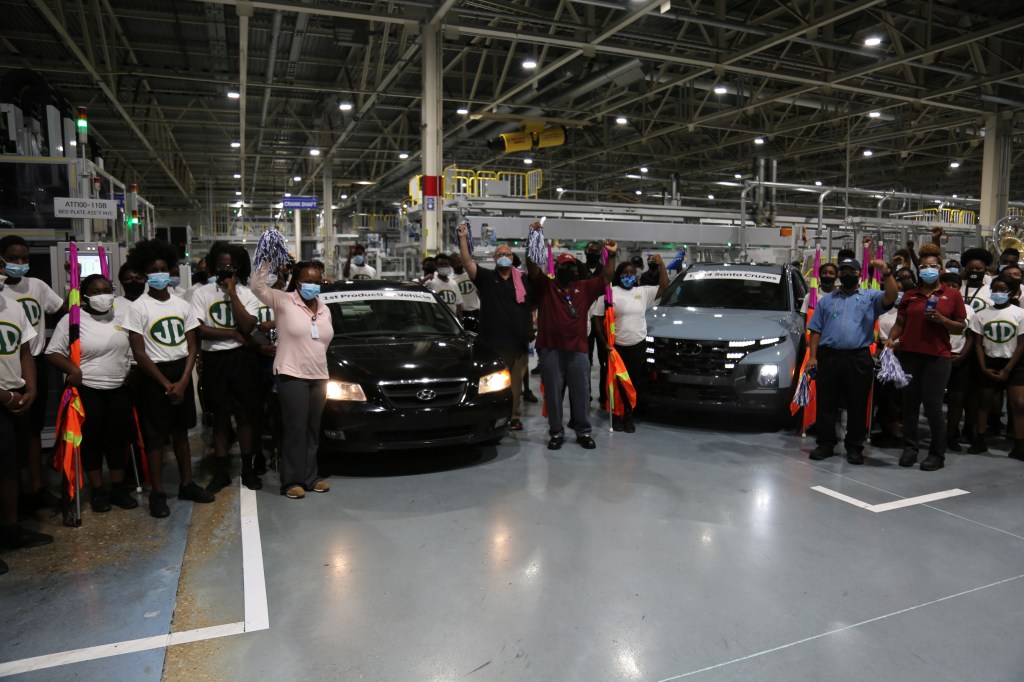
HMMA has reached its 5 millionth vehicle since Hyundai began final assembly operations in Montgomery way back in May 2005. The actual landmark was set when a 2022 Hyundai Santa Cruz rolled off the line, to great cheers from the workforce, joining the plant’s foregoing production of 2,562,880 Sonatas, 1,489,568 Elantras, 908,779 Santa Fes, 36,989 Tucsons, and 1,784 Santa Cruzes, the latter two models added to Montgomery’s menu of products following a major expansion of the plant. Progress marches onward!
It’s an imperfect analogy, but until the late 1930s, you could buy a new Cadillac with three possible engine selections, depending on the model: You could start with a V-8, which Cadillac did a lot to pioneer as an engine configuration when General Motors was first acquiring Northstar; or you could get a car with a V-12, or even a V-16, depending on what your wallet could handle. Amid the megabuck bustle of Monterey Car Week, Bentley Mulliner chose the world’s most extravagant automotive event to launch its new Flying Spur Mulliner luxury sedan. Bentley Mulliner, for the uninitiated, is the commissioning division for bespoke high luxury at Bentley, in addition to being the oldest coachbuilding concern in the United Kingdom. As we’ll see, the Flying Spur Mulliner is the first-ever electrified automobile to bear a Mulliner nameplate. Which, naturally, it does.
You can select this ultra-premium luxury – and performance – sedan with one of three powertrains, two of them comparatively conventional. A twin-turbocharged 4.0-liter V-8 urges the Flying Spur Mulliner to 60 MPH in four seconds flat with a claimed top speed of 198 MPH. Step up to the twin-turbocharged W-12, with three banks of four cylinders and 6.0 liters of displacement, and the top end jumps to a claimed 207 MPH. What’s really new here, though, is a hybrid powertrain centered around a new-generation V-6, whose output is described as 4.1 seconds for the 0-60 sprint and maximum velocity broadcast at 177 MPH. Gotta admit, those 22-inch alloy wheels – with self-leveling center caps that keep the Mulliner logo upright while the wheel’s spinning – get the all-important stance just right, which isn’t always the case in the this class. And being a Bentley, the Flying Spur Mulliner’s got luxury: Each one of the embroidered diamonds in its upholstery has exactly 712 perfectly aligned stitches, and power-operated Mulliner veneer picnic tables, set into the front seat back cushions, are standard.
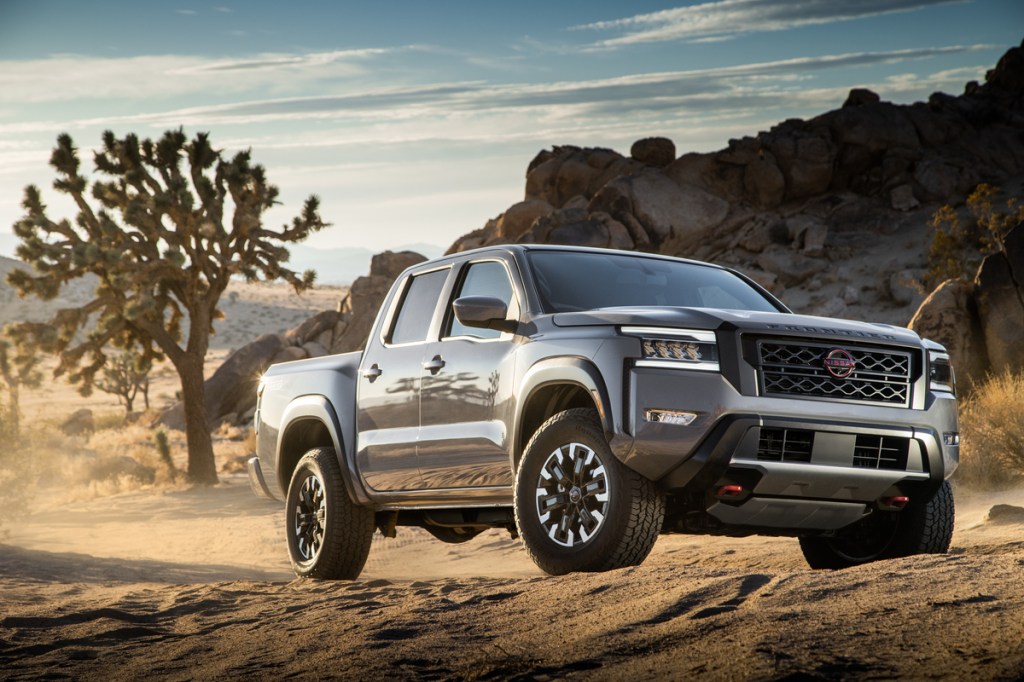
Going truck shopping next month? One of your selections in the midsize pickup world can be the 2022 Nissan Frontier, being rolled out in September with its own birthday present, 310 standard horsepower, best in class among these trucks. The opening gambit is $27,840 for a Frontier S King Cab, representing the Frontier line’s entry model, which means that even the base truck gets a stretched cab.
For most of us, the Frontier will be offered in either King Cab or Crew Cab versions, at the S and SV trim levels. Crew Cabs can be ordered in both short- and long-wheelbase models, with the longer ones offering a full six-foot cargo bed. At the top of the line is the PRO-4X model, which adds Bilstein shock absorbers, an electronically locking rear differential, and four underbody skidplates. A two-wheel-drive PRO-X truck is new for 2022. In any case, the direct-injection engine is mated to a standard nine-speed automatic transmission.
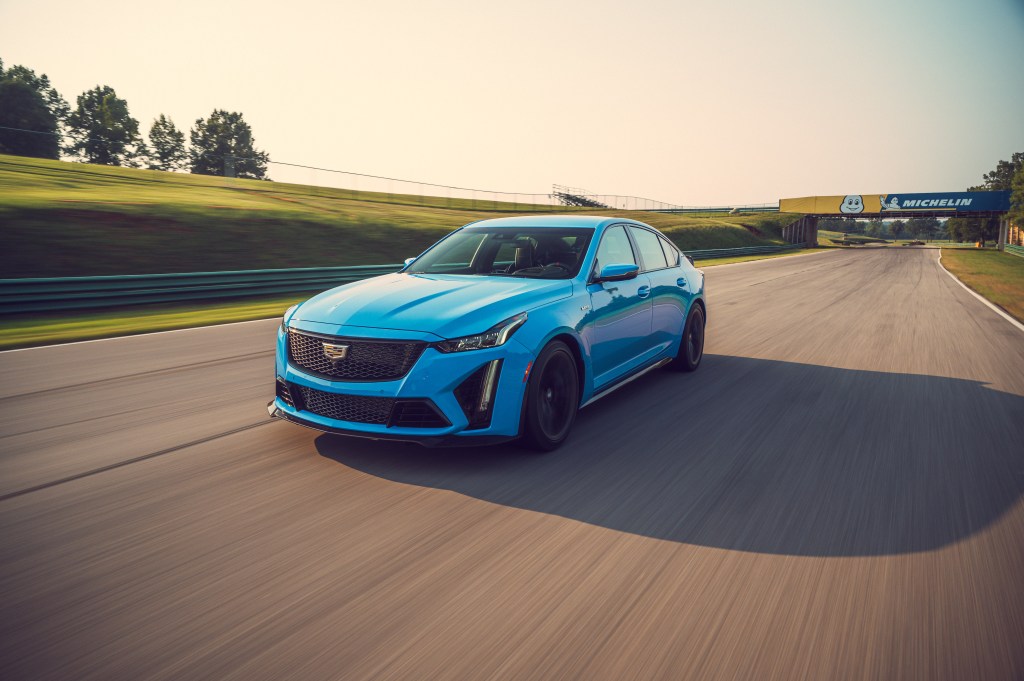
It’s official: The 2022 Cadillac CT4-V Blackwing mega-sport sedan is no longer a manufacturer’s tease, but something you can finally go to the showroom and buy. In an automotive market that is increasingly eschewing sedans, wicked fast and otherwise, the CT4-V stands virtually alone among American automotive offerings. It’s by far the fastest and most powerful production Cadillac in history, with a demonstrated track speed above 200 MPH. You may remember that a while back in this space, we offered a hyperlink where buyers could reserve their own CT4-V or CT5-V Blackwing. It evidently worked, because the first 250 copies of each models were booked with buyers within minutes.
If you’re going to dip your toe in this pond at all, making a dive with the CT5-V Blackwing is clearly the way to go here. This is an extremely serious car: The engine is Cadillac’s 6.2-liter supercharged V-8, rated at a stunning 668 horsepower. A six speed manual transmission – yes, you read that right – is standard. So is an electronic limited-slip differential, and the best downforce numbers in Cadillac history. The CT5-V has a rated 0-60 time of 3.6 seconds with the manual transmission, can pull more than 1 full g on the skidpad, and has a quarter-mile best of 11.30 seconds at 129 MPH. Just the ticket for skinning the Hellcats in your neighborhood. Pricing for the full-on CT5-V Blackwing sedan gets underway at $84,990 – definitely not out of line when you weigh the capabilities here.
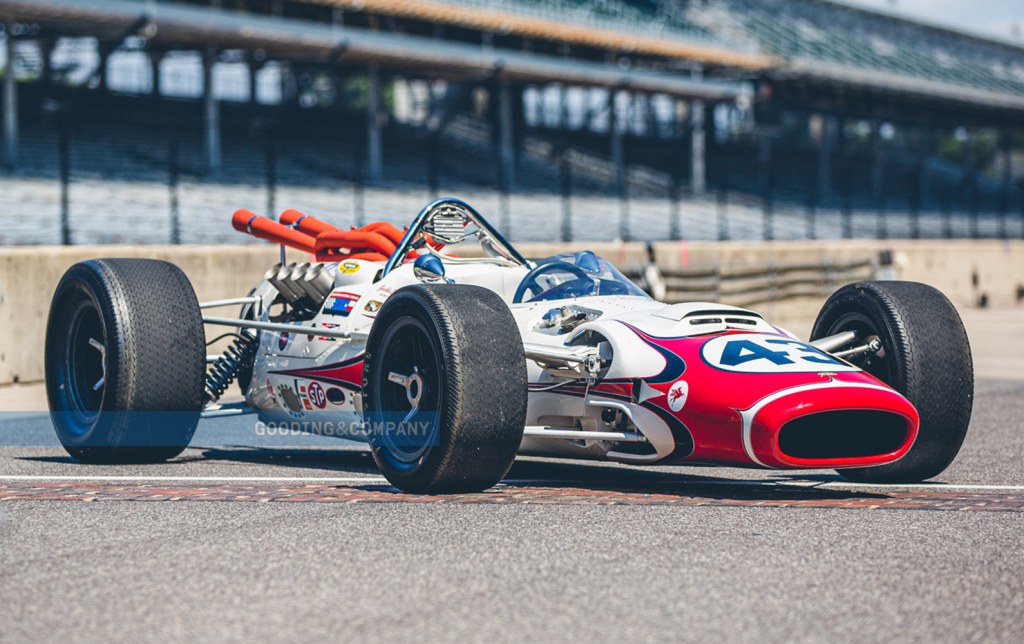
The Texas oilman and bon vivant John Mecom entered two cars in the troubled 1966 Indianapolis 500, marred by the pileup on the initial start that kayoed a third of the 33 starters. Mecom’s pair of new Lola T-90-Fords survived the mayhem. One, driven by Formula 1 champion Graham Hill, was ultimately declared the winner. The other one, driven by rising F1 legend Jackie Stewart, had the race won until the oil scavenge pump quit while he was leading by two laps with eight laps to go. Despite the heartbreak, Stewart was named the 500’s Rookie of the Year and took this car, chassis SL 90/2, to a win from the pole in a USAC race at Fuji, Japan. In yet another example of a fascinating Monterey buying opportunity, this piece of Indy history is being offered for sale by Gooding & Company.
The car went through the hands of historians and collectors Phil Henny and David Uihlein and for a time, was mistakenly believed to be the winning car that Hill drove. The consigner undertook research that proved the Lola’s true identity, and commissioned Walter Goodwin, the acclaimed owner of Race Car Restorations Inc. of Indianapolis, to bring it back to 1966 specifications and correctness, including a proper four-cam Ford racing V-8. This is one of only three T-90s ever produced by Lola, just two of which, the Mecom cars, were powered by four-cam Fords. Fittingly, the pre-sale estimate from Gooding is $1,000,000 to $1,400,000.
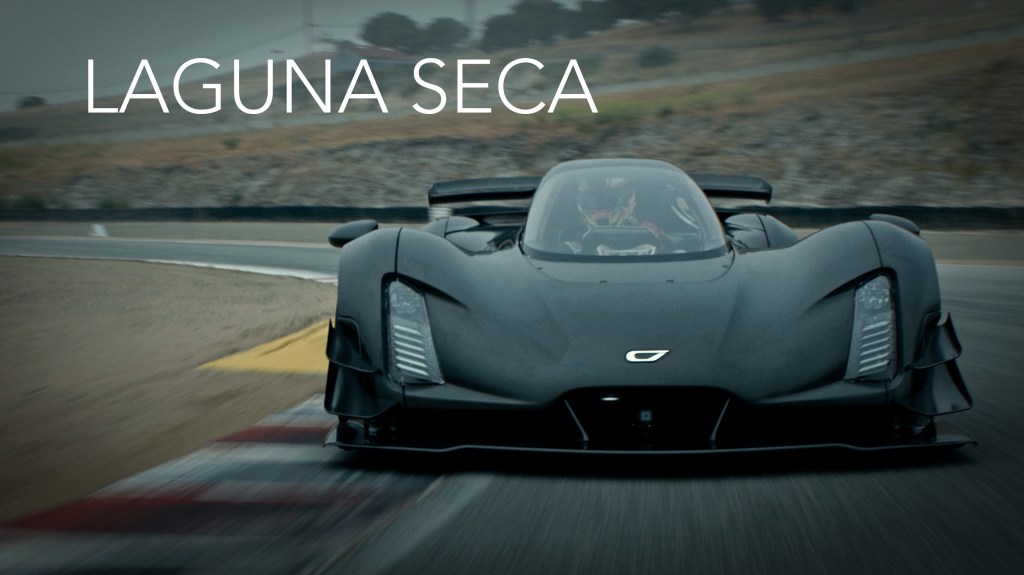
Here’s another example of what Monterey Car Week can inspire. Another guaranteed presence on the peninsula is Czinger, the Los Angeles-based startup that’s preparing to unleash its own supercar, whose performance potential as revealed up to now can only be called staggering. Last week, a pre-production Czinger 21C hypercar drilled the lap record for production-based vehicles at WeatherTech Raceway Laguna Seca, which will be hosting the Monterey Motorsports Reunion during Car Week, arguably the United States’ most prestigious event for historic race cars. With test driver Joel Miller in the seat, the 21C laid down a GPS-verified lap of 1:25.44, knocking more than two full seconds off the previous mark, set by Randy Pobst in a McLaren Senna. The quick lap was set on DOT-legal Michelin Pilot Sport Cup2R street rubber.
Here’s what you need to know: Single center seat. An honest 1,250 horsepower wrapped in a 1,240kg package, providing a claimed power-to-weight ratio of 1:1. All-wheel drive. A hybrid powertrain with true flex-fuel capability mated to a seven-speed manual gearbox. Zero to 400 km/hr – it works out to 248 MPH – in 21.3 seconds, or zero to 62 MPH in 1.9. Claimed top speed, 291 MPH. All we can say is, it’s real, ungodly fast and definitely in the pipeline for about 80 buyers who will actually acquire a 21C.
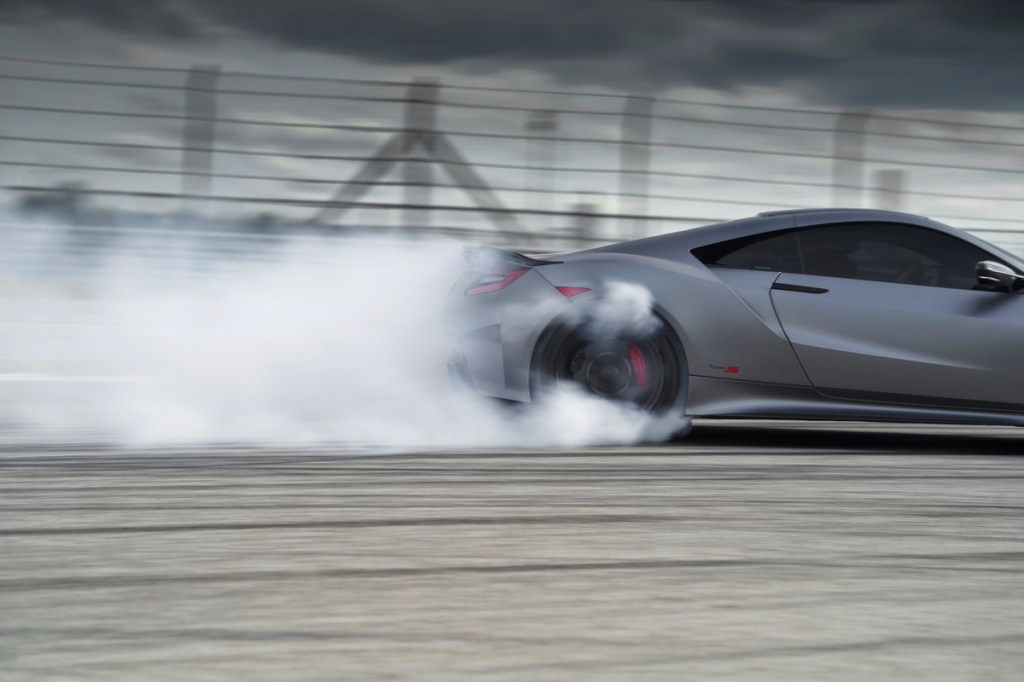
It’s August, which naturally means that Monterey Car Week is right around the corner, a staggeringly spectacular automotive happening encompassing the very best in cars, and which provides endless opportunities to blow a million bucks faster than even Leona Helmsley could manage. Here’s just one example of what we mean. Mecum Auctions, our occasional business partner, is just one of the major auction houses conducting sales of very high-end cars during the Monterey blowout, in Mecum’s case at the former Del Monte estate just outside town. One of the 600-plus vehicles going to the hammer at Mecum will be the very first example, verified by VIN number, of the 2022 Acura NSX Type S, one of just 350 of these mid-engine supercars to be produced, just 300 of which will be reserved for U.S. buyers.
Not everyone likely knows it, but the NSX – for 2022, every example will be a Type S – stands as America’s other mid-engine exotic for the most demanding drivers, produced at the marque’s Performance Manufacturing Center in Ohio, not too far from where its rival, the Corvette C8, is built. It’s a socially conscious screamer, motivated by an enhanced version of Acura’s twin-turbo V6 and Sport Hybrid SH-AWD® system, with actual performance numbers expected close to the official rollout. Whomever gets down the winning bid on VIN 001 will be able to custom-order it to exact personal specifications. Among the beneficiaries from the sale’s net proceeds will be a STEAM (science, technology, engineering, art, math) education program for at-risk or underserved youth through a partnership between Acura and the Center for Science and Industry of Columbus, Ohio. Can’t make Monterey? Click your mouse here and you can reserve an NSX Type S of your very own.
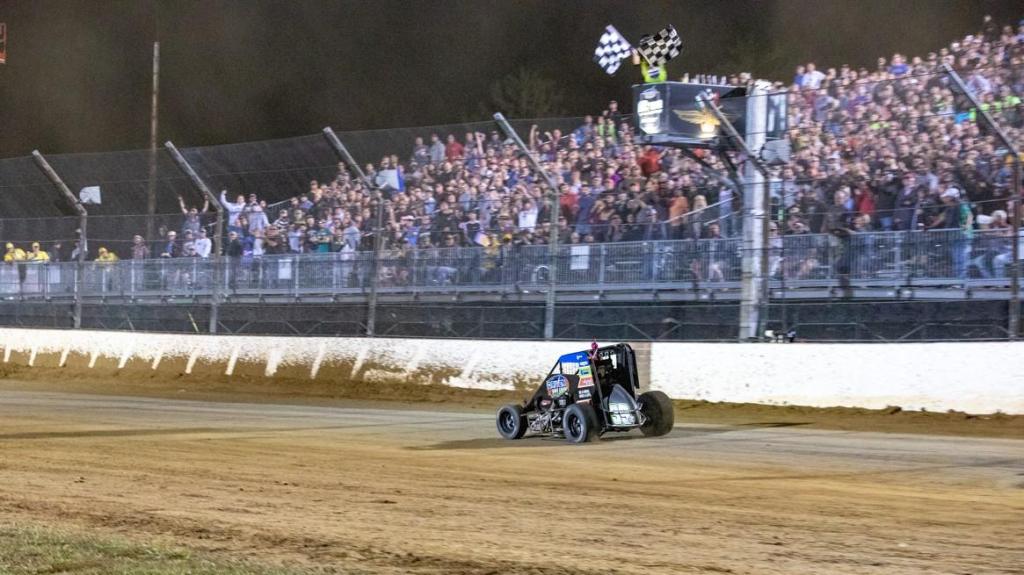
The gold standard in American motorsport is the Indianapolis Motor Speedway, whose century-plus of lore has grown to encompass the myriad disciplines that compete at racing’s holiest shrine. As most people know, it doesn’t always involve the big rectangular oval. A few years ago, IMS management scraped a dirt bullring out of the third turn infield, not far from where today’s Snake Pit is located, and has been putting on a stellar summer gathering for Midget drivers, part of the Speedway’s great grass roots, ever since then. The race is called the BC39, to honor the name and car number of the late Bryan Clauson, a USAC open-wheel superstar and three-time Indianapolis 500 veteran who died in a crash at a landmark Midget event, the Belleville Nationals in Kansas. Last year’s BC39 was a COVID casualty, but it’s back this month, set for August 18-19 at The Dirt Track at Indianapolis Motor Speedway.
The above photo by my pal Steve Koletar gives you an idea just how much enthusiasm the BC39 attracts. The already-swelled entry list for the 2021 running has just grown with a fitting addition: Ryan Newman, who owns wins in both the Daytona 500 and Brickyard 400 in addition to a USAC Silver Crown title. Another new entrant is Indianapolis native Tyler “Sunshine” Courtney, a USAC open-wheel standout who’s recently taken to racing under a wing with marked success, banking a $175,000 to win one of the Kings Royal runnings that took place at Eldora Speedway in Ohio. More entrants include a pair of California shoes, current USAC Silver Crown champion Justin Grant and two-time 2021 USAC Midget winner Thomas Meseraull. Besides Newman’s, more NASCAR flavor will come from 2020 Cup champion Chase Elliott, who proved he’s got a taste for Midgets by showing strongly at the Chili Bowl Nationals in Tulsa. Indianans Conor Daly and Chase Briscoe, from IndyCar and NASCAR Camping World trucks respectively, have also filed paperwork along with the BC39’s two winners to date, Oklahoma’s Brady Bacon – I’ve got his T-shirt – and Zeb Wise of Angola, Indiana, where there’s a really cool high-banked paved half-mile speedway.
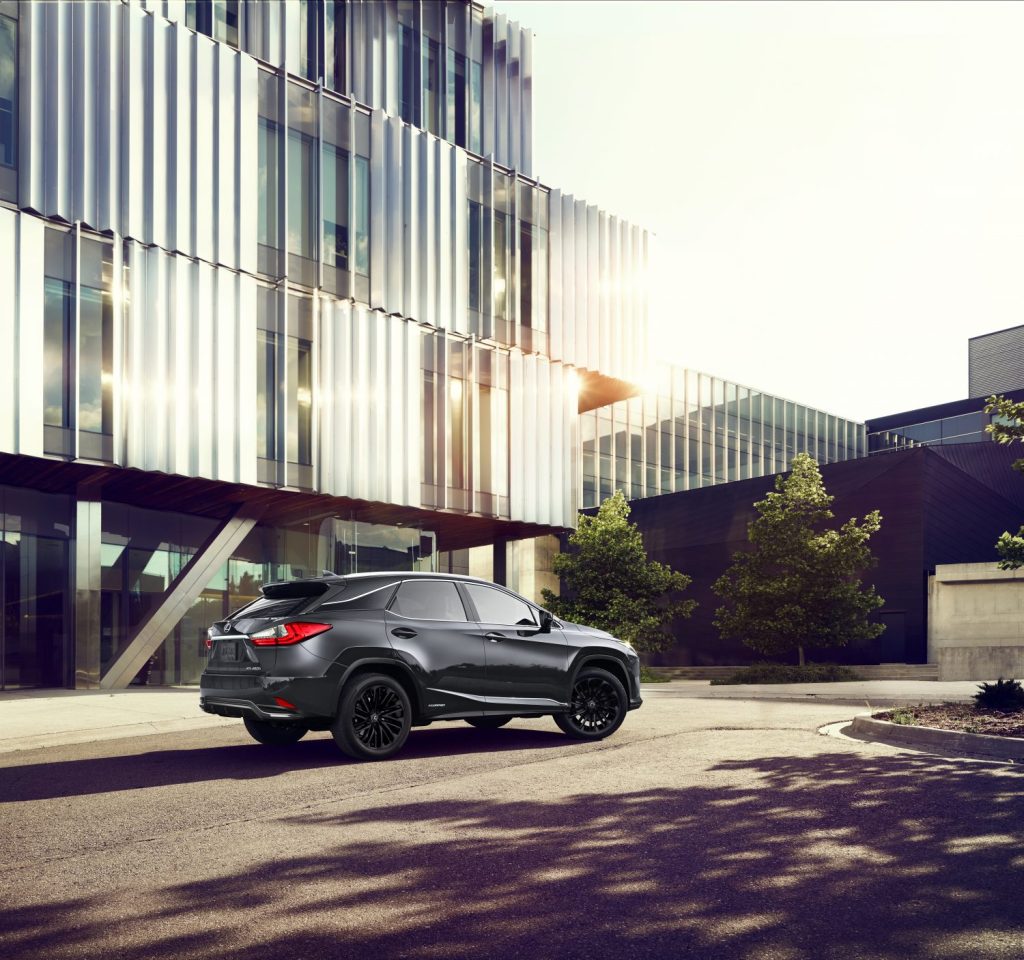
One the popular appearance packages for upscale SUVs at Lexus has been the limited-availability group of goodies known as Black Line, aimed at escalating an already abundant lineup of features and appearance still further. The Black Line will be offered in 2022 on special editions of the RX 350 and RX 450h models. Agai, this is a matter of limited availability, with total Black Line production limited to 2,500 units – 2,100 of them with internal-combustion power, the remaining 400 slated to be hybrids. Both models will incorporate the premium Lexus RX trim level.
Black Line editions of both SUVs will be available in two overall colors, Eminent White Pearl and Caviar, the latter produced with an all-black interior. The interior fittings will include open-pore wood trim and light gray stitching on black NuLuxe seating. The stitching carries through to the center console, steering wheel and upper instrument panel. It all rides on black 20-inch alloy wheels with matching lug nuts. All this sinister-looking sorcery will start at $49,450 for a front-drive Black Line RX 350.
Fittingly, you could say, the U.S. auto industry last went through a revolution akin to the one that’s about to embark right around 100 years ago. The United States was muddling through a post-World War I recession that combined with rising economies of scale in the booming car businesses to drive several thousand mom-and-pop automakers into the ranks of history. This great economic weaning produced the Big Three as we know it, and formed the framework of the industry for close to the next half-century. The current revolution won’t be nearly so bloody, but will still transform our relationship with motor vehicles as nothing else in our lifetimes, and we’re including the OPEC crises in this calculation. The details will emerge later today, but the Biden administration took to Twitter this morning to call for half of U.S. new-sales to use batteries, fuel cells or hybrid gas-electric powertrains by 2030, in addition to new, forthcoming requirements on fuel efficiency and emissions reductions through 2026.
The day’s still young, but the tweet generated a nearly instantaneous response from the industry, led by a joint statement this morning from General Motors, Ford and Stellantis. “Our recent product, technology, and investment announcements highlight our collective commitment to be leaders in the U.S. transition to electric vehicles,” reads the statement. “This represents a dramatic shift from the U.S. market today that can be achieved only with the timely deployment of the full suite of electrification policies committed to by the administration in the Build Back Better Plan, including purchase incentives, a comprehensive charging network of sufficient density to support the millions of vehicles these targets represent, investments in R&D, and incentives to expand the electric vehicle manufacturing and supply chains in the United States.” A similar statement followed within minutes from BMW, Ford, Honda, Volkswagen, and Volvo Cars, which form the so-called “California Framework” of manufacturers who jointly opposed a previous administration’s attempt to roll back emissions and economy objectives in that state, which constitutes the world’s fifth-largest economy. Obviously, not everyone will agree with this, and some will shout that EVs are being jammed down buyer’s throats, or some other windy equivalent. Here’s a fact to consider: According to Reuters, the global auto industry has pumped more than $90 billion of investment – that’s private capital, not taxpayer support – into engineering alternative-power vehicles that right now constitute barely 1 percent of overall sales. A lot of that is aimed at the booming market in China, which has had quotas in place for EV sales since 2019. The industry’s level of intelligent risk in making the investments is tangible proof that they believe U.S. buyers will embrace today’s longer-range, quick-recharge EVs in an equally big way. Half the market will buy then because they want to, not because they have to. It’s that free-market thing in effect.


 Jim Donnelly On Wheels