Will a new Maranello engine stop the Mercedes-Benz parade?

Another week. Another outing for Formula 1 in some exotic locale. And seemingly, that means another 1-2 sweep of the grid by Mercedes-AMG Petronas F1 team, with either Lewis Hamilton or Valtteri Bottas snagging the checkers. The esteemed equipe of Ferrari has pretty much been relegated to the Best of the Rest in 2019, with Sebastian Vettel and Charles Leclerc handling the driving chores. That might change coming into this weekend’s Spanish Grand Prix at Barcelona.

Ferrari is coming into the Catalunya circuit with a new powertrain combination, centered around a revised version of the 1,600cc V-6 that powers the SF90, an engine that was supposed to make its debut later in the F1 season at Montreal. Scuderia Ferrari team principal Mattia Binotto explained that “it’s time for the Spanish GP, traditionally a race where most of the teams bring some updates, therefore we can expect to see a step up in performance from our competitors. We are currently behind in the championship and we have to catch up, which we know means that our development work will be the key to this season. Having brought a new aerodynamic package to Baku, we will also bring some developments in this area to Barcelona.
Binotto added that “on top of that, we will have a new power unit that we are introducing ahead of schedule, as the second specification was due to be brought to Canada. Shell, in close collaboration with our team, has developed a different formulation of race lubricant that will also be introduced with the new power unit, delivering increased performance.
It’s only down to a big team effort with everyone pushing hard to make up ground that we have been able to bring these developments forward.” Here’s where you can keep up with the Maranello team’s exploits on the world stage.
Another luxury Volkswagen steps up to the plate

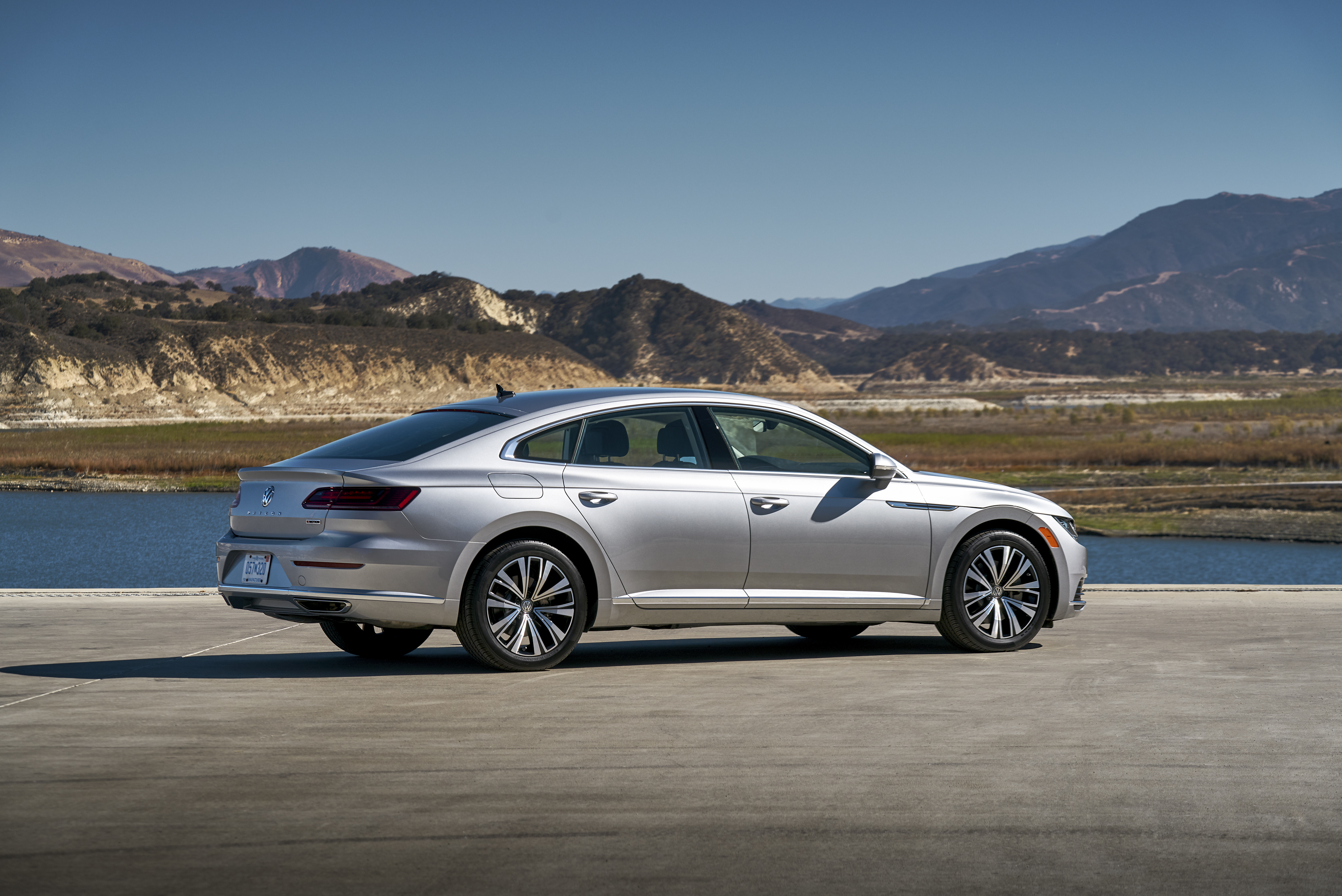
It’s called the Arteon, it’s a 2019 model, and it represents a new conveyance to travel down a road that Volkswagen’s traveled before, with mixed results. You may remember the Phaeton, the Audi-based large sedan with available W-12 power, which sold in numbers that barely constituted a trickle. Volkswagen enjoyed markedly better market performance with the slick, four-door CC. The Arteon is all-new, but it still represents a refinement of that concept, the idea that people will pay for a capable “four-door coupe” with a high level of appointments.

This much is certain, the Arteon certainly has it in the looks department, taking its name from a modification of the Latin word for art. It’s the production version of a design concept that Volkswagen first presented three years ago at the Geneva salon. The Arteon has much more in common with the CC in terms of packaging and affordability than it did with the Phaeton. The Arteon’s 112 inches of wheelbase span a variant of Volkswagen’s MQB platform, and either front-wheel or all-wheel 4Motion drive can be chosen by the buyer. The sole power sources is a 2.0-liter turbocharged TSI four-cylinder engine with start-stop technology, coupled to an eight-speed automatic transaxle with Tiptronic manual shift capability. DCC active suspension damping is standard across the board. Standard interior accoutrements include a fully digital dash with an 8.0-inch touchscreen handling vehicle function and navigation, depending on the model. Suggested pricing ranges from $35,845 for the Arteon SE to $44,945 for the maxed out Arteon SEL Premium.

Is there new life at Lordstown?

No question, it’s not been the best imaginable month for General Motors in terms of good-neighborly public relations. The massive, historic assembly plant at Lordstown, Ohio, ceased operations after its final vehicle, a 2019 Chevrolet Cruze LS, rolled off the line, leaving hundreds of employees who had toiled in the 6.2 million-square-foot factory uncertain about their futures. Lordstown was perhaps best known for producing the ill-starred Chevrolet Vega beginning in late 1970, but the plant successfully built numerous other GM vehicles over the decades.

The workforce at Lordstown has endured nervousness about its future ever since the final Cruze was built in March. Several hundred Lordstown workers have since successfully applied for transfers to other GM plants including Flint, Michigan, and Spring Hill, Tennessee. This week came some more locally positive news: GM disclosed that it’s now in talks to sell the entire Lordstown complex to the Cincinnati-based Workhorse Group, Inc., a manufacturer of electric vehicles and propulsion systems. GM reported it could lead to “significant” numbers of Workhorse hires at Lordstown, although exact numbers were not discussed in GM’s media announcement. On a more precise positive note, GM said it’s creating more than 450 new manufacturing jobs at its facilities in Moraine, Parma and Toledo, Ohio, where the new employees will work at building diesel engines for pickups, metal stamping and laser-cell welding of body components and development of a new 10-speed automatic transmission for trucks and SUVs, respectively.

What hath W.O. wrought now?

Two months from now, July 2019 to be precise, Bentley will mark its 100th year of building unique, inspiring automobiles. Yes, it’s been that long since Walter Owen Bentley pulled the first car to bear his own name out of New Street Mews in London in 1919, the same year my mother was born. W.O., as he became known, was outspoken in his disdain for motorcars of the late 19th and early 20th centuries, dismissing them all as overly loud, crudely executed and cobbled together from cheap materials. The cars this former railway man went on to create have always embraced Bentley, the man’s, opposite view: That they should be supremely comfortable, fast and elegant.

Among many other activities marking its centenary this summer, Bentley has remained faithful to its roots, regardless of having been acquired by Volkswagen AG in 1998 and the shocking step of adding an SUV to its model lineup. One of the special celebrations has been the announcement of a very limited run of the marque’s signature sedan, the Mulsanne, in a new W.O. edition with coachwork by in-house body fabricator Mulliner. This studio image shows the Mulsanne W.O. Edition posed alongside the 8.0-liter sedan that was the last car W.O., who died in 1971, personally designed and built. Only 100 examples of the W.O. Edition will be produced for the global market. Each one will be fitted with individualized engineering pieces taken directly from the 1930 8.0-liter, with no two of the W.O. Editions being exactly the same. For pricing and other data, see the extensive Bentley website; we’ll look at some more Bentley milestones as the big birthday approaches.

A major victory in road racing goes home with – Hyundai?

Any number of car companies have been strongly associated with racing, especially on road courses, for nearly their entire existence. The august brands of Ferrari, Jaguar and Audi (it was Auto Union back in the 1930s) come immediately to mind. And it looks increasingly like another manufacturer’s looking to claim some of that victory gold. It’s Hyundai. Yes, we said Hyundai. No, it’s not a typo or the weird result of some kind of uncontrolled free association.

Instead, it’s the result of a new alliance between the South Korean industrial powerhouse and an established American race team best known for its distinguished accomplishments in Indy cars. Hyundai has teamed up with Bryan Herta Autosport, whose namesake owner has won the Indianapolis 500 as a team boss and had his own career in the hot seat of those wheeled missiles. Running factory-backed Veloster N TCR coupes in the IMSA Michelin Pilot Challenge Series, BHR notched a win last weekend in only its third outing paired with Hyundai, at the Mid-Ohio Sports Car Course. It was Hyundai’s first victory in IMSA competition. The winning race-bred Veloster was shared by co-drivers Michael Lewis and Mark Wilkins. After a mid-race driver change, Lewis outdueled spirited teams from Honda and Audi to claim the victory. IMSA was sufficiently impressed to award BHM the Forgeline Spirit of the Race Award. You can watch this piece of Hyundai history when NBCSN televises the race this coming Saturday at 11 p.m. EST. Think we’ll see a Sonata running in NASCAR someday? To learn more about this landmark win, check out the team website.

It’s not just automotive design. It’s practically magic

Most everyone knows that the building of automobiles has been a global undertaking for some time now. It’s totally typical to have engineers on multiple continents handling various aspects of a new-car project such as powertrain, electronics or styling. Ford has taken this mindset to its logical conclusion by adopting technology that allows engineers and designers to make running changes to a prototype, even if it exists only as a virtual image, in real time, no matter where the engineering expertise is located.

Ford is the first automaker to make use of Gravity Sketch, a new 3D virtual-reality tool that allows engineers to conjure up a large-scale auto design from, literally, nothingness in the freedom of their design studio, regardless of where it’s located. The program or tool that allows this is called Co-Create. You can see it in action in the photo of a Ford designer working on changes to the GT supercar. Donning virtual-reality goggle sets allows any number of designers to work collaboratively on a complex design project whether they’re in Dearborn or Abu Dhabi. “The Co-Creation feature adds more voices to the conversation in a virtual environment, which results in more efficient design work that may help accelerate a vehicle program’s development,” says Ford Design Manager Michael Smith. Co-Creation actually allows design teams to skip the time-honored practice of two-dimensional modeling in its entirety. Expect Ford to utilize Gravity Sketch more broadly as new models continue coming to market.

For 2020, a bright new smile for the Camaro SS

In all honesty, I wasn’t that taken with Chevrolet’s re-envisioned Camaro when it made its first appearance on the streets. Compared to the new Dodge Challenger and Ford Mustang, I didn’t think it was as strongly evocative of its roots as its competition from Ford and (then) DaimlerChrysler tried to be. But time passed, and I found myself being increasingly smitten with the Camaro. Attentively, Chevrolet pursued appearance tweaks during the car’s life cycle that I found pleasing to the eye.

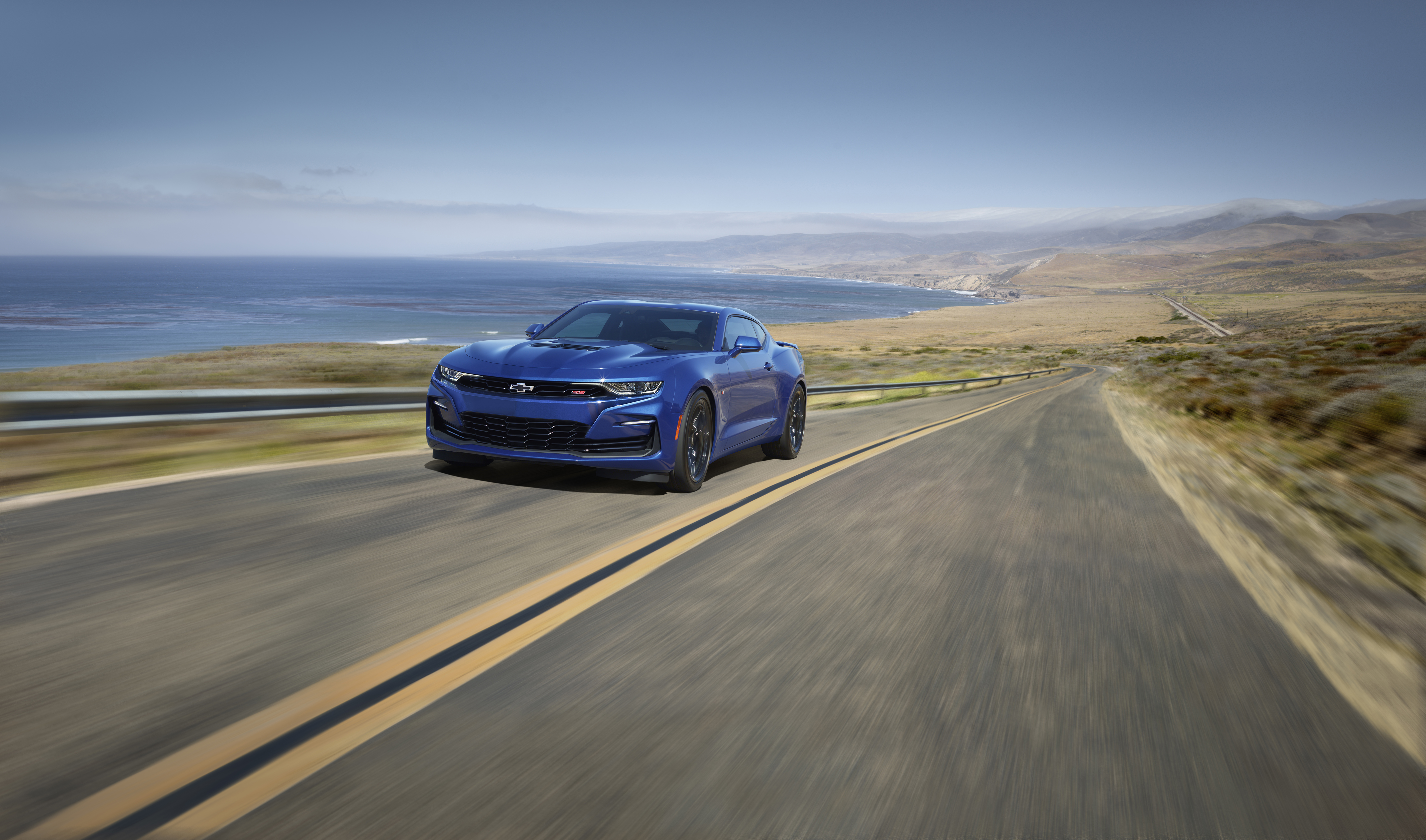
And lately, Chevrolet’s been at it again. The manufacturer just announced changes that will be coming to the Camaro lineup in 2020, led by a frontal restyling of the Camaro SS. The SS gets narrower, better-integrated headlamps, a vented hood, and the iconic bowtie emblem is relocated to the center upper grille, with a new body-colored bar separating it from the lower grille and air intake. The new look borrows heavily from the Camaro Shock prototype that was favorably received at last year’s SEMA show in Las Vegas. Along with the new appearance, the Camaro will be offered with a new LT1 V-8 whose availability will extend to the SS model. With 455hp on tap and a projected MSRP of less than $35,000, Chevrolet expects both the LT1 Camaro and the Camaro SS to represent an affordable path to genuine performance. But the base V-6 Camaro hasn’t been ignored: In 2020, you’ll be able to mate that 3.6-liter engine with a new 10-speed overdrive automatic transmission.

A Flemington hero, a fan favorite, gone way too soon

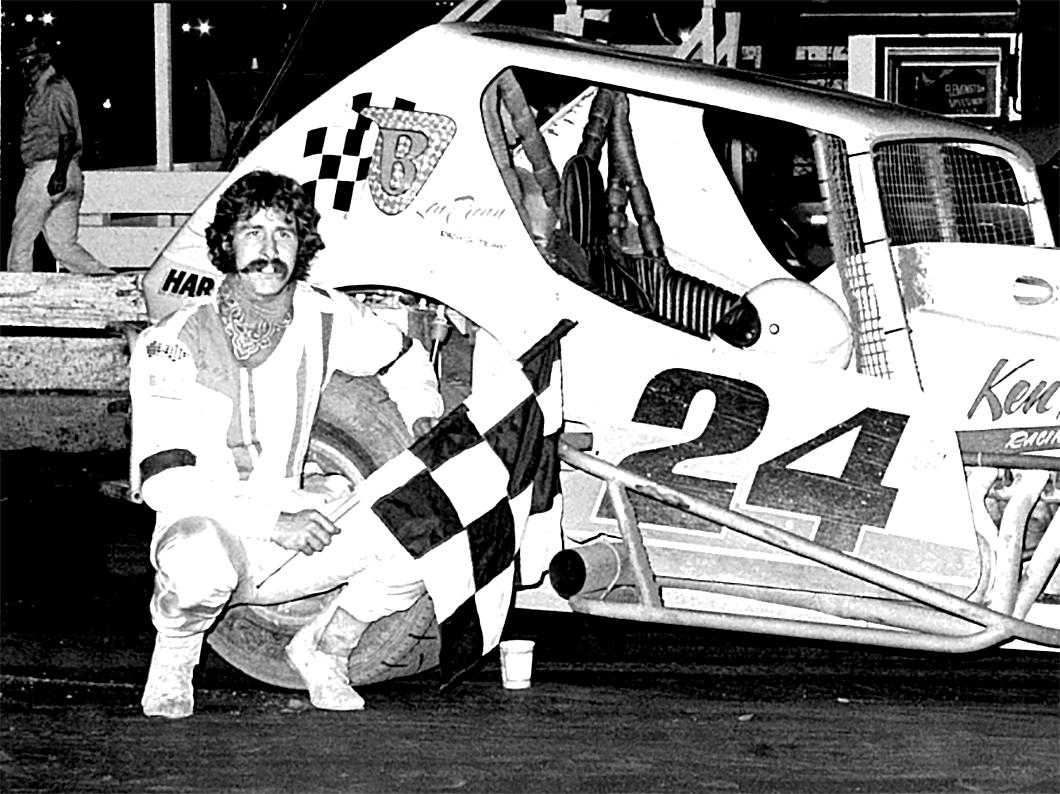
Above my desk hangs a framed pencil sketching of Turn One at the immortal Flemington Fair Speedway in central New Jersey. I spent a lot of nights at that track. The drawing was given away in 2008 in Atlantic City, which was where the Motorsports show presented by Area Auto Racing News was then held. The show featured a panel of Flemington stars who then sat down to put their autographs on the sketch. One of them was Ken Brenn Jr., a long-haired, mustachioed Jersey cowboy who stood fourth on the intimidating square-shaped dirt track’s all-time win list. I treasure that autographed drawing and I’m looking at it now, and Ken’s signature, considerably saddened. Ken Brenn Jr. died suddenly last week. He was only 66.

This photograph by George Gordon, used courtesy of AARN, depicts Ken the way I used to remember him. He came from a racing family; his father, Ken Sr., fielded Midgets and other open-cockpit cars for others to drive. They were invariably beautifully turned out and meticulously prepared. When Ken Jr. came of driving age, the Midgets were fading in the Northeast and his father stepped into the dirt Modifieds as a team owner. His cars were welded together by open-cockpit fabrication geniuses like Budd Olsen (before he, too, starred in Modifieds), Grant King and Floyd Trevis. Ken Jr. became the very first Rookie division champion at Flemington in 1972, ran through the Sportsman ranks and later moved smartly into the full-powered Modifieds, where he scored 59 career feature wins at Flemington. The younger Brenn was always fast at East Windsor Speedway in New Jersey, and at the dirt mile at the New York State Fairgrounds in Syracuse, although victory always eluded him there. Before his untimely passing, Ken was comfortable as an elder statesman of one of dirt racing’s wildest and most unpredictable tracks. He had enormous talent and will be missed. Thanks for everything, Ken.

What if Fireball Roberts hadn’t died so young and tragically?

It was 1964, a grim year in American racing history, when drivers were incinerated at both the Indianapolis 500 and a comparatively new marquee event at Charlotte Motor Speedway, the World 600. That race had barely gotten underway when the early NASCAR hero, Glenn “Fireball” Roberts, got ensnared in a tangle that also involved Ned Jarrett and Junior Johnson. Roberts’ Holman-Moody Ford got driven tail-first into the butt end of the inside backstretch wall. The car flipped inverted and the racing gasoline from its nearly full tank instantly erupted. Because he suffered from asthma, Roberts never dipped his driving uniform in fire-retardant chemicals, which was an accepted practice at the time. Horribly burned, Roberts lingered for a month before dying from complications that included pneumonia and blood poisoning. He was only 35 years old.

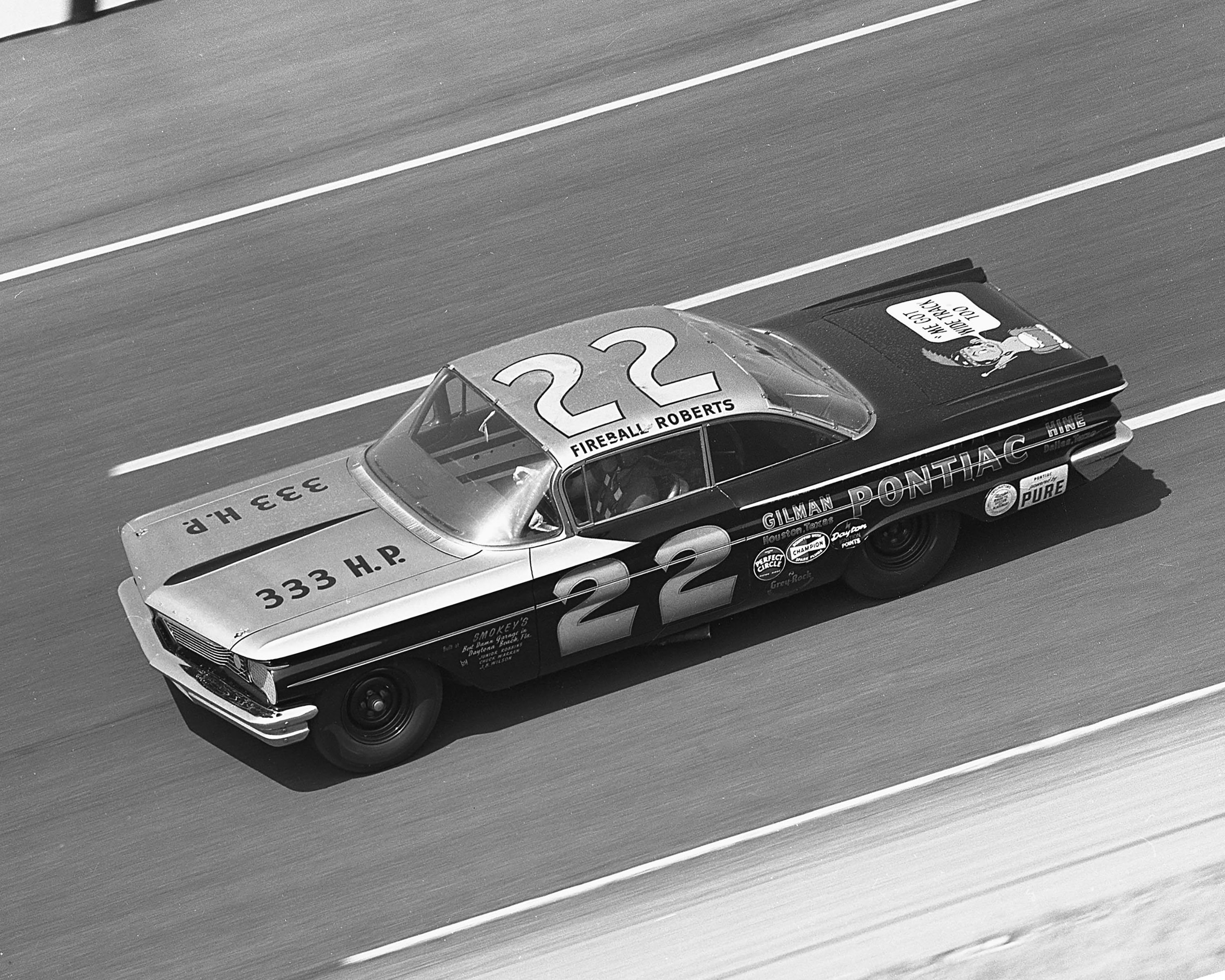
Though his nickname stemmed from hurling fastballs during sandlot baseball in Apopka, Florida, and not from driving race cars, Roberts had been around the wheeled sport for a long time, running his first race on the short oval at North Wilkesboro, North Carolina, in 1947. He was a reliable winner in both Modifieds and then in the Grand National division, including on the sand at Daytona Beach, but his rise to true superstardom was abrupt and meteoric. It began in 1956, when he was invited to join the factory Ford team run out of Charlotte by Indianapolis 500 winner Pete DePaolo. In 75 starts – the NASCAR schedule was considerably busier in those days – Roberts scored 13 wins and 38 top-fives. The win streak continued and in 1959, Roberts teamed up with his fellow Daytona Beach resident, the self-taught mechanical genius Smokey Yunick, to run Yunick’s stable of black-and-gold Pontiacs. The 1960 model here in this photo by ISC Images and Graphics typifies these cars.

This particular shot shows Roberts wiring the field in one of the twin qualifying races for the 1960 Daytona 500. Roberts was an utter terror at Big Bill France’s banked superspeedway, scoring seven wins even though the track only dated to 1959. In 1962, he swept both major NASCAR races at Daytona, in addition to winning the pole for that year’s Daytona 500. Ford lured him away from the Yunick fold to race for Holman-Moody, which had taken over its Charlotte factory operation from DePaolo. Yet despite his relative youth, Roberts was already talking about hanging it up. He had an offer from Falstaff beer to become their spokesman, and he’d already proven that he was up to the task. In a decidedly rough-edged sport, Roberts was erudite, athletically handsome and possessed an easy charm. He’d already been named NASCAR’s most popular driver and was comfortable in front of cameras. In short, Roberts was NASCAR’s first media superstar despite the sad brevity of his lifetime. For every Richard Petty, Darrell Waltrip and Jeff Gordon who came later, Roberts was the prototype. It’s very easy to envision him growing beyond his beer PR gig and transitioning into broadcasting as the sport began to expand beyond its Southern base. Fireball Roberts was one of the great ones. It’s appropriate to remember him as NASCAR returns to Charlotte to run the 600-mile grind later this month. In 2014, he became part of the NASCAR Hall of Fame’s fifth class of inductees. The Charlotte-based hall’s website can tell you about Roberts and the other inductees to have been enshrined or nominated.

Richard Hoffman, 1943-2019

Especially if you’re from the Midwest, and follow the wingless Sprint cars of the U.S. Auto Club, you knew this guy, or at least knew the gorgeous race cars that he and his family fielded and the legion of drivers he shepherded to stardom. Richard Hoffman, who hailed from the Cincinnati area, died April 30 at the age of 76.

This image, from the Facebook page of Hoffman Auto Racing via USAC, depicts the man in his element. Richard inherited his love of dirt track auto racing from his father, Gus, who first fielded a Sprint car in USAC’s inaugural year of 1956. Richard’s son, Rob, later joined the family effort, hallmarked by green, white and orange Sprint cars that stood out even amid the flash of USAC’s “Thunder and Lightning” division. Hoffman’s cars won 117 USAC features and captured 11 national championships in the Sprint division, with drivers Rich Vogler, Robbie Stanley, Dave Darland, Tracy Hines, Jerry Coons Jr. and Brady Bacon. The Hoffmans also dabbled in Indy cars, fielding cars for Larry “Boom Boom” Cannon, Joe Saldana, Jerry Sneva and Spike Gelhausen. The Amsoil-backed national Sprint cars make their enthusiastically received East Coast swing next month; you can get the full schedule on the USAC website.