Looking at a landmark Lotus

If you know anything at all about auto racing journalism, you know who Pete Lyons is. Born in New York, Pete moved to California and in the 1960s, became one of the world’s most acclaimed racing photojournalists. He’s best known for intimately documenting the outrageous Can-Am series for unlimited sports cars, but Pete also spent countless hours chasing and documenting other genres of motorsport. One of them was Formula 1, which leads us to this, his latest work. Lotus 72 is an in-depth story about the development of the first truly great F1 car of the 1970s, brimming with innovation.
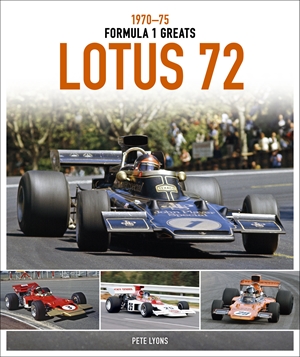
Lotus 72, the book, is a look at how this landmark car came to be, and what it accomplished. Jointly designed by Colin Chapman and Maurice Phillipe, the 72 was an early but highly influential study of incorporating aerodynamics into the F1 toolkit. Its wedge shape was borrowed from the Lotus 56 gas turbine cars that Chapman had designed to race in the Indianapolis 500, and that theory was expanded by the 72’s incorporation of inboard disc brakes, side-mounted radiators and a huge overhead airbox, technologies that soon became standard practice. Just nine Lotus 72 chassis were ever built, but they had outsized influence in contrast to their numbers: Jochen Rindt drove the works 72 to multiple victories before being killed at Monza; he won the 1970 world championship posthumously. And Emerson Fittipaldi – who contributes the foreword here – used the 72 to win his first world title in 1972. Pete takes 320 large-format hardcover pages to tell the story of this groundbreaking car, illuminated by more than 360 photos, including his own. This title is simply a must for anyone interested in F1’s technical history and the unfettered genius of Chapman. It’s available for $79.95 by Quarto as part of its Formula 1 Greats series of titles.

Ford vs. Ferrari, the epic story as it really happened in the 1960s

We’re less than a month away now from the theatrical release of Ford v Ferrari, the dramatized tale of the struggle for racing supremacy between the Ford Motor Company and Ferrari, a savage rivalry that had its roots in Henry Ford II’s failed effort to buy out Enzo Ferrari. The manufacturer’s war that followed had its culmination in Ford’s 1-2-3 finish at the 24 Hours of Le Mans in 1966. The book we’re reviewing here isn’t a rehash of the movie plot, but instead a concise recounting that the forces that made the worlds of global auto production collide with the Machiavellian, old-world fiefdom of hand-crafting exotic cars for competition on the world’s greatest circuits. Ford Versus Ferrari only takes a little longer to absorb than the film probably will, and it’s authored by one of the world’s current lead authorities on motor racing history.

Just to repeat, this is not a book based on a movie script. The author, John Starkey, is a Briton now living in Florida who restores and writes about international racing cars from this era, most notably the creation of Lola and Porsche. This 128-page softcover volume tells the story of how Eric Broadley’s first Lola GT indirectly morphed into the famed Ford GT that crushed Ferrari’s finest. All the real-life characters from the film take turns in the text, including Carroll Shelby, Ken Miles, Dan Gurney and also Ferrari’s lead driver, the great Englishman John Surtees. It’s hard to imagine any two manufacturers going at it today in such an openly hostile struggle for supremacy on such a global stage. Ford Versus Ferrari is an authoritative telling of an incredible story in a format you can easily get through in one night. It is certainly worthy of a read. The book comes from Veloce Publishing Ltd., costs $19.99 and can be ordered through Motorbooks in the United States.

Ford views an all-electric motoring future in a big way

We’ll say it again: Ready or not, electrically powered automobiles are here to stay and they’re going to be coming at us en masse during the coming years. To that end, the Ford Motor Company has announced plans to create and offer North America’s largest charging network for electric vehicles, consisting of more than 12,000 charging locations across the continent supporting up to 35,000 individual charging plugs. Drivers will be allowed to access a new FordPass app on their mobile phones or through an electric vehicle’s on-screen dashboard, which will allow drivers to locate a charging station, following the progress of the charge and, yes, pay for their fresh load of juice.

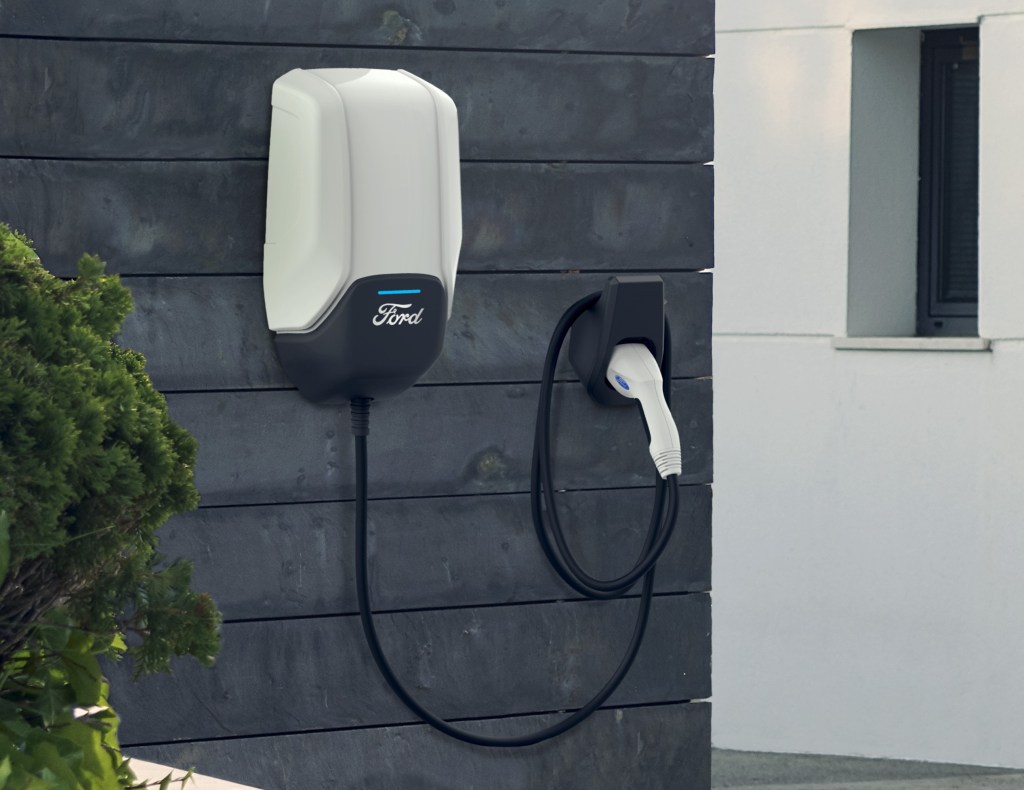
Industry observers generally agree that one obstacle to widespread acceptance of electric vehicles is buyer concerns about where they’ll be able to find a place to get them recharged. Ford says its network will be the biggest in North America, and should help to alleviate those worries and just maybe, make buyers embrace the technology with fewer trepidations. Forthcoming electric Fords, including the Mustang-based SUV that’s coming to market next year, will come standard with a Ford Mobile Charger that will be able to handle both 120- and 240-volt outlets, a technology developed in partnership with Amazon that will allow a vehicle to fully charge overnight. The FordPass charging network will allow a vehicle to take on 47 miles of range in just 10 minutes, meaning you’ll be able to juice up your ride while you juice up with your favorite latte. Ford expects to spend $11.5 billion on advancing the reach of electric technology by 2022.

Aston Martin’s continuation Zagato is an award winner

You simply cannot be an observer or celebrant of automotive history without including Aston Martin, now marking its centenary of building superior sporting cars, in your ongoing deliberations. That’s what happened this week at the Historic Motoring Awards, where a panel of judges selected the firm’s beautiful DB4 GT Zagato Continuation as Bespoke Car of the Year. The judges, including Jay Leno, Octane editor-in-chief James Elliott and collector-car insurance leader McKeel Hagerty, selected the Continuation for the award in part because of its modernized use of traditional coachbuilding techniques, and for the fact that it’s being constructed at Aston Martin’s historic home base of Newport Pagnell in England.

Look at that grille opening, the sinuous curves along its flanks, and the airy-but-aerodynamic roof treatment, to say nothing of the traditionalist wire wheels. Only an even 19 copies of the DB4 GT Zagato Continuation are being fabricated to celebrate Aston Martin’s biggest birthday ever. Each one of the luscious Zagato-themed bodies is constructed of 1.2mm-thick aluminum sheeting stretched across a digitally created body buck and hammered into shape to the tune of some 4,500 man-hours per car. These were the skills used when Aston Martin and Zagato – which marks its own centennial this year – first collaborated on a sports car some 60 years ago. This car is a foll0w-on to the 25 DB4 GT Continuation cars that sold out in 2017. The same outcome is likely here, regardless of the fact that the DBZ Century Collection has a price tag of 6 million pounds Sterling.

A New Beetle convertible raises money for a worthy cause

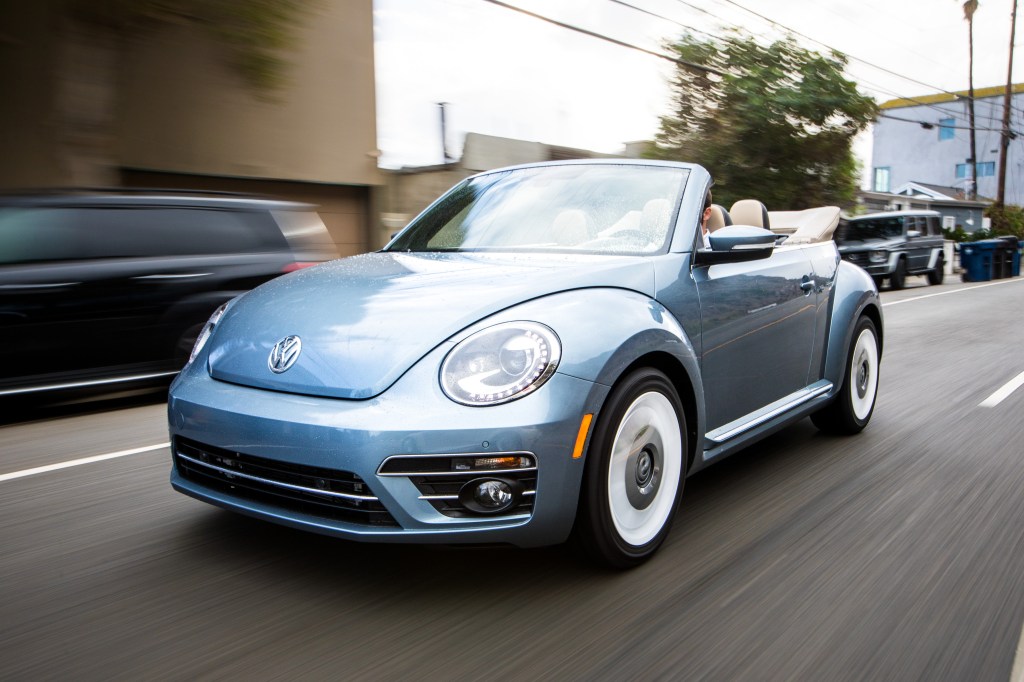
Big things are happening at Volkswagen, led by a headlong dive into the market for electric vehicles, especially in the European Union. To enable that, the German giant’s assortment of models is undergoing a profound revision. Part of that process involves axing at least one of Volkswagen’s recent signature models, the second-generation New Beetle. Basically, anyone who was smitten by the retro specialty subcompact has already gone out and acquired one, so it’s going away. At the just-concluded inaugural Chattanooga MotorCar Festival in Tennessee, a 2019 Beetle Convertible Final Edition SEL was raffled off to attendees to serve a singularly noble cause.

Chattanooga is a growing city in the mountain South, and coincidentally happens to be the site of Volkswagen’s new U.S. assembly plant. The convertible was offered as a fundraiser to benefit the Erlanger Neuroscience Institute, the region’s only medical center dedicated to treating disorders of the central nervous system, including among pediatric patients. Volkswagen was also the major sponsor of the Chattanooga festival, and used the occasion to roll out its new Atlas Cross Sport SUV, which is assembled at the Tennessee factory.

It’s still a station wagon: Audi revives the A6 allroad for 2020

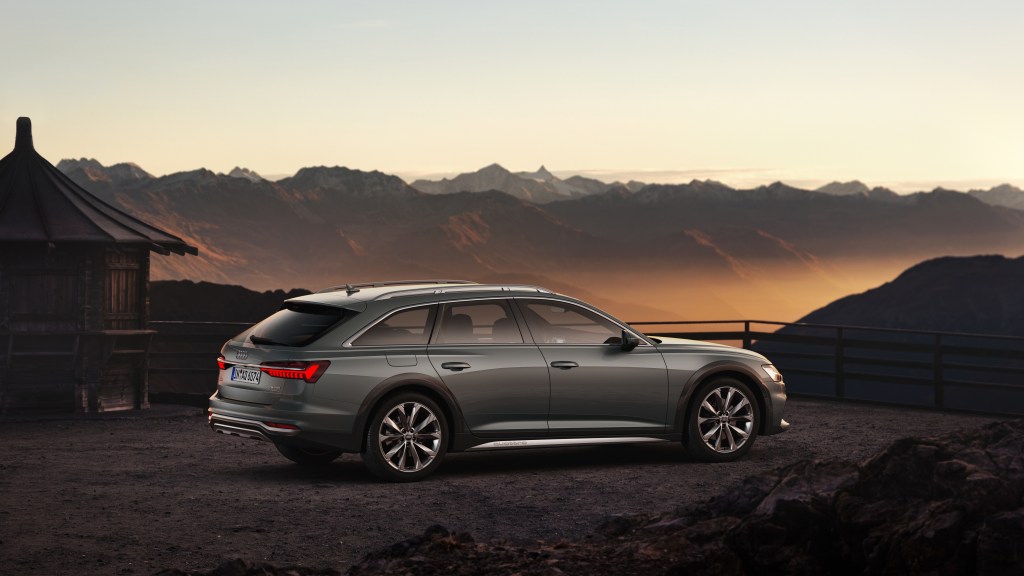
It’s not a crossover, all-activity vehicle, SUV, pickup or anything else other than a station wagon. And it’s got great, legitimate capabilities under all kinds of road and weather conditions. The Audi A6 allroad – yes, the model name is all lowercase, just like “quattro” – is a well-proven, if somewhat obscure, go-anywhere wagon for families with lots of stuff to tote around. And after a hiatus, it’s making a return to Audi’s U.S. model lineup for 2020.

Ready for just about anything, the A6 allroad makes its return outfitted with adaptive air suspension that offers no less than a half-dozen driving modes, including two for off-roading, which take advantage of the wagon’s standard 7.3-inch ground clearance. Also in the handling department, the A6 allroad will offer standard all-wheel steering, hill descent control and tilt-angle assist, the latter of which will transmit an audible warning to the driver if he or she attempts a grade so steep that the car is in jeopardy of tipping over. Standard power comes from a turbocharged 3.0-liter TFSI V-6 with Mild Hybrid Electric Vehicle technology, which is mated to a seven-speed dual-clutch automatic transmission. Factory-rated output is 335hp and 369-lbs.ft. of torque. In honor of the A6 allroad’s 20th anniversary of existence, Audi has revived the Gavial Green color choice in which the car was originally finished. Find out more at the Audi USA web address.

The story of how a fundamental technical advance saved the lives of racing drivers

Ayrton Senna. Dale Earnhardt. Manfred Winkelhock. Scott Brayton. Adam Petty. Kenny Irwin Jr. All of these racing drivers, and several others, had their lives snuffed out by basilar skull fractures, the result of a vicious whiplash-like impact that accompanied a crash, severing the spinal cord at the base of the skull. For a long time, nobody knew quite what to do about it. Then, road racer Jim Downing and his brother-in-law, Dr. Robert Hubbard, brainstormed a relatively simple combination of carbon fiber and high-tensile fabrics that would immobilize a driver’s neck and skull in a high-g accidents. The HANS device, standing for Head and Neck System, was the restrain system they created, and today is standard driver protection in virtually every form of professional-level motorsports. Along with the SAFER impact-absorbing wall system, it’s the greatest advance in personal driver safety since the invention of the flame-resistant coverall driver’s suit. This is the amazing story of how it came to be.

Auto racing is very big business today, but old traditions, including the one that drivers sometimes die, can be hard to retire. The award-winning motorsports journalist Jonathan Ingram here tells how Downing and Hubbard not only had to invent the HANS, but convince skeptical sanctioning bodies and many drivers (most notably Tony Stewart) of its lifesaving value. In 182 hardcover pages, Ingram traces the commonality of driver deaths that led Downing and Hubbard to their mission, describes the outcome of their investigation, and recounts the development of the HANS, including biomechanical data of the forces acting on drivers in a crash. Beyond any dispute, the creators’ work has saved lives, and won them recognition for engineering advance from Formula 1, the Indianapolis Motor Speedway and SAE International, among others. This vital new book retails for $34.95 and can be purchased from Coastal 181 of Newburyport, Massachusetts, which has all kinds of unique titles aimed at racing enthusiasts in their stocklist.

Regardless of fuel, this Hyundai can take a really heavy hit

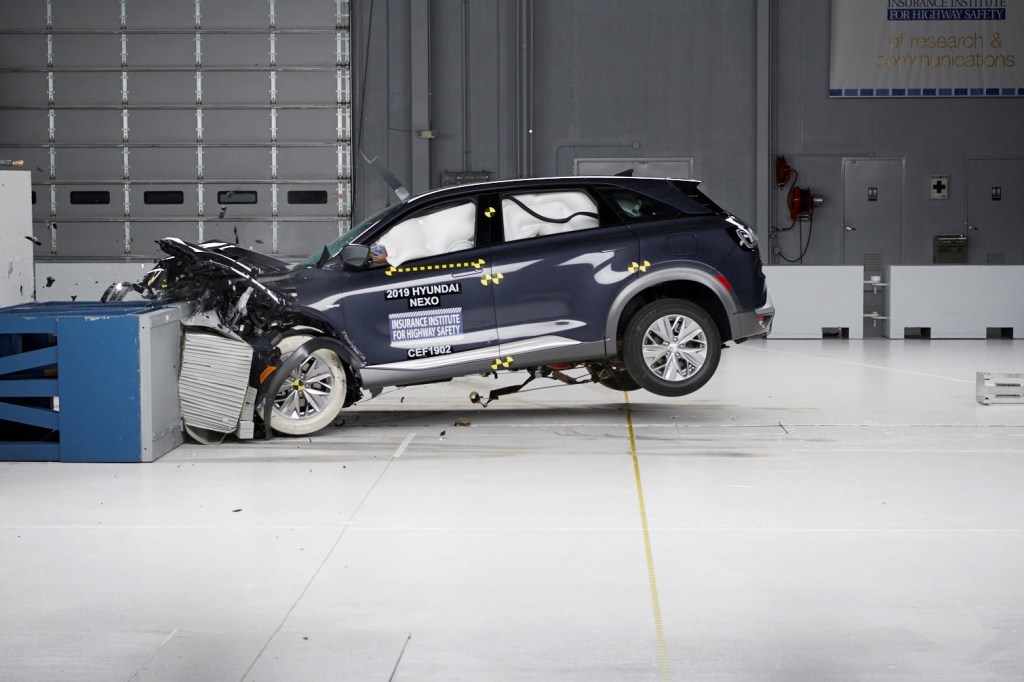
It’s not just about deactivated cylinders, hybrids and plug-in electrics. Vehicles powered by hydrogen fuel cells are becoming realistic options for environmentally conscious drivers now, too. Hyundai already sells one, the NEXO, though currently only in California. One 2019 NEXO was just put to the barrier test, and was awarded with a Top Safety Pick classification from the Insurance Institute of Highway Safety.

A more-or-less midsize SUV, the NEXO is the first hydrogen fuel cell vehicle the IIHS has ever evaluated. The testing period was limited to vehicles produced after June 2019. To be classified as a Top Safety Pick, a vehicle must score a “good” rating in the driver-side small overlap front, passenger-side small overlap front, moderate overlap front, side, roof strength and head restraint tests. The vehicle must also achieve a good headlamp rating, and an advanced or superior rating for frontal crash prevention. The NEXO received good ratings in all six crashworthiness tests that the IIHS administered, and successfully avoided impacts at 12 and 25 MPH on the institute’s test track. There’s no word yet on when the NEXO might go on sale in the other 49 states, but stay tuned.

Chevrolet eyes 2021 Colorado debut at SEMA next month

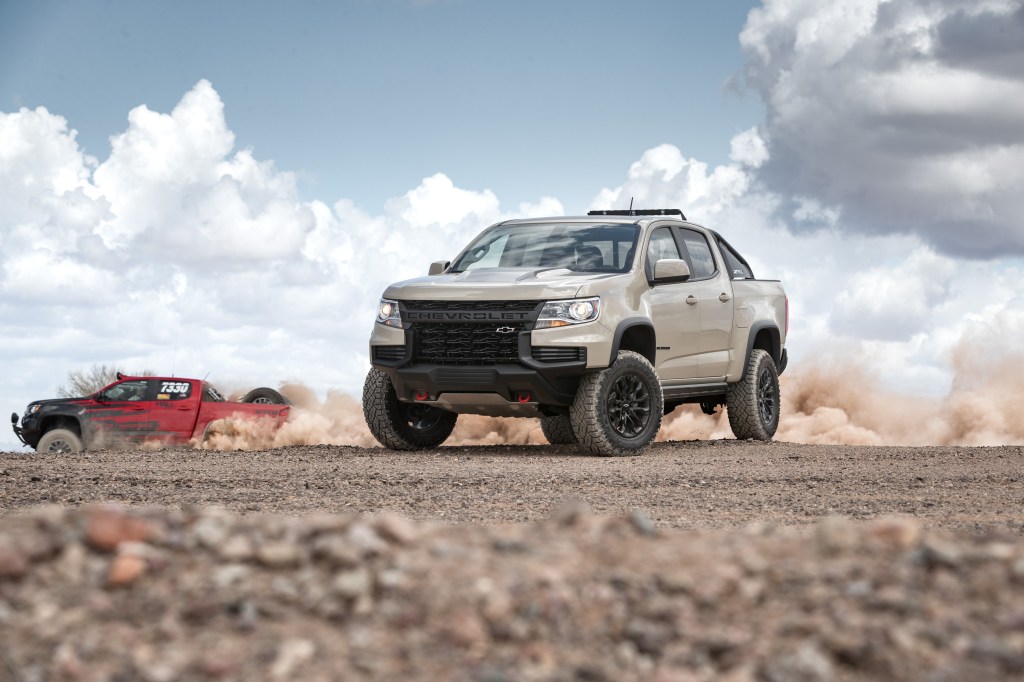
SEMA – it stands for Specialty Equipment Manufacturers Association – is the Oscars of the automotive world. From its founding as a display of speed parts in the late 1940s, SEMA has ballooned to become the world’s largest trade show of any kind. The automotive aftermarket uses it as the venue for unveiling tons – literally – of performance and dress-up parts every year, and the automakers enthusiastically follow suit, presenting design studies or actual new models that can serve as blank canvasses for the proper positioning of all those new goodies. This year, Chevrolet will roll out its 2021 Colorado midsize pickup in a series of events next month that will climax with the SEMA show in Las Vegas.

Like some other vehicles in its category, the Colorado is presenting more in-your-face visuals to do battle in the middle-sized pickup wars against the likes of the revived Ford Ranger and Jeep Gladiator. All versions of the truck will get revised center grille bars and bowtie emblem, while the tailgates will have “CHEVROLET” stamped into the outer sheetmetal rather than the previous bowties. The WT, LT and Z71 Colorado trucks will make their first appearance as this is published, at the Method Racing Wheels Laughlin Desert Classic off-road race. The performance off-road ZR2 variant, which makes its official debut at SEMA, will have a distinctive “Chevrolet” front fascia, plus position-sensitive shock absorbers, front and rear locking differentials, a two-inch suspension lift, a 3.5-inch wider track, and new this year, tow hooks. All Colorado models are assembled at General Motors’ plant in Wentzville, Missouri.

At Ford, ingenuity comes from anyone who practices it

There was an old story about a U.S. Supreme Court justice – it may have been the late Hugo Black – who once said that when he picked up a newspaper, he went to the sports pages first. The old jurist preferred to start his day reading about the accomplishments of humanity, not its myriad failings. In that spirit, we happily present the story of Professor Taehyun Shim and the innovation he developed that’s now in volume production at the Ford Motor Company for its line of pickups.

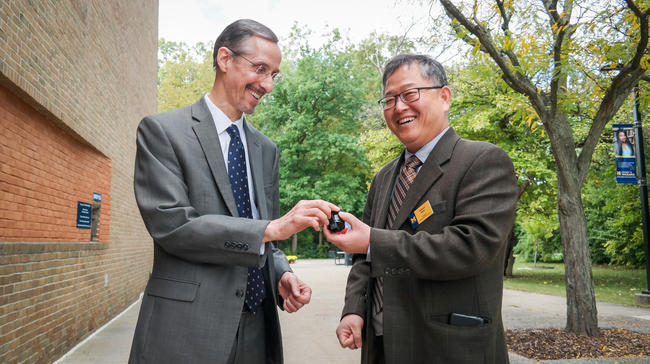
Before we discuss what Dr. Shim did, let’s talk about the guy on the left in this photo. He’s Ed Krause, Ford’s manager for external alliance, whose job description basically involves finding scientists and other brainy types out in the wider world whose knowledge and practices can benefit Ford in its product development. That usually involves direct collaboration with universities, and Krause estimates that he’s oversee about 1,900 collaborative projects in his 19 years on the job. A professor of mechanical engineering at the University of Michigan-Dearborn, Dr. Shim had worked on a number of Ford projects with Krause before doing the research that made Ford’s Pro Trailer Backup Assist possible. His application-driven research at Ford’s behest led to his creating the original control algorithms that allowed the company’s trailer-backing driver assist to exist and function. As built by Ford, the system allows a driver to enter the dimensions of his trailer once, engage Reverse, push a button on the dash, gently modulate the accelerator and point the vehicle with a knob, while the software directs the backing for you. Krause and Dr. Shim are examining one of the system’s control modules in the photo. I’ve always been fond of saying that cars are nothing but metal, glass and rubber. It takes people to create them and make them go. Here’s a great example of what I mean by that.