Fuel cells for Hyundai haulers

The other day, I was passed (illegally) by some guy in a big American pickup with diesel power. The engine’s abundant torque sent the truck booming by me in a wall of noise and a cloud of soot. Not too far away, just off Interstate 95, a flotilla of big rigs sat in the sprawling parking lot of a chain truck stop, most of them idling to keep the air conditioning churning away inside their cabs. Diesels for heavy trucks have long faced federal emissions requirements, but let’s face it, they’re not fully clean. Hyundai has a solution that may mitigate that reality over the long term. It’s just shipped the first 10 units of its new XCIENT Fuel Cell heavy-duty commercial truck to Switzerland, where the trucks will be handed over to actually trucking fleets in September. Hyundai has been one of the world’s most active automakers when it comes to fuel-cell technology, and plans to produce 1,600 of the XCIENT Fuel Cell trucks by 2025.

If you’re still learning about this avenue of green technology, fuel cells provide accumulated, compressed hydrogen for a vehicle’s internal-combustion engine to burn, an element of creating electricity. The zero-emission XCIENT Fuel Cell truck utilizes a 190kW hydrogen cell system incorporating a pair of 95kW fuel-cell stacks, fed by seven large hydrogen storage tank. That’s what’s concealed behind the metal fairing aft of the cab and ahead of the truck’s rear axle. The range per full charge is said to be 400km – about 248.5 miles – with eight to 20 minutes required for refueling. The range calculation factors in the mountainous driving that’s standard in Switzerland. With an obvious eye on American trucking, Hyundai is now working on a long-distance tractor unit with an enhanced fuel cell system that it says will be able to travel 1,000km on a single charge. The XCIENT Fuel Cell truck was created out of a joint venture between Hyundai Hydrogen Mobility and Swiss-based H2 Energy, which will lease the trucks to fleet operators. Hyundai is going all-in on this technology. It already builds the NEXO, its second-generation hydrogen-fueled SUV, and plans to be selling 670,000 EVs annually by 2025, including 110,000 fuel cell EVs. By 2030, Hyundai plans a capacity of 700,000 fuel-cell systems a year to power road vehicles, ships, railroad equipment and even drones.

The Ford Bronco’s nearly back

It’s getting very close: Ford is preparing to reintroduce the Bronco off-roader after a production hiatus that dates to 1996, when the relatively new Explorer came to be emblematic of all-terrain family fun in Dearborn. It’s abundantly clear in recent years that for many of us, the Bronco really never went away. A whole mini-industry has grown up to provide reproduction parts for various generations of the Bronco, which first debuted in 1966. First-generation examples have proved to be exceptionally popular among collectors, with Hagerty, the specialty-vehicle insurance experts, documenting through their valuation department that original Broncos have jumped in value by more than 75 percent in just the past three years. But this is all about selling new vehicles, not old ones. The official introduction of the 2021 Bronco line takes place next Monday night, and we’ll have a report after it happens.

Let’s look at what we know in the interim. First off, the new Bronco is going to be part of a standalone family of new models, including a traditionalist two-door that can be broken open in Jeep fashion (there, we said it), the first-ever four-door Bronco, and a smaller-sized Bronco Sport, which, if you look above, seems to match the dimensions of the existing Ford Escape compact SUV pretty closely. From a technological standpoint, that’s all we know right now. But it’s abundantly clear how strongly Ford feels about its heritage in this market. It goes all the way back to World War II, when the Ford Motor Company’s gargantuan production capacity led it to build the lion’s share of the original Jeeps that went to the armed forces, under license from Willys. Not only that, but the 1960s Ford president Donald Frey – the same guy who green-lighted the original Mustang – is credited with coining the term “sport-utility vehicle” when the first Bronco was revealed in late 1965. It wasn’t long before off-road racing immortals Rod Hall and Larry Minor (the latter also owning a famed string of NHRA Top Fuel dragsters) scored an overall win in the 1969 Baja 1000 in a production-based Bronco, the first and last time a true production vehicle has captured the Mexican desert classic. That’s led Ford to get the new Bronco accepted as the official vehicle of SCORE International, which continues to sanction desert racing, as part of the buildup to next week’s rollout.

Got cash? Here’s a Thing for you

It’s probably a consequence of COVID-19 derailing the normal doings of the automotive world, but the retrospectives on past-tense technology and design that have been circulated of late by Volkswagen and to a lesser extent, Audi, have proven to be some illuminating reading. Hence, we share them with you. In the overreaching sweep of the global industry during the 1970s, the Volkswagen Type 181 was largely an afterthought, albeit an undeniably cute one that flew directly in the face of governmental occupant-protection standards that were first coming into existence. A rebodied Beetle that could trace its roots to the Wehrmacht’s Kubelwagen scout car of World War II, the Thing, as it quickly came to be known on these shores, was an exercise in developing a NATO jeep that came to be embraced by the sun-and-surf set. It was sold here from 1972 to 1975, when emerging federal crash standards rendered it legally obsolete. Of late, it’s become something of an auction staple. You have a hard time now stopping in at a sale of collector vehicles and not running into one of these, um, Things. Some, as you’ll see, are more dear than others.

Among the places where the Type 181 was produced was Volkswagen’s sprawling assembly plant in Puebla, Mexico. That led Wolfsburg to approve production in 1974 of about 400 Puebla-built Things for use by high-end resorts in Acapulco, Mexico, to ferry their well-heeled guests from the airport to, we’d guess, the fabled diving cliffs of that city. The Acapulco Thing, as it was known, featured an integral tubular roll cage topped by a striped fiberglass roof plus a winch and, amazingly, air conditioning. Right down to its blue-and-white color scheme, the Acapulco Thing was the thematic heir to the Jeep Surrey that Kaiser Motors produced between 1959 and 1964. About 1,100 Jeep Surreys were built, which makes the Acapulco Thing, whose total production was 400 vehicles, even more rare today. It’s the most desirable collectible Thing you can find now, when one makes an appearance at an auction. If you love the Beetle and its air-cooled variants, an Acapulco Thing could easily stand as the centerpiece of your fleet.

Ford’s racing icon, remembered

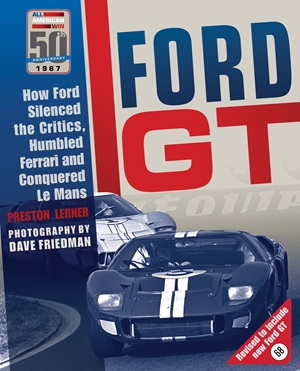
It’s been more than half a century since the Ford Motor Company upended the haughty hierarchy of international motorsport by sweeping the 24 Hours of Le Mans with its own cars and engines. Three years ago, Motorbooks commissioned a new title on the development of the Ford GT40 and its klieg-lighted triumphs on the global stage. That effort involved author Preston Lerner, one of the United States’ most acclaimed motoring journalists, and my longtime cohort Dave Friedman, who, as company photographer for Shelby-American during its 1960s glory days, got to witness this unprecedented effort first-hand. With an editorial pairing that talented, the book couldn’t miss. That’s why it’s still in print. And if there’s only one book to have on the GT40’s growth and success, Ford GT by Lerner and Friedman is it.

The narrative of this 236-page hardcover history belongs to Lerner, whose CV includes stints at Automobile and Hagerty Publications, and the photos are all Friedman’s from his tenure with Ol’ Shel. Yes, the story of the GT40, and of Henry Ford II’s rage-fueled determination to humiliate Enzo Ferrari, has been told in the past. But the sheer quality on both sides of this book’s germination makes it eminently worthy, and again, a rock-solid one-volume read on this glorious episode in the annals of American auto racing. You will not question your purchase after the fact, we assure. The retail price is $60. I’ve included links above to both the publisher and to Friedman’s website, where you can acquire examples of his unforgettable work to decorate your office or garage.

Early E-types star at Silverstone

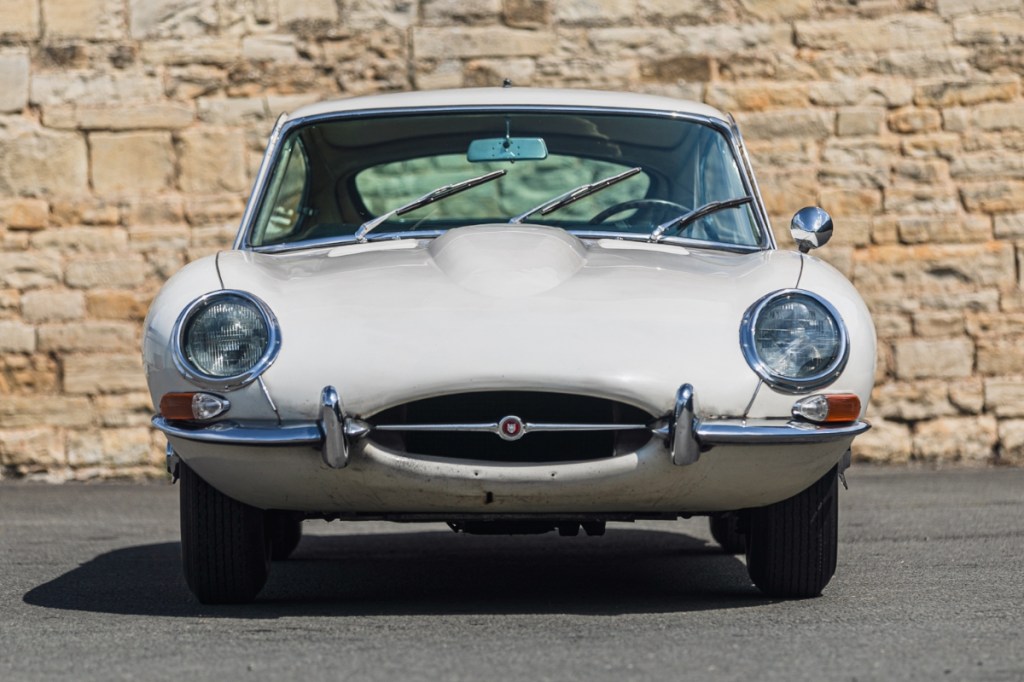
Let’s spend a holiday Sunday marking some automotive history. The Silverstone Auctions in England take their name from the historic U.K. road circuit where the firm conducts the bulk of its sales of landmark motor vehicles. Its next sale comes off the final weekend of this month, and we’re spotlighting it because the sale is going to feature a pair of highly desirable, indisputably significant British sporting automobiles. It’s a pair of very early Jaguar E-types from the first year of that unforgettable, sinuous sports car’s production at Coventry. Two of them, effectively a matched pair of E-types finished in Cream with Beige interiors, among the very first E-types ever produced, are being offered separately to discriminating buyers with a strong taste for Jaguar’s rich heritage.

Both are the desirable “flat floor” early E-types. The first, seen above, is a 1961 fixed-head coupe, the 249th built after production commenced, with an actual 49,319 odometer miles from new. It was delivered new to El Monte, California – nearly 90 percent of all E-types produced were exported to the United States – where it remained with its original owner until very recently, who had kept it off the road since 1985. Silverstone Auctions described this as the most original early E-type FHC in existence. The second, identically finished car is an E-type roadster, also with a flat interior floor, the 598th built. It was sold in Phoenix but returned, showing 74,414 miles to the old sod for a new mohair top and an interior refurbishment. Both cars are said to be fully numbers-matching, each original except for a repaint in the original Jaguar color. Can you imagine these two bookending your collection? Contact the auction house and book a flight on British Airways if you’re anxious to acquire one, or both.

Delivering cars is now a gas

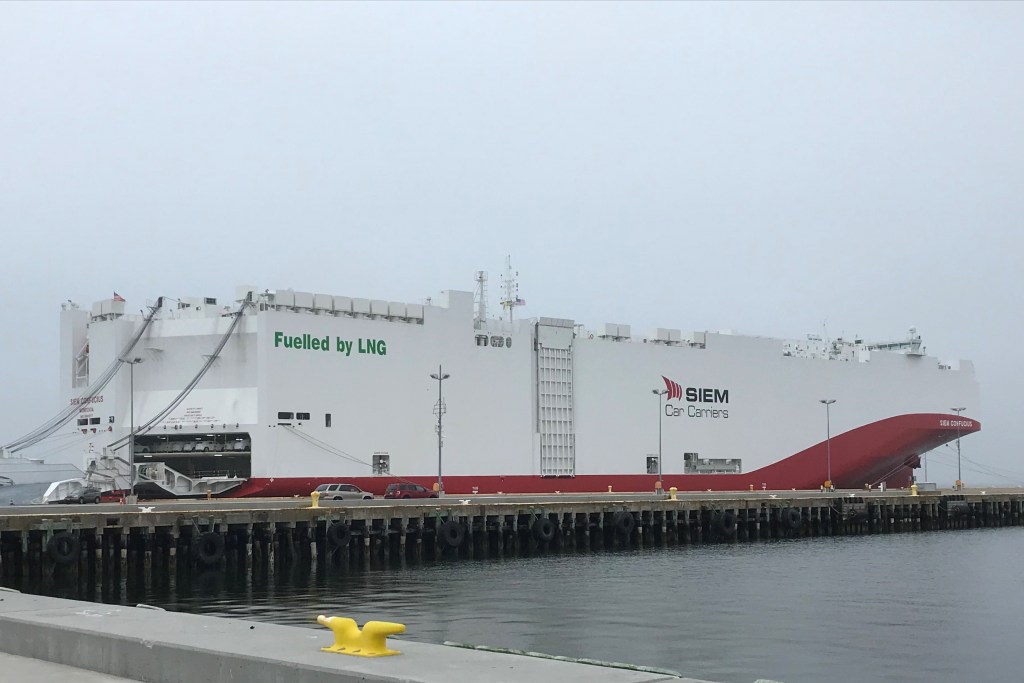
Statement of terms: If it involves transportation, it’s got a home on this website, and always will. Here’s an indication of what we mean: Cars built outside the United States typically reach their intended market aboard transport ships that are commonly known as ro-ros in the maritime industry, short for roll on, roll off. Volkswagen makes extensive use of this kind of cargo ship. The first in a pair of new transport ships used by Volkswagen, fueled by liquefied natural gas, just made its first call at the automaker’s East Coast port of entry in Davisville, Rhode Island, after a voyage from Emden, the port city in the German state of Lower Saxony, where Volkswagen produces the Passat.

The newly launched Siem Confucius is one of two LNG-fueled ro-ros built in China for Volkswagen transportation partner Siem Car Carriers AS of Norway. Both ships use LNG to run their massive diesel prime movers, can carry up to 4,800 cars on 13 cargo decks within their massive hulls during a single voyage. Each such odyssey will require a 475,000-gallon load of fuel to complete each round trip to the United States from Germany, which encompasses 12,000 nautical miles and usually involves another stop in Veracruz, Mexico. LNG has emerged as a desirable vehicle fuel – lots of urban transit fleets have adopted it – because it has lower carbon monoxide emissions than the sort of diesel fuel that transit buses and marine engines typically burn. You’re seeing this trend in other forms of transportation, too: Close to home, the Florida East Coast Railway operates the 351-mile line between Jacksonville and Miami that was pioneered by the great entrepreneur Henry Flagler. The FEC has lately accelerated its adoption of LNG as a locomotive fuel. It’s now common to see pressurized tank cars coupled between pairs of FEC road locomotives, serving as fuel tenders.

COVID-19 cancels Sprint car racing’s greatest happening

Locale by locale, some speedways have been inching toward resumption of their seasons, in many cases without fans, or with enforced social distancing. One such track is the historic Knoxville Raceway in central Iowa, which recently got the World of Outlaws back in operation with several fan-less events. The biggest happening at the track, however, is the Knoxville Nationals, a guaranteed four-day sellout during its run each August. COVID-19 infection rates across Iowa have been on the upswing, and the notion of running this huge event, which draws well over 100 of Sprint car racing’s top teams, is unthinkable. That’s why the Marion County Fair Board in Knoxville has decided that the 60th running of the sport’s greatest event will not take place this year. Knoxville made its decision less than 24 hours after Eldora Speedway in Ohio declared that what’s arguably the second-biggest Sprint car race in America, the Kings Royal, won’t be taking place this year, either.

It takes three days of qualifying – four, if you count the “alphabet soup” of preliminary features on the final night – to set the field for Knoxville’s A-main, which includes luminaries like the guy pictured above, multi-time track champion Terry McCarl of Altoona, Iowa. All we can say is, you haven’t really experienced auto racing until you’ve witnessed the majesty of a Knoxville Nationals. It’s truly one of the most compelling, intense short-track events anybody can ever experience. Yes, it’s that good. Start making your plans for 2021 now and it you happen to be anywhere near Des Moines in the coming year, try to take in the National Sprint Car Hall of Fame and Museum, whose sparkling headquarters overlooks Turn Two of the track. And hang in there. We’ll all get through this eventually.

Don’t call it Optima anymore

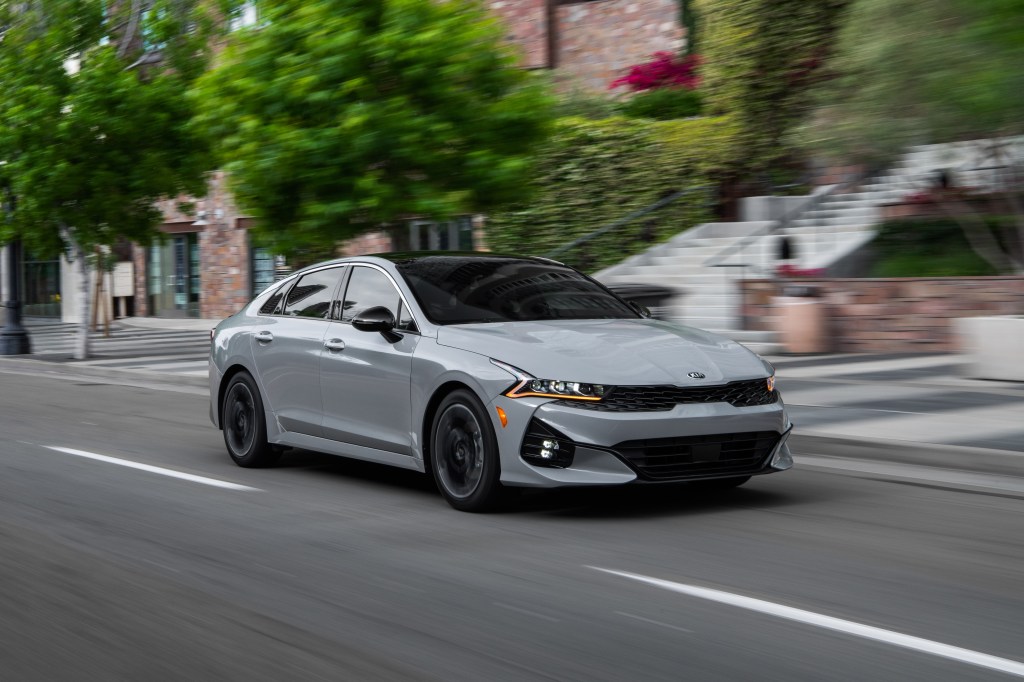
You know this car. The Kia Optima, restyled cousin to the Hyundai Sonata, has soldiered along while its built a following of buyers who appreciate its honest capability and impressive array of creature comforts at an affordable price, with the added bonus of one of the most comprehensive warranties the modern auto industry offers. Since Kia doesn’t have the Godzilla-scale advertising footprint of some other automakers, the Optima doesn’t always automatically appear on some people’s shopping lists. That’s unfortunate, and Kia plans to do something about it, right now. The Optima is about to get a very serious makeover, but that’s not all. It’s getting a whole new identity. The new generation of this very capable midsize sedan is now going to be known as the Kia K5, and it’s got some attributes that we’re confident serious drivers are going to find very much to their liking.

Built alongside the Telluride SUV in West Point, Georgia, the 2021 Kia K5 will initially be offered in four trim levels when it goes on sale this summer, with a GT version coming in the fall. And it’s that last offering that’s the really big news here: The GT will get its urging from a 2.5-liter turbocharged inline-four producing 290 horsepower, and mated to a new eight-speed, dual-clutch automatic transaxle. And for the first time, all-wheel-drive will be available across the K5 range. Kia says that with this driveline combination, the K5 will reach 60 MPH in 5.8 seconds. The car will ride on the same modular N3 platform that also underpins the Sonata and the upmarket Kia Stinger sedan, with a wheelbase of 112.2 inches. Three driver-selectable drive modes will be available, along with Apple and Android connectivity, a Bose Premium 12-speaker audio system, panoramic sunroof and a full suite of driver-assistance systems. We like what we see here.

Braking when it’s important

The imagery that accompanies this entry comes from Toyota, but the subject matter is broader than just one manufacturer’s product might indicate. Toyota cites figures from the National Highway Traffic Safety Administration estimating that about 400,000 motorists are injured each year in collisions with drivers distracted by infotainment systems, texting, looking at members of the opposite sex and all kinds of other issues that have nothing to do with operating a vehicle. Recently evolved technology known has automatic emergency braking, where the car takes over its stopping functions for you, can reduce rear-end crashes by up to 46 percent according to research by the University of Michigan. AEB is offered, or even standard, on a growing number of vehicles, especially those optioned by some form of adaptive cruise control, which can directly control the application of brakes in an oh-my-God situation.

If you’re old enough to have a perspective on the development of safety systems in mass-market motor vehicles, you’ll be pleased to learn that the driving public is embracing AEB considerably more rapidly than it warmed to things such as mandatory seat-belt use and airbags, to name just two situations. Toyota has included AEB in its Toyota Safety Sense suite of active-safety measures, which is now standard on 16 different Toyota models plus the entire Lexus lineup. From personal experience, we can assure that the first time you experience an activated AEB system in action, it’s a little unsettling, as you feel the car fully taking control of the evasive maneuver for you. But we can also tell you that you’ll appreciate the added set of “eyes” that scan ahead of the vehicle and engage the system in emergencies. We’ve gotten smart of late about any number of things. There’s no reason accident avoidance shouldn’t be one of them.

A book that lives up to its title

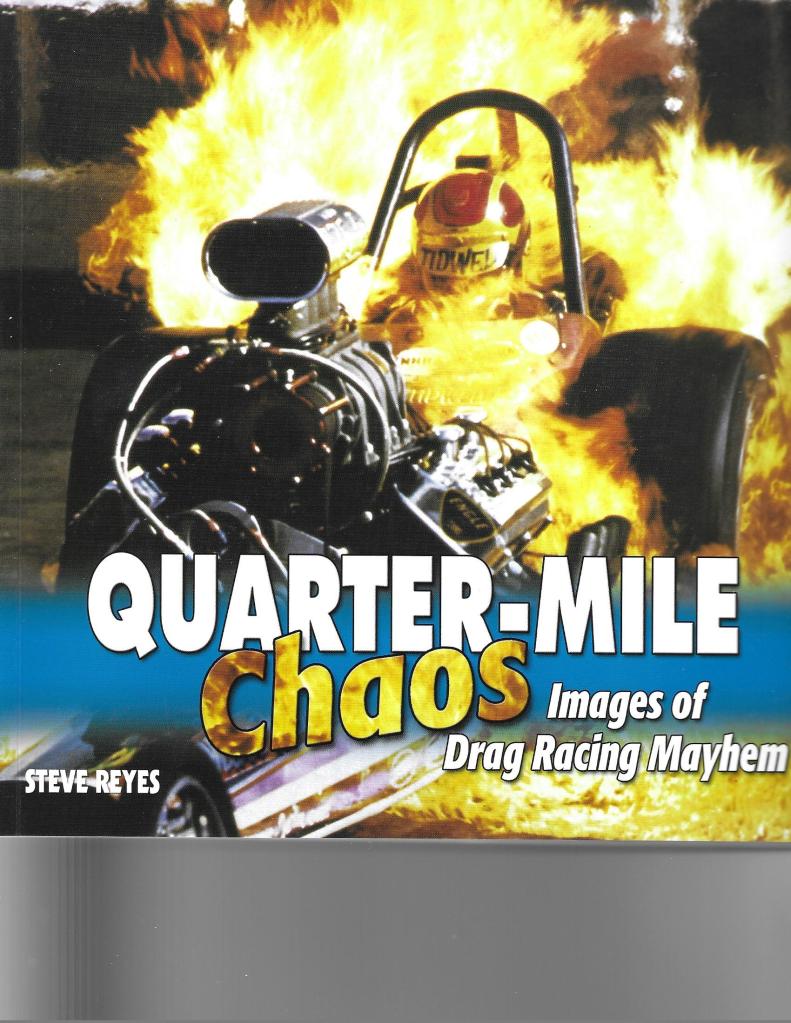
We’re all used to it, more or less, when things in life just don’t measure up. Earlier today, I spent an hour trying to convince a bank that the credit card they issued me really wasn’t expired, before I got disconnected. You get the picture. We deal with disappointments and frustrations like this every day. That makes us very appreciative when somebody, or something, actually delivers the goods they promise. One case involves drag racing itself, the most riotous, ear-splitting consciousness overload that most of us will ever experience during our lifetimes. Drag racing is deafening, blindingly fast and prone to the outbreak of calamity with next to no warning. Literally, anything is possible in this noisy, sudden variety of motorsport. My pal Steve Reyes, one of the best photojournalists that the quarter-mile sport has ever spawned, now has a volume out that clearly documents the outrages that drag racing can abruptly toss out to both competitors and onlookers.

Here’s what you need to know: Steve’s new title from CarTech, Quarter-Mile Chaos: Images of Drag Racing Mayhem is something like this: Take all the Mad Max movies and combine them. Then multiply them by a factor of 20. That’s the level of disaster and spectacle that this 180-page softcover work dishes up. It’s a razor-sharp, high-resolution recounting of fire, flying metal, tumbling cars, errant tow rigs, wheelstands, disintegrating fiberglass and the creative natural display of grenaded engine components. Imagine a Night of Fire or Night of Destruction at your local dragstrip that you can keep in your bookcase, magnified by a dozen or so. The action spans the whole heritage of drag racing from the 1960s forward. It’s sensational, unforgettable stuff, and you can enjoy it without stuffing plugs into your ear canals. This look at motorsport historic run amok lists for $36.95.