Tomorrow is “charging” closer

In the recent past, we’ve published updates on Volkswagen’s all-ahead-full effort to create an infrastructure that can support the wave of EVs it expects to produce – some under its new alliance with the Ford Motor Company on electric and self-driving vehicles – over the coming decade. Part of that plan is the creation, by both automakers, of a new commercial infrastructure that will allow EVs to be conveniently serviced and recharged. That is going to be a huge undertaking, second only to developing the new vehicles themselves. Volkswagen Group of America last week took a stride forward in that department, as it announced the opening of a next-generation charging station at its Arizona Proving Grounds outside Phoenix. The site will handle real-world testing of EV charging systems under severe heat conditions – remember, daytime summer temperatures of 110 degrees are commonplace in that locale.
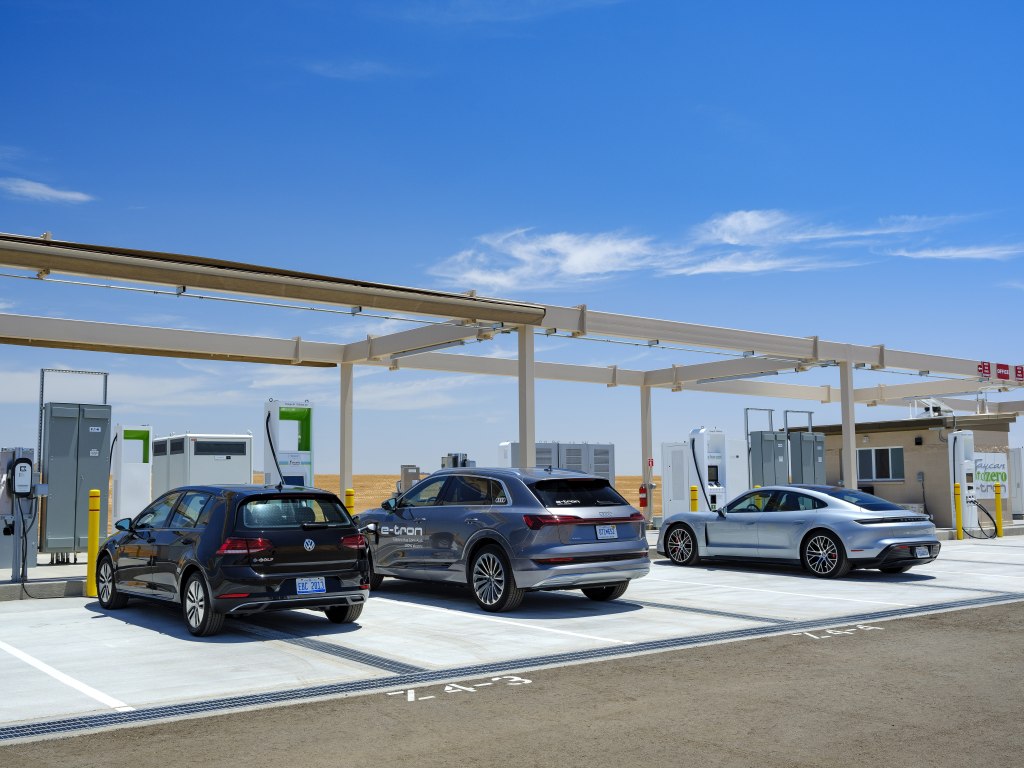
This, cousins, is what getting “gas” is going to look like in the immediate future. Volkswagen’s facility in Maricopa, Arizona, will have charging stations for 50 vehicles, comprising 25 DC fast chargers, capable of producing up to 350kW and recharging EVs at the rate of 20 miles’ range per minute; plus 10 Level 2 AC chargers to simulate less complex home-based recharging. The charging systems will utilize standard connector plus as used in North America, the European Union and China. A remote-controlled shade will provide some relief from the sun at various charging spots. Volkswagen Group of America invested $9 million in the charging station, which became operational in February. The long-term plan from Wolfsburg calls for Volkswagen to operate a global network of charging stations at dealerships outfitted to handle volume EV service and repair.

2021 Camry is about choices

Does this make you feel old, too? The Toyota Camry – in Japanese, the nameplate roughly translates to “crown,” which also used to be a Toyota model moniker – will turn 37 in 2021, capping an amazing run in the global automotive universe that saw the car start out as a home-market, four-door version of the Celica sports coupe before blossoming into the United States’ top-selling passenger car from 1997 through 2016. That’s an amazing record, covering a time span that saw the Camry evolve into a strongly equipped midsize sedan for those interested in much more than basic transportation. The Camry will come into 2021 with dramatic styling that accents the car’s broadest and most diverse model lineup in its long history. How so? The 2021 lineup will offer five trim levels with four-cylinder power, five more with four cylinders and all-wheel drive, three trim levels for V-6 models, and four when hybrid powertrains are specified. Among them will be the Camry XSE Hybrid, the first-ever version of the car to mate electric power with the Camry’s highest level of appointments.

Every new 2021 Camry will debut Toyota Safety Sense 2.5+, the manufacturer’s array of driver-assist technology that will include automatic emergency braking. The interior will feature new seven- and nine-inch floating multimedia displays. What gets our attention most forcefully, however, is the line’s first-ever performance variant, the Camry TRD, which will mate Toyota’s direct-injected, 301hp V-6 with an eight-speed automatic transmission and, heavens, a cat-back performance exhaust system. A front splitter, rear spoiler and side skirts will be part of the go-fast visuals. The TRD-tuned chassis adds stiffer coil springs that drop the Camry TRD’s ride height by more than half an inch. Its front brakes will have 12.9-inch rotors with dual-piston calipers. Just the ticket for all the Kyle Busch fans out there.

Nissan returns to the EV trail

It’s been an even decade since Nissan introduced the Leaf, its pioneering all-electric passenger hatchback, to the North American market. That was a start, and it’s been strongly successful, with more than half a million copies of the Leaf finding buyers in the ensuing 10 years. Nissan is now beginning to undertake a historic product revamp, with plans underway to roll out 10 new models over the next 20 months. Here’s one of them, and it squarely continues Nissan’s growing focus on non-hydrocarbon propulsion. The all-new Nissan Ariya – the name reminds one of a Whitesnake tune – will join the Leaf in Nissan’s lineup as an all-electric crossover. Nissan predicts that the 2021 Ariya, in the form of its long-range two-wheel-drive model, will allow drivers to cover up to 300 miles without having to recharge the batteries.

Introduced last week, the Ariya roughly matches the gasoline-fueled Rogue crossover in dimensions and capacity. It will be offered with and without all-wheel drive, and its suite of driver-assist electronics will include Nissan’s ProPILOT Assist 2.0 autonomous-driving software, plus voice-recognizing Amazon Alexa cloud-based voice-command service, Apple CarPlay and Android Auto. The Ariya’s lines represent something of a departure from recent Nissan styling practice involving spikes and angles (think the Nissan Juke and Maxima, to name a pair). The Ariya will use electric motors singly or in pairs, depending on powertrain option, with up to 290 kW of output. When it goes on sale here late next year, the starting MSRP is expected to be around $40,000.

Yee-haw! The Bronco’s back!

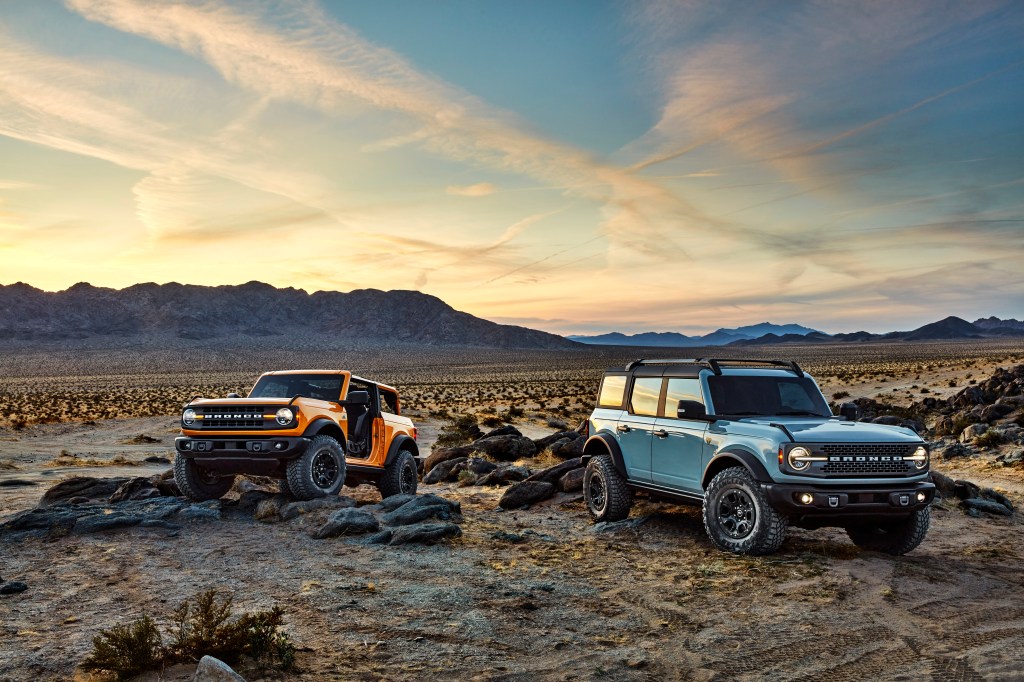
As promised, we’re following the rebirth of Ford’s original (other than the scout cars it built for the military) brush-bashing baby, the Bronco, and yes, it’s fully respectful of the vehicle that started it all way back in 1966. We spoke about Fiat Chrysler Automobiles a little earlier, and we’re here to make clear that the revived 2021 Bronco is a heavy-caliber shot fired directly across the bow of FCA, specifically targeting one of its halo vehicles and profit leaders, the Jeep Wrangler. We think we can confidently predict that this iteration of the Bronco will give pause to any prospective Wrangler buyer.

First off, the new Bronco will be offered in two body styles, including the first four-door Bronco ever built. Two-doors will have three-section removable roofs. The four-doors will have a standard fabric roof, and its roof will be removable in four pieces. All Broncos will have removable doors; the four-door’s can be stowed onboard in protective bags. Seven individual Bronco series will be produced, with four content packages. A color LCD multifunction instrument panel can be augmented by an exclusive SYNC 4 system with 12-inch color screen that incorporates an archive of more than 1,000 driver-selectable trail maps. EcoBoost turbocharged engines will be part of the package, either a 2.3-liter inline-four with 270 horsepower or a 2.7-liter V-6 rated at 310 horsepower. Both will be coupled to a new, segment-exclusive seven-speed manual transmission that includes a rock-crawler low gear. Shift-on-the-fly or automatic 4×4 systems will be available, using Dana axles and Spicer differentials. The powertrains will offer seven driving modes. It’s very clear that this vehicle is built and outfitted with hardcore off-roading in mind. The base MSRP is set at $29,995. Plunk down a $100 fee, and you can reserve one of your own by going here.

Reviving a winning concept in motorsports promotion

Remember the IROC series? It stood for International Race of Champions, was jointly founded by Roger Penske and NASCAR executive Les Richter, who was also an inductee in the Pro Football Hall of Fame, along with Ontario Motor Speedway builder David Lockton. It matched world-class drivers from a variety of international racing disciplines in identically prepared Porsche 911 Carrera RSRs, with television coverage of the competition rounds on ABC. It was an immediate success, but still underwent gradual changes. IROC switched from Porsches to purpose-built stock cars, which pleased the NASCAR drivers in the field, who came to dominate the series’ championship standings. IROC eventually became an all-oval series, but returned to the Daytona International Speedway road course in 2006. The series went on hiatus the following year when it was unable to find a title sponsor. The IROC holdings were liquidated the following year. A lot of people who believed in the soundness of the original concept were sorry to see it go. Now, some important shakers in motorsports world intend to make it happen again.

Tony Stewart went into the record books as the final IROC champion by winning the title in 2006. He lead a consortium that this week announced the Superstar Racing Experience, an IROC-inspired racing series, matching champions in identically prepared cars, that is set to debut next year. Stewart’s partners include former NASCAR championship crew chief and TV personality Ray Evernham – who served as crew chief for the original IROC series – former NASCAR executive George Pyne, and sportscasting executive Sandy Montag. The premise is simple: Put together televised Saturday-night racing programs matching the best from various types of racing. A 2021 schedule of six races, all to be live on CBS, is envisioned. Evernham will be in charge of designing and building the race cars, a parallel of his IROC responsibilities. Little beyond that has been finalized, but Stewart told Speed Sport that he’ll be one the drivers, who could come from literally any series, including the world of x-sports. Evernham predicted that the SRX cars will emphasize horsepower over aerodynamics, and said venues might include legendary American short tracks such as the Nashville Fairgrounds, Stafford Motor Speedway in Connecticut, the Terre Haute Action Track, Five Flags Speedway in Pensacola, Florida, Iowa’s Knoxville Raceway and Eldora Speedway in Ohio, which Stewart owns. Given everything else that’s going on in the world, you may not have noticed it, but some dramatic events have been reshaping American auto racing over the past year: Roger Penske’s takeover of IndyCar racing and its hallowed home, NASCAR’s response to Black Lives Matter, and now this. In addition to being a certified racing superhero, Stewart also has ownership of a NASCAR team, Eldora, and the All-Star Circuit of Champions for Sprint cars. Evernham, a former NASCAR team owner, has partnerships with Axalta, Goodyear and Valvoline, among others, and hosts Glory Road on NBCSN. Pyne and Montag are influential people in their own fields. A new generation of powerbrokers is emerging in American racing. This deal is really going to happen, and it’s going to be exciting. Stay tuned, literally.

Expanding the lexicon of cars

Perhaps not everybody will consider this newsworthy, but please bear with us, because a whole new automotive company is about to come into existence. The Detroit Free Press reported this week that the coming merger between Fiat Chrysler Automobiles and Groupe PSA – officially, the second entity here is known as Peugeot S.A. – is going to bring a new name to the landscape of automotive manufacturing. When the 50-50 merger becomes official early next year, the new company will be known as STELLANTIS, all in upper case as per preferred FCA practice. As the principals describe it, it’s a take on the Latin phraseology meaning “to brighten with stars.” The new corporation will have a very broad footprint: FCA’s automotive nameplates encompass Abarth, Alfa Romeo, Chrysler, Dodge, Fiat, Fiat Professional, Jeep, Lancia, Maserati, and Ram, formerly Dodge Trucks. Groupe PSA comes to the party packing Peugeot and Citroen, along with former General Motors holdings Opel and Vauxhall, plus the premium Citroen sub-brand DS and Peugeot motorcycles. FCA had been looking for a global partner since before its colorful honcho, Sergio Marchionne, died two years ago. A proposed alliance with Renault fell through, not long after FCA moved to invest $4.5 billion in upgrading its Michigan manufacturing locations. The deal between FCA and Groupe PSA is estimated to be worth $50 billion.

Kindly allow for a little editorializing here. From its inception, this online discussion has closely tracked the ongoing changes in the world of personal mobility as they involve technology, new markets, and the partnerships that are going to make those changes real in a world that’s transforming itself at a dizzying pace. It’s important to note that STELLANTIS will refer to the corporation only; the marque names in its combined portfolio will remain unchanged. Which means that at least for now, there will still be vehicles branded Chrysler and Dodge, which take their names from the founders of what became Chrysler Corporation in 1924. Yes, that was nearly 100 years ago, and both Chrysler and Dodge have recently been rendered down into niche nameplates offering American-style luxury and outrageous performance, respectively. It’s undeniably a little bit sad, though, that “Chrysler,” the name, which recalls the entrepreneurial giant who founded the company, will no longer exist in the American corporate pantheon. Read the papers, watch TV, or go online. A lot of things aren’t the way they used to be anymore, and that’s often a very good reality. But Walter P. Chrysler, and people like him who built the business of selling cars, transforming millions of people’s lives in the process, were giants who former transformed both industry and society. We shouldn’t fear change, but we definitely ought to venerate the mileposts of its passage, and the people who made that journey possible. So I’ll respond to this development by channeling my inner Edith Bunker and paraphrasing, “Mister, we could use a man like Walter P. Chrysler again.”

To the moon, Toyota fans!

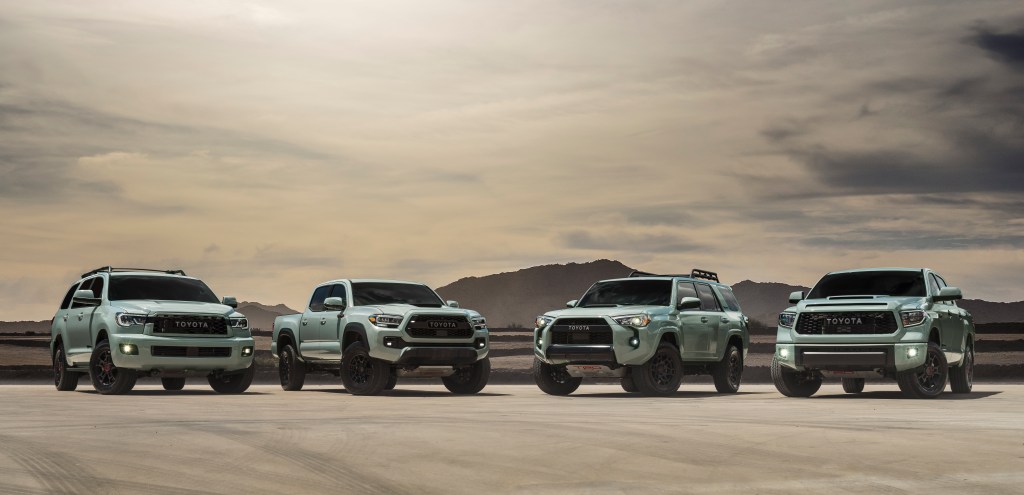
It’s been more than 50 years since men first walked on the moon, but the whole exercise, in all its horizon-stretching technological brilliance and focused sense of national purpose, still excites me a half-century-plus since then. And if you’re one of those who insists the whole thing was faked by the government and the moon walk actually took place in a TV studio, too bad. It’s fascinating enough in my own case that the outwardly insignificant news of a new automotive paint scheme suddenly becomes, well, newsworthy when there’s an Apollo connection. That brings us to the disclosure that Toyota has a new 2021 color in its palette for its TRD Pro lineup of off-roaders, which encompasses specialized versions of the 4Runner and Sequoia SUVs and the Tundra and Tacoma pickups. The new color, a light monochromatic gray, is called Lunar Rock. It will supplant Army Green in the TRD Pro selection of hues.

If you spend any time in front of the TV looking at the home-improvement networks, you most likely realize that the light-gray theme (often with white trim) is currently the red-hot choice of color for interior decor, so it’s probably logical that the theme was going to make its way to the automotive world at some point. Hey, look at the most expensive motorcycle Harley-Davidson sells, the CVO Limited tourer, base price $44,039, has a pale gray known as Sand Dune among its color offerings. Order a TRD Pro vehicle, and you’ll get specific alloy wheels shows with Nitto Terra Grappler tires, plus Fox shock absorbers and tuned coil springs. So no more bad jokes about how gray is all about getting old, because it’s not.

Here’s our idea of charity

When it comes to generating funding for motorsports preservation, nothing beats the idea of putting a historically significant racing car up for the public to bid upon. The Motorsports Hall of Fame of America, located at Daytona International Speedway, is doing exactly that. Full disclosure time again: I do research for these fine folks, who are my neighbors, from time to time. If you come to the speedway once the pandemic restrictions are eased, you can visit and take in a whole range of genuinely historic racing vehicles that were once wrung out thoroughly by legends of this great sport. One of them is going on the block next week as a fundraising initiative, and fittingly, it’s a historically important car. Read on.

This race car will go on the block next weekend at the huge Mecum Auctions sale at the Indiana State Fairgrounds in Indianapolis. The car is March 82C, chassis number 1 – the first March 82C ever built – in which Hector Rebaque of Mexico scored his first and only CART victory after migrating from Formula 1 to the IndyCar ranks. It was a spectacular win, in the 200-miler at Road America of Elkhart Lake, Wisconsin, in 1982, as Rebaque nailed down the top spot for Forsythe Racing over a trio of MSHFA inductees – four-time Indianapolis 500 winners Al Unser Sr. and Rick Mears, plus 1986 Indy champion Bobby Rahal. McLaren Engines bought the chassis from Jerry Forsythe at the end of the season, which used it as a test bed for the stock-block turbocharged Buick V-6 that would win the Indianapolis 500 pole in 1985 with Pancho Carter in the hot seat. Later, chassis number 1 became a show car for King Motorsports, owned by the NHRA legend Kenny Bernstein, which employed the late Jim Crawford – a wonderfully intriguing and very fast driver who I spent some time with at a Buick turbo V-6 media event – as the team’s lead driver. Donated to the MSHFA in the early 1990s, it still wears the Mac Tools livery that King Motorsports utilized, and yes, there’s a Buick turbo V-6 behind the cockpit. Think about this, an actual race-winning IndyCar, as the centerpiece of your collection. This 82C is set to go to the block next Saturday in Indianapolis. I’ve covered this auction for Hemmings Motor News, and it’s a terrific happening. If you can make it in person, you can register to bid online by going here.

World’s greatest station wagon?

Yes, we know that by some observations, it’s a nearly extinct species. But the two-box station wagon – you know, a car, riding on a car platform, not an SUV – is still relevant to many of us. Full disclosure: I owned a couple of AWD Volvo wagons and liked them. It’s especially enjoyable for me to think of the motorway police in the United Kingdom patrolling in turbocharged Volvo station wagons, equipped with medical gear, for both nailing speeders and assisting the injured at accident scenes. Cars like these prove that wagons aren’t necessarily frumpy or jammed to bursting with screaming, unruly kids. And if you’re still not convinced that a conventional station wagon can exist as a rock-hard, scintillating performance automobile, we’ve got something you need to examine closely.

The vehicle in question here is the Mercedes-AMG E 63 S, which can assuredly, immediately, transform anybody’s opinion about what a station wagon is all about. With a lot of additional cargo space, this is the spiritual descendant of the fabled AMG-tuned Mercedes-Benz “Hammer,” one of the 1980s’ most legendary performance automobiles of any sort. Mercedes-AMG is now a full-borne corporate brand, rather than the earlier manufacturer-modifier alliance, and the E 63 S wagon is being refined with sheetmetal that allows it to explore a new horizon in performance tuning, that of aerodynamic front-to-rear balance, a parameter long associated only with racing cars. This is probably the first station wagon is automotive history to involve aerodynamics engineers so directly in its fundamental design. Even its alloy wheels have been reshaped for maximum aero efficiency. That’s just for openers. The package includes all-wheel drive, a nine-speed automatic transmission, active shock damping and the handbuilt AMG-spec 4.0-liter twin-turbo V-8 that’s rated at 603 horsepower, just the ticket to get you home before the Haagen-Dazs starts melting out back. Buy this, and nobody will ever ridicule your choice of a station wagon, anywhere. The MSRP is $111,750 and if you’re still not convinced, the E 63 S is also available as a sedan.

Turbo toughens the Mazda3

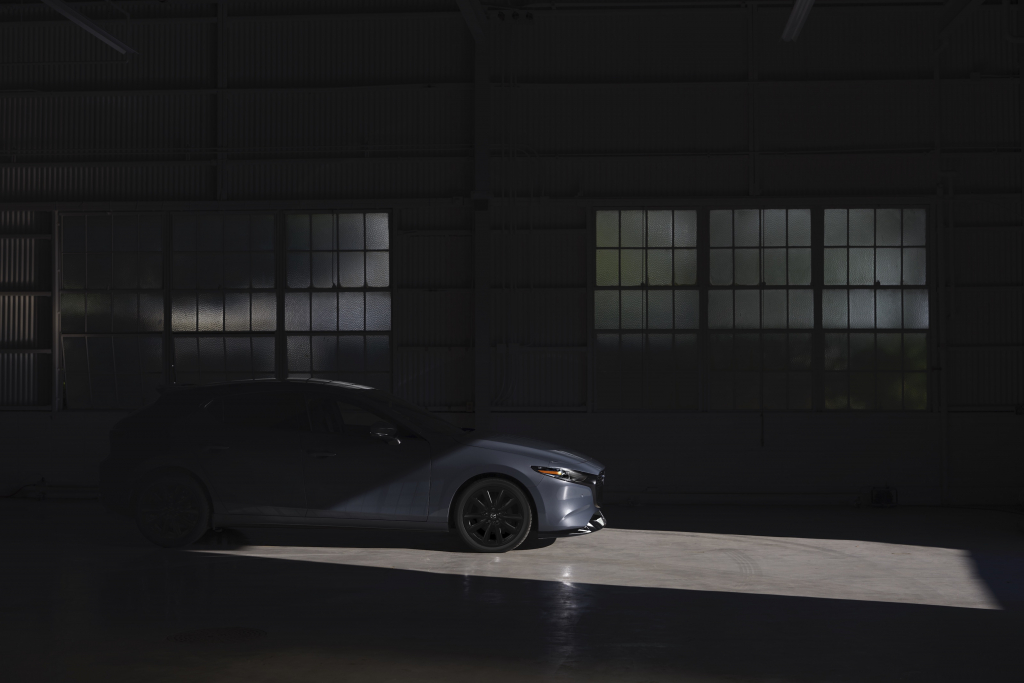
Generally speaking, we’re less than enthralled with car manufacturers’ teaser photos, largely because they frequently don’t show very much that’s relevant. We’re willing to make an exception here because the vehicle in question sounds like something that’s going to boast a strong measure of coolness. The subcompact Mazda3, to use current model nomenclature, was extensively redone for 2019 and thus captured the juried World Car Design of the Year Award, for its Kodo – it’s Japanese for “soul of motion” – styling themes. Nice car, very appealing to look at, but as with many two-box economy cars, standing to benefit greatly for additional horsepower and grip. Mazda says firmly that it’s now fixed those issues.

For 2021, the fourth-generation Mazda3 is being reintroduced, in a manner of speaking, with a major influx of new performance credibility. Mazda has announced that its turbocharged 2.5-liter Skyactiv-G four-cylinder engine will be extended to the Mazda3 for 2021 in a new series model called the Mazda3 2.5 Turbo. That’s 2.5 liters of displacement, a heck of a lot for a car of this size. The builder assures that the turbo engine will bring the Mazda3 to a rated 250 horsepower, with up to 320-lbs.ft of torque on 93-octane fuel. Perhaps more importantly, the 2.5 Turbo will also have Mazda’s i-Activ all-wheel-drive system. A raft of driver aids and infotainment connectivity, including Apple CarPlay and Android Auto, will be part of the package, including 12-speaker Bose audio and a heated steering wheel. The new model will be in Mazda showrooms by the end of the year, and you can get more information on the impending launch by going here.