Porsche power takes the WEC

Porsche, the powerhouse of Stuttgart, and dominance in international sports car racing go togehter like … what? Jaegerschnitzel and mushroom gravy? Bockwurst and sauerkraut? Like any tasty combination you care to offer, folks, because this playground has been the property of Dr. Ing. Ferry and his descendants since before I went through Confirmation. It’s happened again, this time at the recent eight-hour finale for the FIA World Endurance Championship in Bahrain, where Porsche wrapped up the season title via a one-two finish in the GTE-Pro category. The winning entry just has to be one of the world’s most thematically and aesthetically perfect racing cars, the Porsche 911 RSR, which fittingly wrapped up its debut season with an international title.
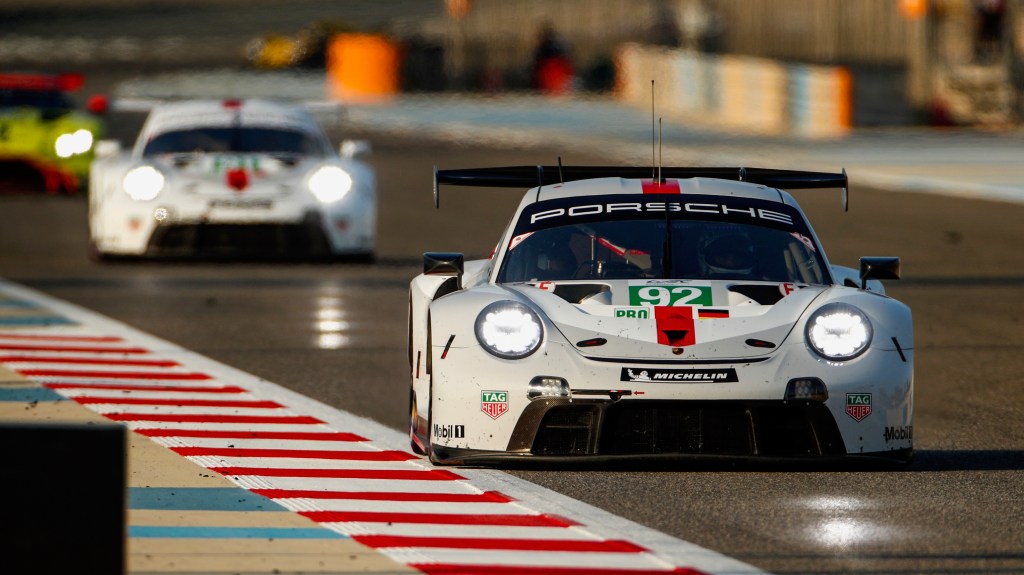
It was the kind of Porsche putsch that would have made Ferry’s chest swell with pride: The Bahrain round marked the 911 RSR’s third win in the eight rounds that made up the pandemic-revised WEC season. The season actually spanned two calendar years, in keeping with current FIA WEC practice, as Porsche took the opening round last year at the historic Silverstone circuit in the United Kingdom. Taking the overall win at the Bahrain International Circuit were teammates Kévin Estre and Michael Christensen, with Richard Lietz and Gianmaria Bruni clawing their way from fourth on the grid to place second.

Mexican artwork on wheels

Volkswagen has had a major presence in Mexico for most of its post-World War II existence. It operates a huge assembly plant in Puebla, the capital of the eponymous Mexican state, which builds thousands of vehicles destined for the North American market. Mexico was also among the very last places where the immortal air-cooled Volkswagen Beetle was still legal for production, and still enjoys local status as a cultural touchstone that has somewhat eluded the United States since the first Golf, nee Rabbit, reached these shores in 1975. In Mexico, the Beetle has long served as a canvas for artistic expression; the famous “Wedding Beetle” is one such creation. Here’s another collaboration between one of Germany’s most storied automakers and the artisans from one of its biggest markets.

Officially, this colorful creation is known as the Vochol, a takeoff on Mexico’s fond moniker for the ageless Beetle, vocho. What we have here is a Mexico-market 1990 Beetle festooned with more than 2.2 million glass beads, transforming it firmly into an artifact of rolling sculpture. It’s name recalls not only the vocho, but also the term Huichol, which is a colloquialism that describes the indigenous Wixárika people native to the western Mexican states of Nayarit and Jalisco. Eight artists from a pair of Huichol families labored on this Beetle for eight months, coating its sheetmetal curves with resin and then applying the glass beads by hand, one by one, in a variety of geometric patterns. The project consumed some 9,000 hours of hand workmanship, and features symbology relevant to Huichol spiritualism. It’s the largest single piece of Huichol beadwork ever created, and the bead-bedecked vocho now resides at the Museo de Arte Popular in Mexico City when it’s not on loan, a journey that’s taken this car all around the world.

Title time for Corvette Racing

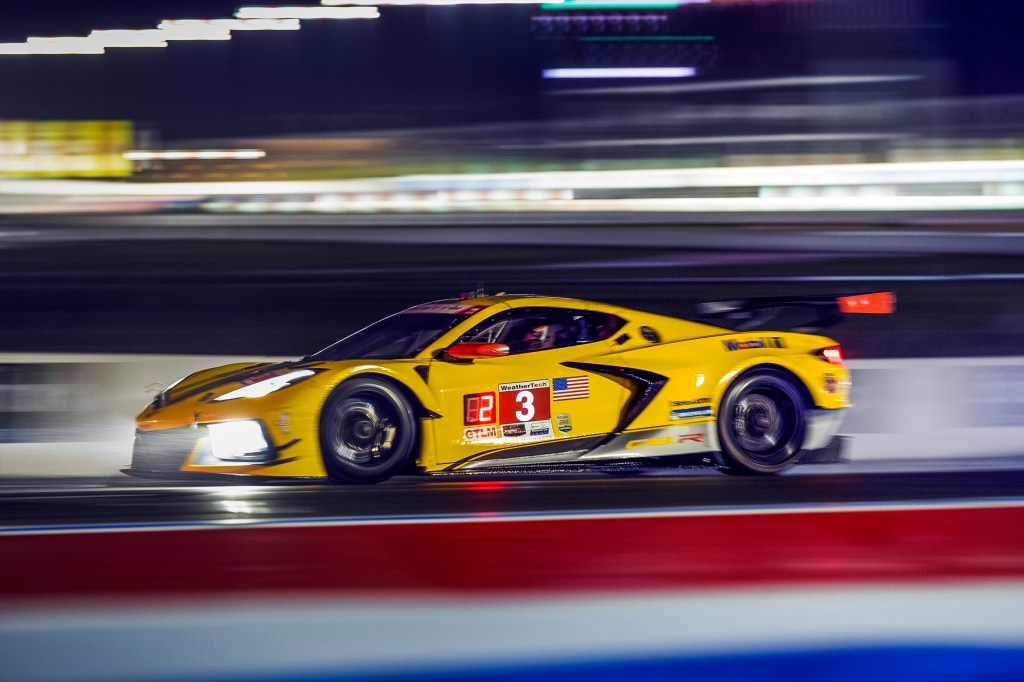
The pandemic-rescheduled 12 Hours of Sebring made some significant news this weekend before the race itself was even in the books. Chevrolet needed only to take the green to secure the season title in the GT Le Mans Manufacturers category of the IMSA WeatherTech SportsCar Championship with the mid-engine Corvette C8.R, marking the inaugural season of pro-level competition for the landmark Corvette design. It was the second time the bowtie brigade struck IMSA gold this month, as team drivers Antonio Garcia and Jordan Taylor captured the GTLM driver and team championships two weeks ago at the WeatherTech round at Laguna Seca.

The C8.R is built by longtime Chevrolet technical partner Pratt Miller of Michigan, and thumps out horsepower courtesy of Katech Engines, another Michigan-based GM performance cohort of long standing. This is the third championship title for Corvette Racing, as the effort is formally known, in the past five years. It’s the 13th IMSA manufacturer’s title for Chevrolet since 2001, but only the second time that a first-year Corvette model has been the basis for a title-winning effort, the first coming in 2005, also in partnership with Pratt Miller. The Sebring weekend also spotlighted the final career start for longtime Corvette Racing team driver Oliver Gavin, who is ending is full-time driving career.

Lexus LS 500, 500h abound with performance and refinement

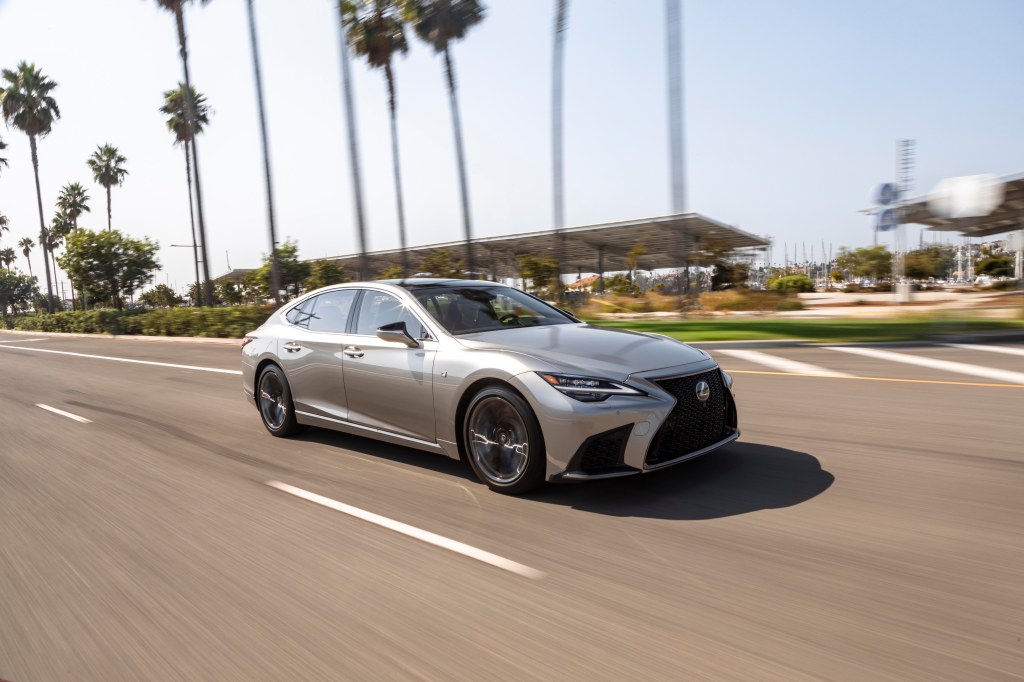
We all know how much Toyota’s premium nameplate, Lexus, has done to redefine what a Japanese automobile is since it appeared on these shores in 1989. The original LS 400 made it clear to everyone that maybe, just maybe, not every interpretation of the S-class had to necessarily come from Mercedes-Benz. Lexus introduced the latest version of its flagship LS sedan in 2018, and it’s heading into 2021 with a raft of refinement that’s applicable not only to the hydrocarbon-fueled LS 500, but also to the part-time-electric LS 500h.

With that oh-so-pronounced grille treatment leading the way, the LS series remains on the Lexus GA-L platform, which receives revised shock absorber and spring rates for 2021, enhancing its ride quality. Adaptive Variable Suspension incorporates adjustable ride height. Standard power, hybrid and otherwise, is the Toyota-designed 3.5-liter twin-turbocharged V-6, with all of 416 horsepower on tap, linked to a standard 10-speed automatic transmission. AWD is an option, and the LS offers six choices of powertrain responsiveness, selectable by the driver. A new Palomino interior treatment, with black accents, will be offered, and a 12.3-inch multimedia touchscreen becomes standard, now with Amazon Alexa compatibility. All LS variants hit the showrooms late this month with a starting MSRP of $76,000.

Going to Kansas City with Ford for a new generation of EV van

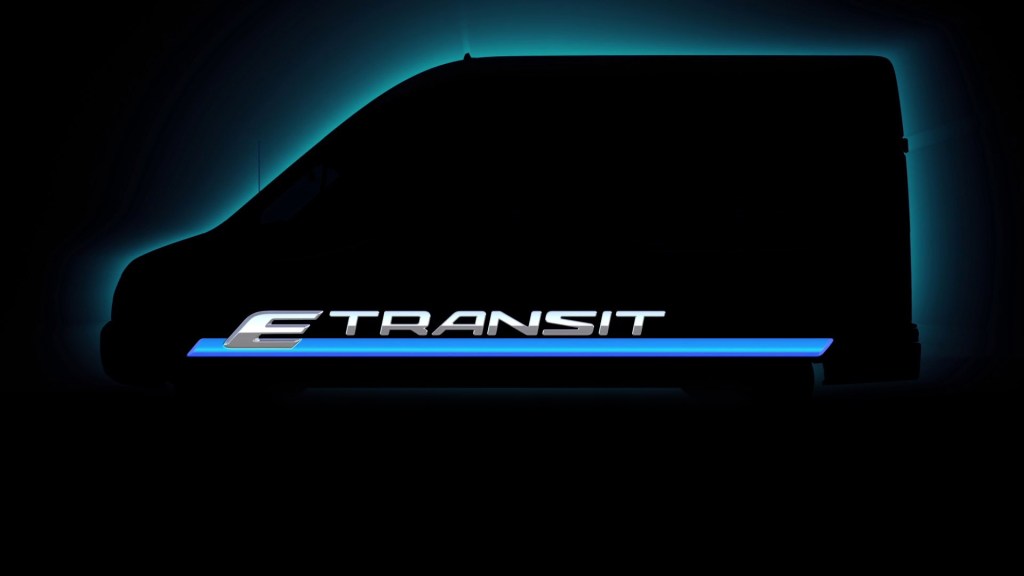
This entry kind of has to be a teaser, because I heard today from the Ford Motor Company that’s it’s planning to do a formal introduction of its new E-Transit van early tomorrow morning EST, with most of the new vehicle’s details embargoed until the actual rollout event, in keeping with common industry practice. This is a very big deal in Dearborn, given the fact that the E-Transit, the new all-electric F-150 pickup, and the all-electric Mustang Mach-E crossover are very much being prepared for introduction, with the Mach-E set to reach showrooms by next month. But a peripheral, and equally big, development is the ongoing upgrade in Ford’s massive manufacturing infrastructure to accommodate this new generation of EVs. Ford is putting $100 million into its historic assembly plant in Kansas City, Missouri, to support manufacturing of E-Transit, which is scheduled to be offered for sale in late 2021.

That investment in Kansas City will also include 150 new jobs directly supporting the E-Transit. Ford is sinking more than $3.2 billion in manufacturing capacity to build EVs, part of Dearborn’s overall investment of $11.5 billion in new vehicle design, technologies and EV assembly. Part of that huge effort is the earmarking of $150 million for the Van Dyke Transmission facility in Sterling Heights, Michigan, where e-motors and e-transaxles for EVs, including the F-150, will be produced. Ford has also budgeted $700 million, and an additional 200 jobs, at the sprawling River Rouge complex in Dearborn where F-150s, including the EV, are assembled. Further EV upgrades are seen at Ford assembly plants in Oakville, Ontario, and Cuautitlan, Mexico. Oakville will be the designated plant for battery-dependent EVs; the Mustang Mach-E will be produced at the Mexico site.

Smithsonian adds the story of racing’s HANS device

One of the good guys in this business is Jonathan Ingram, who’s been covering motorsports for more than four decades now, with a special concentration on racing’s engineering and technological grounding. Last year, Jonathan authored CRASH, the story of the HANS device that restrains the upper body and spine of racing drivers during high-g impacts. The Head And Neck System, as it’s formally known, has saved the lives of countless racers since its widespead adoption that followed the death of Dale Earnhardt at the 2001 Daytona 500, including some of its early skeptics and detractors. The HANS story makes clear that racing engineers can achieve benefits that go beyond the sport’s immediate outcomes. As a result, Jonathan is getting some impressive recognition.

The HANS device was created by five-time IMSA champion Jim Downing and his late brother-in-law, Dr. Robert Hubbard. Jonathan’s book recounts their struggles, and the task of getting racers to accept the value of their research, in intimate detail. The Smithsonian Institution has now selected the book for listing in the library of its National Museum of American History. It tells of racing’s long-held position that safety advances were intended to protect the paying spectator, not drivers, until the cataclysmic death of NASCAR’s greatest icon forced driver’s, and others, to accept that basilar skull fractures were indeed preventable through technology. Despite its biomedical subject matter, this is an excellent book that’s a proper fit in any modern racing library. You can order CRASH here, where you’ll find a number of other works by the author, a couple of them about that Earnhardt guy.

A Mighty Good motor book

You could fill a number of goodly sizes republics with the number of people who’ve developed fascinations with the automobiles that Cecil Kimber and his successors created. To more people than we can count, an MG is a British sports car. It did more to launch amateur sports car racing in the United States than any other such vehicle. And its rich history endures, however tangentially, to this today. MG is a historic marque that deserves a keeper of a book on its heritage. Here it is.

We’ve had beaucoup big-format, thickly produced volumes on Corvettes, Porsches and Pontiac GTOs, all worthy subjects. So it’s appropriate to see MG get the same respectful treatment in a very useful, impressively detailed narrative. The Complete Book of Classic MG Cars does a sprightly roll through the Octagon’s lifespan from Kimber’s earliest cars, which first emerged nearly a century ago. The tale encompasses 240 hardcover pages and 300 images. The author is Ross Alkureishi, a staff stalwart at Thoroughbred & Classic Cars magazine, which makes his veneration of his topic beyond dispute. It’s just being released under the Motorbooks imprint at $50 a copy. If you’ve ever felt the lilt of a Magnette Airline coupe or an MG WA with drophead coachwork by Tickford, you’ll find a home here. Like its subject matter, the book drips with charm.

Just don’t call them mags

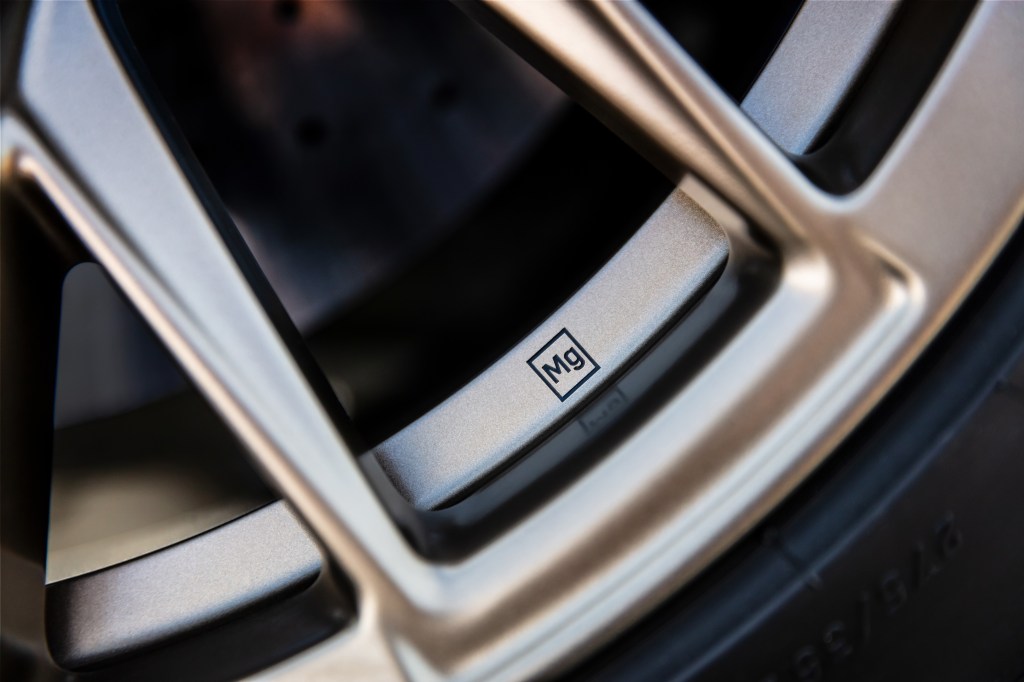
Growing up in Brooklyn, when the American muscle car was taking over the street, you weren’t tough if your nose-down ride didn’t have mags on it. You know, custom wheels, maybe bought at a place like R&S Strauss, the absolute hot ticket being the Cragar S/S. The wheels took their nickname from the original magnesium wheels, even though they didn’t contain a single grain of magnesium, just lots of chrome plating. It was kind of an insult to real magnesium wheels. Magnesium is the lightest structural metal in existence, which means you can cast a wheel out of the material that’s considerably lighter than an aluminum one. Competition magnesium wheels made by Halibrand and Campagnolo found their way to the Indianapolis 500 and onto years’ worth of Ferrari endurance and Formula 1 cars. Real magnesium wheels generally aren’t found on the street. But here’s an exception.

T

If you keep up on American high performance, you’re doubtless aware that Cadillac not only produces some highly credible sports sedans, but also participates in the IMSA Weathertech sports car series with its DPi-V.R prototype. That relationship is going to bear some tangible fruit as Cadillac prepares to roll out its 2022 CT4-V Blackwing and CT5-V Blackwing next summer, representing Cadillac’s new performance pinnacle. They will become the only vehicles in General Motors’ global product lineup to offer actual forged magnesium wheels as optional factory equipment. Magnesium has some ideal properties when cast into wheels: It makes for crisper chassis response by reducing unsprung weight at the car’s corners, and the metal processes vibrations by turning them into heat energy, which is harmlessly dissipated.

Here’s the whole Golf R

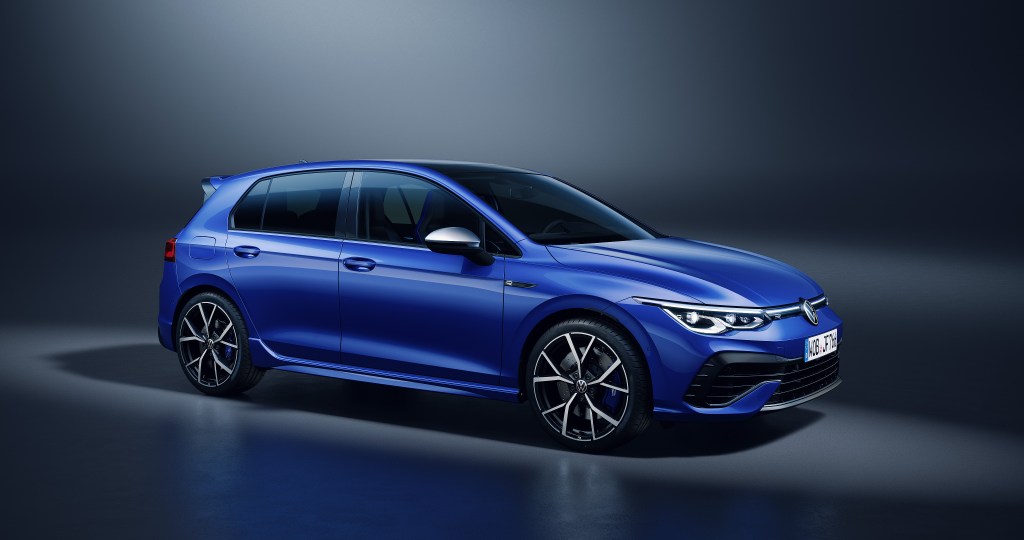
Sorry, but we just had to give this, the latest iteration of an original hot hatch from Day One, another look. And it’s a validation of the notion that when it comes to cars, as with so many things in life, evolution can be a beautiful happening. The 2022 Volkswagen Golf R that teased about here very recently is indeed out of the bag, all of it, starting out with its zinging 310 standard, turbocharged horsepower backed up by 310 pounds of torque. In this week’s reveal, Volkswagen has proclaimed that this all-wheel-drive (also standard, as in all previous editions of the Golf R) subcompact will rip-snort its way from 0 to 62 MPH – that’s 100 km/hr, the national speed limit in Canada – with an indicated top end of 155 MPH. An all-weather megahatch. What a concept.

A major part of this news story is that the Golf R, shown above in Euro-spec trim, will boast another sort of evolution, that being an enhanced version of the 4Motion all-wheel drive system. It adds a second differential located between the rear wheels, controlled by the Golf R’s Vehicle Dynamics Manager and using active chassis damping, the system can distribute torque between both rear wheels for optimized grip, a process known as torque vectoring. It’s an advance that’s exclusive to Volkswagen. The 1.8-liter EA888 engine sets new output benchmarks for this engine design. Both the intake and exhaust camshafts employ variable valve timing. Seriously, this is real go-fast goodness with some impressively taut visuals. Pricing will come later, but you can look for this to hit the showrooms in the latter part of 2021.

This week: A new Golf R

One of the cool things about doing this is that you get to keep pace with everything that’s in the auto industry’s pipeline when it comes to new vehicles, engines and technology. And there’s a big one coming this week. Volkswagen will continue a performance heritage that reaches back to 2002 when it rolls out its new Golf R on Wednesday. It will sit atop the model hierarchy of the eighth-generation Golf, and thereby occupies a place of honor: When the first Golf R32 was introduced in 2002, it immediately outsold the manufacturer’s projections by 300 percent. That makes this an important car. Volkswagen promises it will be a worthy successor.

Perhaps the most noteworthy news concerning the new Golf R will be its use of Volkswagen’s 4Motion all-wheel-drive system, with driver-selectable torque control for power directed to the rear wheels. The 4Motion system is managed by communication with other chassis controls including the Golf R’s electronic differential locks and its adaptive shock damping. Volkswagen is saving the precise output numbers for the car’s actual introduction, but assures the Golf R will receive the most powerful version of its EA888 2.0-liter turbocharged inline four, with direct injection, a water-cooled exhaust gas duct in the cylinder head that feeds the turbocharger, and variable valve timing with dual camshaft adjustment. Put it this way: The performance Golf it replaces had a factory rating of 292 horsepower. We’ll see it that number gets toppled.