Crazy power, reduced poundage mark BMW’s M5 CS

Let’s be honest here: Every so often, a good rap across the forehead can do wonders at refocusing the conscious for many of us. BMW has a somewhat understated way of achieving the same effect, in this case by announcing a limited-edition, ultra-performance version of the already exclusive M5 sport sedan. While it hasn’t discussed either pricing or production totals yet, it’s clear that BMW intends for this new low-build model, which will only be offered in the 2022 model year, to forcefully grab your attention. We assure you, the M5 CS can accomplish that objective, and others.
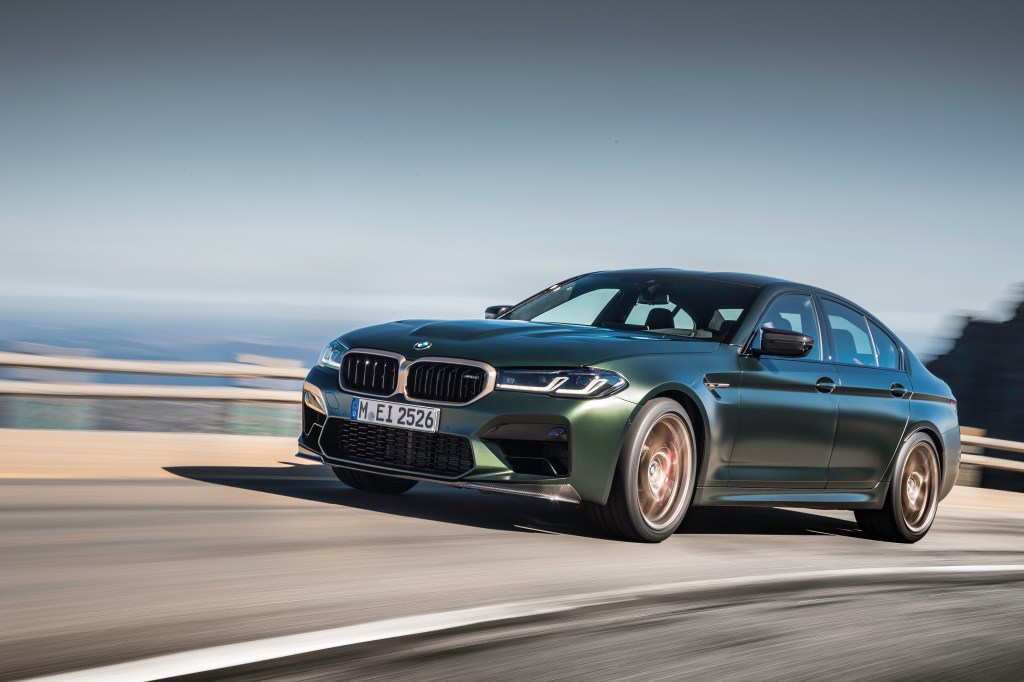
BMW flatly calls the M5 CS the quickest and most powerful production automobile in its history. To wit: The 4.4-liter twin-turbocharged V-8, with dual oil pumps, will produce 627 horsepower and 535-lbs.ft. of torque, while linked to a standard eight-speed M Steptronic automatic transmission and standard M xDrive all-wheel drive. BMW is announcing an observed top speed of 190 MPH with 0-60 taking just 2.9 seconds. Part of the reason is that the enhanced use of composites in the design and assembly process cuts overall weight by 230 pounds over the already potent M5 Competition model, while beating the same car’s total output by 10 horsepower. The CS also boasts a broader power band than the M5 Competition. To cope, the CS has its spring ratings increased by 10 percent, its ride height dropped by 0.2 inch. Carbon ceramic brakes with six-piston front calipers are standard. The one-year-old distinction will guarantee the M5 CS instant-collectible status when the first units arrive in the second half of this year.
GM, Navistar combine on fuel cells for heavy trucking

You’ve read here recently about how Hyundai has been laboring away at its plan to build over-the-road highway trucks powered by hydrogen fuel cells, a technology that, along with autonomous driving, promises to upend the interstate cargo industry as fuel technological advances in the past ever have. This might be a good juncture to lay out exactly what a fuel cell is, and does. If you look at a heavy truck today, you’ll see fuel tanks, usually on either side underneath the cab, mounted to the frame rails. The hydrogen fuel cell – in industry parlance, it’s now called a cube – can be packaged aboard a big rig just as easily, in the same spot, lined up in twos or threes, linked to the truck’s onboard battery pack.

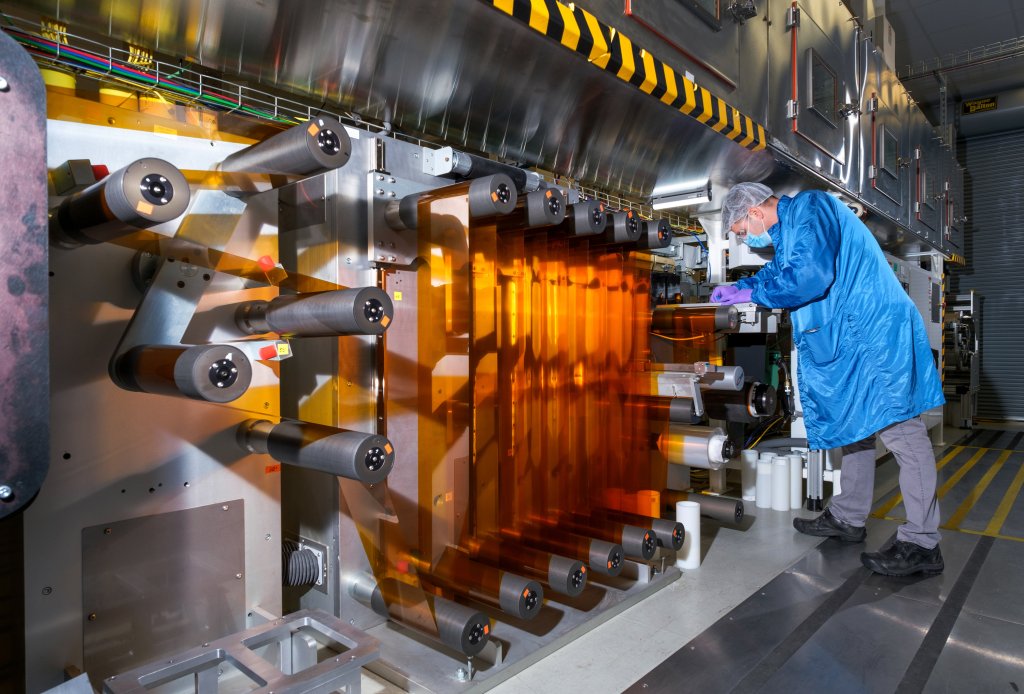
General Motors has converted a former assembly plant in Pontiac, Michigan, over to fuel cell research and the development of manufacturing processes, now calling the facility the GM Global Propulsion Systems Pontiac Engineering Center. GM refers to its fuel cells under the trade name Hydrotec, and this week announced a deal with Navistar Corporation, the successor to International Harvester, under which GM will supply the truck manufacturer with Hydrotec cubes, each containing about 300 individual fuel cells, for Navistar’s forthcoming International RH Series of fuel cell electric trucks. Navistar and GM already have a collaborative agreement developing and building Navistar’s CV series of medium-duty hydrocarbon-fueled trucks, which replaced the foregoing Chevrolet Kodiak.

Saluting Audi’s all-conquering quattro driveline system

If you really like motorsport, you’ve got to appreciate the beat-the-clock, brutal purity of international rallying. And if you respect that world, you likely hold Audi in high esteem indeed. It’s not the first automaker to seriously experiment with all-wheel drive, but Audi is the first – we apologize to fans of Ferguson, which helped create things like the AWD Jensen Interceptor – to fully weaponize the technology for combat on the klieg-lit stage of global competition. The quattro system, small “q,” revolutionized the craft as few advances before or since have done. The rally version of the Audi quattro is one of the sport’s most influential and devastatingly effective cars, definitely in the same rank as the Saab 92 and the original Mini Cooper.

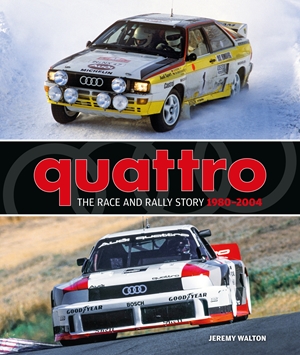
This sort of march to utter greatness deserved an in-depth look in print, and lo, it’s finally received one. My pal Jeremy Walton from the U.K., long a contributor to both Motoring News and Motor Sport, has unleashed his prose and technical knowledge on this preemptive nuclear strike-level rallying legend. quattro: The Race and Rally Story is an intensively detailed, 304-page romp through the history of Audi’s rally program, which, for yours truly, has a personal connection. One of the luminaries in the book is John Buffum, the greatest rally driver the United States has ever produced, who campaigned the quattro early in its development from his Libra Racing base in Vermont. The last time I was there, John’s shop also housed the World Rally Champion entry of Michele Mouton, just one of the drivers to achieve global stardom with a quattro, the list also including Stig Blomqvist, Walter Rorhl, Bobby Unser and Hurley Haywood, the latter noting rare non-Porsche achievement for Audi. All told, Audi captured three WRC titles and a like number of Pikes Peak scores before Haywood and Hans Stuck brought it closed-circuit glory via the Trans-Am Series and IMSA. All of it, including full engineering background, is in Walton’s excellent book. It lists for $80.00 in the U.S. from Evro Publishing; it’s available to order via Motorbooks by going here.

Interior quiet, exterior freshness define 2021 Buick Envision

You might not realize it, but the Buick Envision, Flint’s five-passenger compact crossover SUV, has recently established itself as Buick’s third largest-selling model. It may also be news to you that this vehicle is manufactured in China for the North American market, assembled by the SAIC-GM joint venture in Jinqiao, Shanghai. And while the Envision sold more than 33,000 units here in 2019, more than four times as many examples were sold that same year in China. So the Envision is a legitimately international vehicle, and after a series of facelifts, it’s getting the full second-generation treatment from Buick in 2021.

Descended thematically from Buick’s Rendenvous and Rainier model likes, the Envision rides on a version of the General Motors Epsilon vehicle platform, the E2XX, which it shares with vehicles including the Chevrolet Malibu and the Buick LaCrosse-based Roewe 950 for the Chinese market. With a wider stance, the new-generation Envision will be offered in three trim levels: Preferred, Essence and Avenir, with a Sport Touring package available on the first two model designations. A 10.2-inch touchscreen its standard, and Amazon Alexa integration is optionally offered. Pick the Avenir, and you get a standard heated steering wheel, along with active interior noise cancellation and a full suite of driver aids that include emergency barking and lane departure assist. Standard power is a 2.0-liter turbocharged inline-four with 228 horsepower, linked to a nine-speed automatic transmission, with available all-wheel drive.

Aluminum scraps add up to green energy savings in Nissan Rogue’s assembly process

If you’re like us, and you get seriously annoyed every time you see some fool pitch an empty Busch or Coors can out the window, take heart. Not everyone among us is that kind of irresponsible. Hopefully, that helps to explain why it’s gratifying to learn that the science of recovering waste metals is an ongoing learning process aided by industry. It’s good for the environment and moreover, just plain good business. Nissan recently issued an explainer on how it saves metal, and energy, in the manufacturing process for the Nissan Rogue, its midsize crossover SUV, which happens to lead that segment of the U.S. market in terms of sales. Here’s what we learned.

Most of the 2021 Rogue’s structure is robotically welded from stamped steel, in keeping with common industry practice. To save weight, and thereby boost the Rogue’s EPA mileage rating, its hood and doors are stamped from aluminum, rather than heavier thin-gauge sheet steel. If you’re familiar with the process, you know that refining bauxite into raw aluminum requires vast amounts of electric power. Nissan has partnered with Kobe Steel Ltd. and UACJ Corporation in Japan, and with Arconic Corporation and Novellis Inc. in the United States, to create a closed-loop recycling system for the Rogue’s aluminum components. As aluminum sheet is stamped into body parts, leftover scrap is shredded and collected using a pneumatic system, then separated by metal grade and returned to a processing firm. This kind of recycling reduces the amount of energy that would have been required to make aluminum from raw bauxite by more than 90 percent. You do the math. This is what can happen when the private sector commits itself to environmental responsibility.

VW sinks its Golf putt

Literally breaking this minute, here’s some huge news, albeit not unexpected: Volkswagen of America has halted production for the U.S. market of one of the most instantly recognizable and highly influential cars in modern automotive history, the subcompact Golf. Assembly of the landmark econocar will end later this month at Volkswagen’s plant in Puebla, Mexico, as the iconic automaker prepares to unveil an entirely new Mk 8 Golf GTI and Golf R, with their arrival in showrooms eyed for sometime this fall.

How important was the Golf to Volkswagen? Although it was sold side-by-side with the Beetle for a time after its 1974 introduction – in the United States, it was first known as the Rabbit, and built for a time in New Stanton, Pennsylvania – the Golf ultimately shoved Volkswagen’s pioneering vehicle aside, at least in the U.S. market. The Golf has been produced across eight generations, and its front-engine/front-drive/water-cooled execution instantly redefined everything Volkswagen had been until that point. More than 2.5 million copies of the car have been sold in the United States alone, including the fleet of baby-blue diesel Rabbits, with matching interiors, that did yeoman duty as photo and circulation cars at the newspaper where I worked in New Jersey. One car’s dashboard broke free due to the diesel’s incessant pounding, but who cares? The last of the current design, the 2021 Golf TSI, is the sole Golf model now offered and rides on Volkswagen’s MQB platform. Current cars will remain on sale until the inventory from Puebla is exhausted.

Lotus, Alpine declare alliance

Here’s a corporate hookup that’s certainly less than obvious, if only for the geography involved. British and French collaborations on car design aren’t numerous, and certainly make news when one such joining occurs. This one is especially noteworthy, both for the names involved and for the hoped-for outcome. Groupe Renault and Group Lotus – historic competitors on the world’s race courses, especially in Formula 1 – have signed a memorandum of understanding on mutual design cooperation, specifically on the development of an all-electric supercar, using the Lotus and Renault-allied Alpine brands. The deal underscores the sheer immensity of trying to design any EV from scratch, which has sent any number of automakers far larger than these two to establish partnerships in the hopes of flattening some of the technical and financial obstacles to large-scale EV production.

Given that the deal was only disclosed this week, it’s useless to speculate on what sort of car might result, except that it’s safe to say that it won’t be the one depicted above, the revived Alpine A110. Introduced in 2017, the A110 is a rear mid-engine sports car that recalls the original Alpine A110, a rally legend built between 1961 and 1977. Founded in 1955, Alpine is the longtime tuning partner of Renault, in BMW/Schnitzer fashion, right through Renault’s bonding with Nissan. The reimagined A110 is built in small numbers at the Alpine factory in Dieppe. Last year, Alpine announced a partnership with MV Agusta to produce a special limited edition of the MV Agusta Superveloce sport motorcycle. Alpine has fielded an Oreca-built LMP2 prototype with Nissan power, and the Renault team in F1 will be rebranded as Alpine F1 this season. If the notion of a French alliance with a chauvinistically British nameplate like Lotus seems a little strange, consider that since 2012, Renault and Caterham Cars – which made its rep selling updated takes on the iconic Lotus Seven – have owned a 50 percent stake in Alpine and its operations.

The light that memorializes a nation’s terrible loss

Somehow, this just seems like an appropriate gesture to recognize today. The United States has paused through several venues leading up to today to remember those who have been claimed by the global coronavirus pandemic, an American toll of sorrow that passed 400,000 lives this week. Different entities have marked that grim benchmark in different ways. The Ford Motor Company chose a historic initiative as its canvas for creating a memorial to those lost to COVID-19. Ford presented its tribute overnight yesterday.

Ford chose to light up not only its world headquarters in Dearborn, Michigan, last night, but also lit up the historic Michigan Central passenger rail station in the Corktown neighborhood of Detroit that the auto giant is restoring as part of a major investment in renewing the city. The Michigan Central memorial was planned by the 2021 Presidential Inauguration Committee, which also created the sea of flags, representing the pandemic’s fallen, around the Lincoln Memorial Reflecting Pool in Washington that was so prominently displayed this week. Mostly during my time with Hemmings Motor News, I had the chance to explore this spectacular, and spectacularly neglected, structure from just outside its gates. Opened in 1914, the Beaux Arts station structure was abandoned and vandalized for years, and seemed like a sure candidate for the wrecking ball until Ford stepped it. Ford bought the station, and the adjoining Roosevelt Warehouse, in 2018 and is redeveloping the site as its Corktown campus, a $1 billion project that will repurpose it as Ford’s research center on autonomous-vehicle development.

The car that saved Porsche marks its 25th birthday appropriately

For all the endless discussion about how SUVs transformed Porsche, there’s another vehicle in its product portfolio that deserves special mention. Recall that in the early 1990s, Porsche was in fiscal disarray as sales of its two front-engine GTs, the 928 and the 944-derived 968, seriously flagged. The immediate decision was to create a sports car that strongly recalled Porsche’s origins as an enthusiast car that used available mechanicals to keep prices within reach. The first result of that initiative was the Porsche Boxster, one of the sweetest-handling sporting pieces you can buy anywhere, at any price. The Boxster, officially Porsche Type 718, has been produced in four generations, and soon spawned a coupe-body sibling, the Cayman. The Boxster was an instant success, swiftly becoming Porsche’s biggest-selling vehicle, and helped it keep the wildebeests at bay until the mega-profitable Cayenne SUV arrived in 2003.

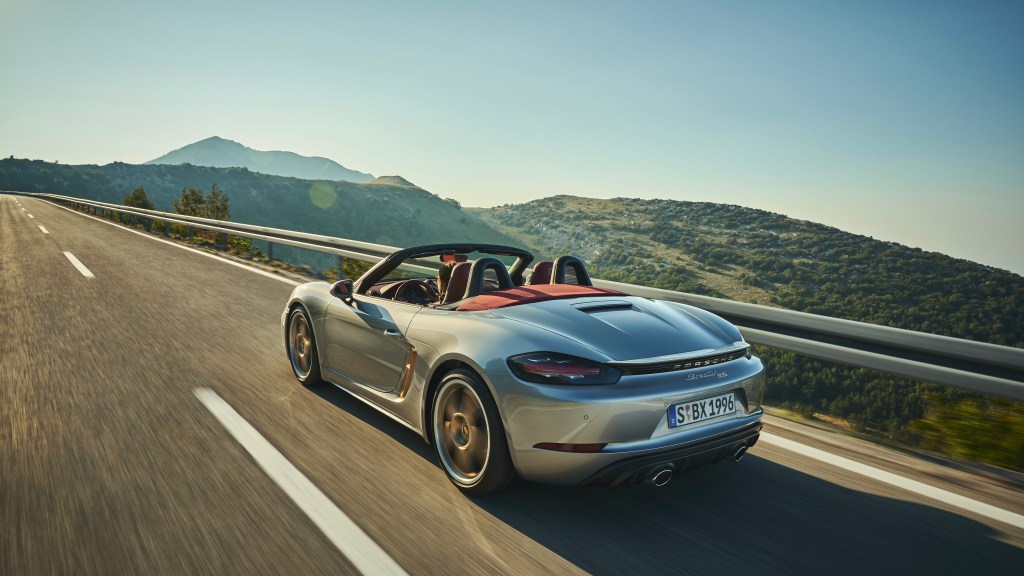
Predictably, Porsche is marking this important milestone with a 25th anniversary edition of the Boxster. Powered by Porsche’s 4.0-liter flat-six, the anniversary Boxster is its use of Neodyme, a metallic brown, as the contrast color for components such as its wheels. Three overall colors will be offered, offset by a red convertible top, Bordeaux leather interior with a heated multifunction steering wheel, and “Boxster 25” accents. It’s available for ordering now with deliver beginning at the end of March. If past Porsche experiences with special editions are any clue, these will be snapped up in a hurry, but take heart: More than 357,000 copies of the Boxster have been produced over its lifespan, and enthusiasts prize good used ones as serious drivers cars that can be had for short money.

The racer’s edge, interpreted as a digital road map for drivers

Great racing drivers aren’t born, they’re made, the product of unshakeable personal focus and technical excellence gained by years of training and practice. It’s a learning curve that can’t be made any less sharp. For ordinary drivers, the kind who can go through a lifetime of motoring without getting paid or saluted for doing it, the kind of skills that racers possess have usually been unattainable. Only now, Toyota thinks it’s discovered a training tool. In cooperation with Stanford University in California, Toyota is gradually developing a list of algorithms that could be used to program driver-assistance technologies in future cars.

Stanford researchers have been putting professional drivers in a DeLorean DMC-12, of all things, modified for drifting and data acquisition. Using the drivers’ reactions in the DeLorean, which the research team has named MARTY, Stanford has been able to write algorithms that could, in both theory and practice, allow for autonomous vehicle reactions to sudden direction changes and the like, using a database gleaned from the drivers’ responses at the wheel. One such algorithm has allowed control of a rear-drive vehicle in a drift situation. Toyota has joined to adapt this collision-avoidance architecture to vehicles in its own fleet, such as the GR Supra. Toyota Racing Development is handling the bulk of the work with Stanford. Toyota has the stated goal of reducing the world’s 1.25 million annual traffic fatalities to zero.