How rodders learned their craft

Life comes to a temporary stop anytime we get a mailing from CarTech Publishing in Minnesota, because they have a demonstrated knack for editing and producing automotive histories that cram an impressive level of sheer information into a package that’s pleasantly easy to both digest and afford. One such package showed up on the doorstep recently that we’ve got to share, right now. The author is my longtime Hemmings cohort Bob McClurg, who moved to Hawaii after one of motoring journalism’s most stellar and comprehensive careers. An accomplished CarTech author, Bob’s latest endeavor is a comprehensive history of the shops – all of them, and there used to be plenty – where car enthusiasts gathered to shop, socialize and strategize about speed. If you’re even peripherally excited about either hot rodding or auto racing, you’ve simply got to have his book.
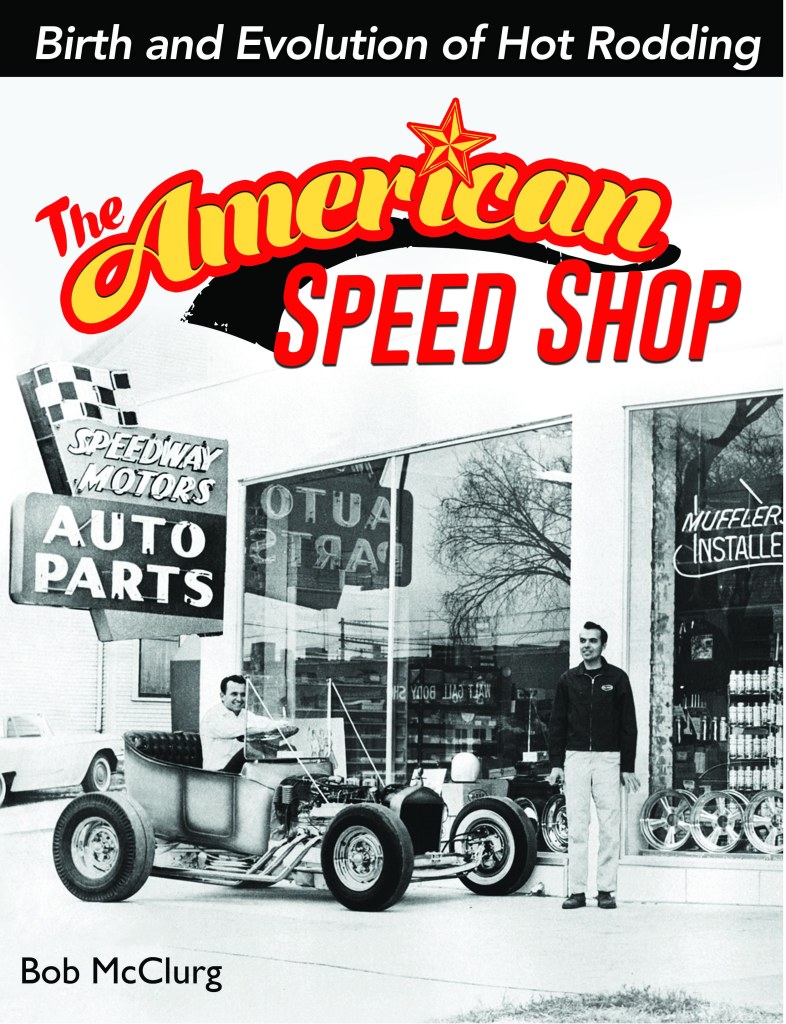
The American Speed Shop isn’t the first book that’s ever attempted to catalog the hundreds of retailers who sold speed equipment, and thus created a billion-dollar industry, but it’s certainly the most digestible and user-friendly such effort we’ve yet encountered. The author takes 192 hardcover pages, with more than 400 photos, to tell how this industry evolved. Each shop – and the appendix that lists them runs into the hundreds of entries – gets a useful capsule in the text, which covers both the Mom and Pop businesses as well as the mega-retailers that followed, led by the likes of “Honest Charley” Card from Chattanooga. It was amazing to find one such listing on the Manhattan Speed Shop in New York City, which operated a shop on lower Broadway for years, and also backed the dirt Modifieds that Roger Laureno and Whitey Kidd Jr. arced around Flemington Fair Speedway. The history of SEMA, the industry lobbying giant that these retailers created, is also fittingly told. The foreword is by the late Tom Madigan, an acclaimed journalist who penned biographies of pioneering speed magnates such as Vic Edelbrock Sr., Bill Stroppe and Mickey Thompson. This very impressive work retails for $42.95.

Bentley’s bespoke Bentayga

In what must have been an intriguing step for Bentleyphiles, the company that W.O. Bentley conjured in Cricklewood, England back in 1919, the year my mother was born, has experienced something of an epiphany: With its newly introduced Bentayga – if you need a tutorial, it’s pronouned Ben-TAY-guh – Bentley is all of a sudden in the SUV business. There’s considerable interest, given the fact that the crew at Crewe has loving pieced together some 20,000 examples of the base V-8 Bentayga since the model was announced. Thats’s an impressive figure, enough so that the Bentayga joins the rest of Bentley’s lineup in becoming eligible for the Mulliner Personal Commissioning Guide, a wellspring of personalizing that befits a vehicle in this lofty category.

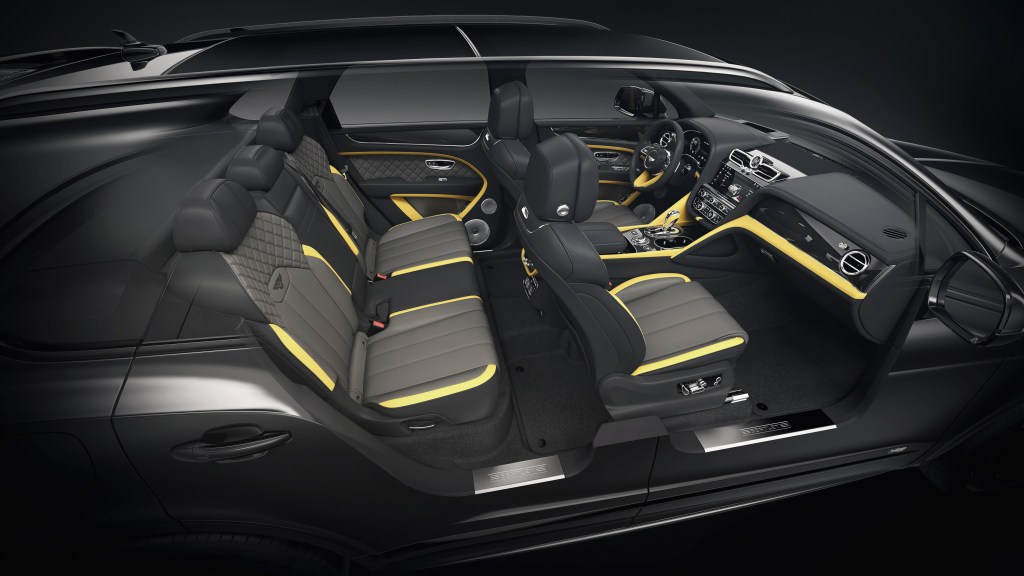
A look at the bespoke Bentayga interior above reveals that at first glance it’s in keeping with SUV all-activity aesthetic practice in its color selection, note the jaunty yellow accents throughout the cabin. The Mulliner guide, named for Bentley’s eternal London coachbuilding partner, is a means to take this variety of self-expression to a level most people probably don’t dare dream about. The potential choices involved are too numerous to list, but here’s a few facts you call mull: In terms of interior hides alone, the Mulliner guide will offer buyers 27 selections. To that, you can add 100 choices for painted veneers in the cabin, wheel options, stitching selections, an out-of-sight paint palette, and on and on. If you’re of the right age, you’ll recall that the Big Three used to allow this kind of option proliferation even on low-price cars during the 1960s before the domestic industry came to realize the cost and complexity that it caused to the ordering process and stopped it. In Bentley’s orbit, these considerations don’t matter. The Bentayga’s V8’s 4.0-liter twin-turbo engine produces 542 horsepower. The model range will grow soon to add a hybrid and the Bentagya Speed, fitted with the 6.0-liter W-12 we discussed here recently, good for a thumping 626 horsepower and a claimed top end of 190 MPH.

Self-driving at VW by 2025

Right now, it’s focused on trucks and other purposeful driving, but Volkswagen Commercial Vehicles, a Volkswagen Group subsidiary, is relying on a reimagined street icon as it prepares to implement autonomous driving in actual traffic use by 2025. The platform for this advancement is Volkswagen’s ID. BUZZ, a prototype for a coming all-electric takeoff on the legendary Samba van, which is expected to make its premiere sometime next year. Field testing is beginning in Germany on the self-driving system created by Argo AI, into which Volkswagen invested a billion dollars last year to develop self-driving logic.

If you found the original Samba as appealing a piece as we do, you’ll likely welcome its revival, no matter who or what is doing the driving. The overarching strategy behind the ID. BUZZ is for the van to incorporate ride-hailing and -pooling capabilities in urban areas. Meanwhile, Volkswagen has further applied billions of euros to its in-house Car Software Organization, which will be creating autonomous programs for non-commercial vehicles – the rest of us, in other words – while the commercial group gears its work toward eventual use by such providers as robo-taxis and van services.

Volvo goes gas-free by 2030

If you grew up long enough ago to remember when Volvo’s product lineup was anchored by the venerable 122, known affectionately as the Amazon, you appreciate that the nameplate’s reputation in this country was forged via a message of staid-but-competent conservatism, The flip side of all this is that the Amazon was denuded a long time ago, Volvo isn’t a Swedish automaker any longer and in the world as a whole, societies are trying to keep the ozone layer from being fried into nothingness, with calamitous consequences. For all these reasons and more, Volvo, now a holding of the Geely automotive conglomerate in China, confirmed what’s been rumored for months: It will abandon the production of all cars using internal combustion engines – including hybrids – by 2030.

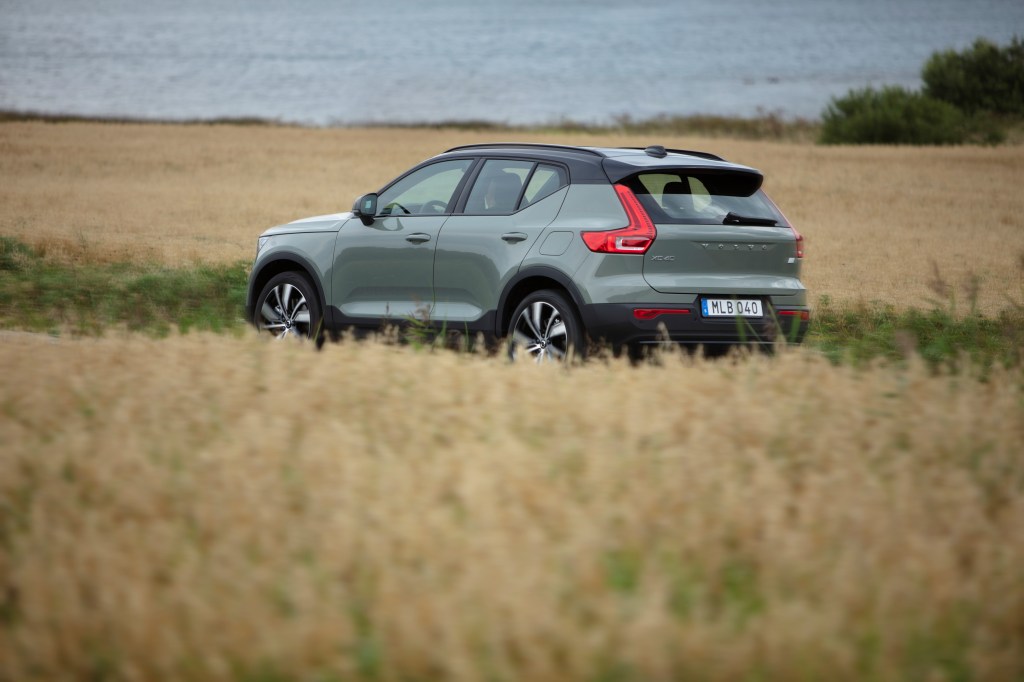
Auto manufacturers tend to view the process of going non-ICE as an effort to meaningfully reduce the firms’ life-cycle carbon footprint per individual vehicle. We have essentially reached the point where it’s no longer economically feasible for some automakers, especially those with non-Big Three sales volumes such as Volvo, to produce and federally certify gasoline-fueled powertrains that a diminishing number of customers are interested in buying in the first place. With doleful apologies to the naysayers, this is a textbook case of market forces driving management decision-making. It’s a big part of why Volvo introduced the above-depicted vehicle, the XC40 Recharge, in global markets late last year as its initial fully electric offering. Volvo’s plan envisions that by 2025, half of its global production will be fully electric, with the remainder hybrids. That means Volvo’s departure from pure ICE power is imminent, a reality that may be wistful for anybody who’s ever felt an overhead-valve B18B shake its way out of slumber.

Doings for drivers in Detroit

It was good to get a communication this week from longtime associate Tim McGrane, a genuine mover in the world of collector cars whose personal CV boasts stints at the helm of the Blackhawk Collection in California and as head of the famed road circuit, Laguna Seca, on the Monterey Peninsula. Tim’s moved east for a new position as CEO of M1 Concourse, a motoring country club for enthusiasts who really like to use fast cars as properly intended, located in Pontiac, Michigan. Cognoscenti from the Wolverine State will immediately get that the facility’s name is a takeoff on a famous local highway designation, namely the immortal Woodward Avenue. M1 Concourse, under Tim’s leadership, has a cool array of forthcoming events that includes a matter of personal significance.

This Motown country club for car people includes 250 private garage condominiums, related amenities and Champion Motor Speedway, the 1.5-mile driving circuit that’s the centerpiece of the complex, opened in 2016 on the former site of General Motors’ Pontiac West assembly plant. M1 Concourse has three major weekends slated for its 2021 schedule, post-pandemic. The Woodward Dream Show, August 19th-21st, is an adjunct to the famed Woodward Dream Cruise. The facility’s signature 2021 event will be the inaugural American Speed Festival, set for September 30th-October 3rd, a combination of vintage races on the course with a limited car show honoring the Chaparral race cars of Jim Hall. The American Speed Festival will also host the induction ceremonies for both the 2020 and 2021 classes of inductees to the Motorsports Hall of Fame of America, which was located for a long time in nearby Novi, Michigan, before moving to Daytona International Speedway. Full disclosure, I’m an elector to the hall, which was forced to postpone both programs due to COVID-19 restrictions.

A boonie-buster from Shelby

Think about it: Those two great American icons of the automobile, Mickey Thompson and Carroll Shelby, never cooperated on a vehicle together, in large part because each man’s road map through the industry and racing took such very different courses. Shelby was a Le Mans winner and a folk hero of international sports cars. Thompson was a hardcore hot rodder and drag racer who attacked Bonneville, Indianapolis and later largely invented stadium off-road competition. If both these guys had sidled up to each other in life and decided to cooperate on a vehicle design, we have a reasonable idea of what might have resulted. Here it is.

You notice they even got the color right? This is the 2021 Ford Shelby F-250 Super Baja, a traditionist off-road that happily rumbles its way right on by current considerations about carbon neutrality and the like. That ain’t no game for this arena, hoss: To be produced in a limited run of just 250 units, the F-250 Super Baja mates the Navistar-built Ford 6.7-liter Power Stroke turbocharged diesel V-8 with a Shelby American-scienced suspension created in collaboration with FOX Performance, of off-road shock absorber fame. The Super Baja struts on 18-inch alloy wheels shod with 37-inch BFGoodrich mudder tires, including a pair of spares riding the custom steel chase rack in the cargo bed. Vents, steps, lights and powder-coated trim abound. The stance and vibe speak for themselves. All this and 475 Navistar horsepower. Click to get on line, and if you’re picked, the tariff will be $125,805.

IONIQ evokes the first Hyundai

Elsewhere in the industrial powerhouse of South Korea, Kia’s sibling, Hyundai, has had its own newbie to roll out. And more than a vehicle, it’s actually a whole new brand. IONIQ, all upper case as per Hyundai style, is its nameplate for in-house EVs, which it marked this week by introducing the IONIQ 5, using the corporation’s BEV platform that’s exclusively earmarked for electric vehicles. The BEV derivative it rides on is known internally as E-GMP, standing for Electric-Global Modular Platform, an architecture that allowed the vehicle’s wheelbase to be extended as you can see in the photo, which comes to the round number of 3,000 millimeters. That treatment is intended to remind buyers of the humble vehicle that led Hyundai to its present station in global industrialization.

Look analytically at the interplay between the front fascia – there’s no grille, obviously – the rounded wheel arches, and the angle of the rear backlight. The IONIQ 5 is intended to be reminiscent of the Hyundai Pony, which debuted in 1975, a good decade before Hyundai first arrived to do battle in the U.S. market. So let’s say here that the first Pony was a thoroughly conventional compact sedan with a longitudinal layout and rear-wheel drive. It used engines and transmission supplied by Mitsubishi (the Hyundai Excel that succeeded the Pony, the first car Hyundai actually brought to the U.S., was a knockoff of the Mitsubishi Precis and Hyundai’s first front-drive car), and rode on a chassis designed by the British icon John Crosthwaite, the same guy who created the Lotus Eleven sports racer and later, the Intermeccanica Italia, the handsome, Ford-powered Italian-American collaboration.

Kia says so long, Sedona

We ought to start out by declaring what the new Kia Carnival isn’t before we disclose what it actually is. Initial reaction aside, this is not a rebadged or repurposed Telluride SUV. Instead, the Carnival is a completely new vehicle, probing a segment of the market that’s still early in its evolution. The Carnival is Kia’s entry that replaces the longstanding Sedona minivan, About the only thing the Carnival shares with its predecessor is three rows of seats. The Carnival is described by Kia as a “multi-purpose vehicle,” and despite its decided SUV-ish two-box profile, we need to make clear that by the conventionally accepted defnitions, this is not an SUV.

First, the seven- or eight-passenger Carnival is front-drive only; the standard engine is a best-in-class 3.5-liter V-6 producing 290 horsepower, linked to an eight-speed automatic transmission, and with a standard towing capacity of 3,500 pounds. Styled at Kia’s design complex in California and sharing its new N3 platform with the Sorrento SUV and the K5 sedan, the Carnival boasts a lower-than-normal step-in height, removable bucket seats, and available reclining VIP seats throughout the interior. The center seat can be folded down to create a table inside the cabin. The dashboard incorporates a matched pair of 12.3-inch LCD screens; one for vehicle information, one for infotainment purposes, with the most comprehensive ADAS suite in its segment. Due in the second quarter, the Carnival will be offered in four trim levels.

Another Lordstown milestone

General Motors has a long, rich and decidedly uneven history in Trumbull County, Ohio. The massive assembly plant it opened in 1966 in Lordstown was one of the domestic auto industry’s first geared solely to producing compact cars. It was tasked with building the crucially important Chevrolet Vega subcompact, but an assembly line speedup led to a bitter national strike against GM in 1972. We all know how the Vega turned out. I have a good friend whose father was then a GM worker and who described his family being forced to live on grilled Spam during the yearlong walkout. Skidding sales of compacts led GM to shut down Lordstown Assembly in 2019 after its final vehicle, a Chevrolet Cruze LS, came down the line. The main plant has been taken over by Lordstown Motors, a startup that plans to build EVs. Elsewhere on the property, GM is making its own moves in that orbit.

This past week, ironworkers at the Lordstown site bolted in the final beam during a “topping out” ceremony for the new plant that’s going up, in which GM and LG Chem will team up to produce battery cells under their joint venture, Ultium Cells LLC. The partners are investing $2.3 billion to build what will ultimately be a 2.8 million-square-foot assembly and shipping operation.When completed next year, the plant will cover the equivalent area of 30 football fields and will have the capacity to produce batteries with the combined capacity of 30 gigawatt hours, with room to expand. Given the Youngstown region’s recent economic history, it’s encouraging to know that GM and LG Chem envision that the Lordstown project will create 1,100 new green-technology jobs in northeastern Ohio.

Three rows of joy from Bentley

When it comes to technology that bespeaks uncompromising powertrain sophistication, few concepts get it done as forcefully as a 12-cylinder engine. There’s a guy across the street from here who vintage races an E-Type and an XJS, both with unmuffled Jaguar V-12 power. It’s very enjoyable when he stretches the cats’ legs by blasting up and down the road. You get it. Twelve-cylinder engines have commonly used the vee configuration, meaning that to accommodate one, you usually need a long hood: Think about a 1934 Packard, or a Ferrari 275 GTB/4. Packing twelve cylinders hasn’t always been practical, but there are ways to get it done. Here’s a technically delicious solution from Bentley,

The delightful image from Bentley shows what we’re talking about. A relatively recent strategy for packaging 12 cylinders in compact confines, largely as defined by Bentley, involves adding a third cylinder bank. It’s not easy to pick out visually, but this new 12, earmarked for Bentley’s forthcoming ultra-exclusive Mulliner Bacalar, has a middle cylinder bank rising vertically from the crankshaft bore. Bentley has been doing this for a considerable while, having introduced its first twin-turbocharged W-12 in 2003, and refining the process ever since. So far, the world’s only W-12 to see volume production has been produced by the Volkswagen Group, which happens to own Bentley, and was the source of that 2003 powerplant. It resided in the short-lived luxury Volkswagen Phaeton sedan before being making its way to the Bentley Continental Flying Spur and then back to Volkswagen, where it was offered in the Tourareg. The Mulliner Bacalar engine displaces 6.0 liters and produces 650 horsepower, while also reducing emissions by 28 percent over previous W-12s. Bentley has produced some 100,000 engines of this configuration for Volkswagen Group use at its base in Crewe, England.