Roaring ’20s in Greensboro

Shop regularly for a whimsical collector car, prowl the auctions, and you’ll find out fast what sells fast at big numbers: Muscle cars. Anything with a Chevrolet bowtie. Any Chrysler product of any generation with any Hemi engine. Lately, the first-generation Ford Bronco, early Toyota FJ40 Land Cruiser and Volkswagen Samba microbus, especially the 21-window variety, are hot as a stolen pistol. Finding something from deeper in history, especially from the 1920s, when literally hundreds of smaller manufacturers folded as the industry coalesced around the emerging Big Three, can be a serious challenge at many sale. That’s why our attention was drawn to the selection of interesting vehicles from that decade, which will be part of a newly scheduled auction next month in Greensboro, North Carolina. It’s handling the collection of a guy who knew, appreciated and understood his Brass Era stuff.
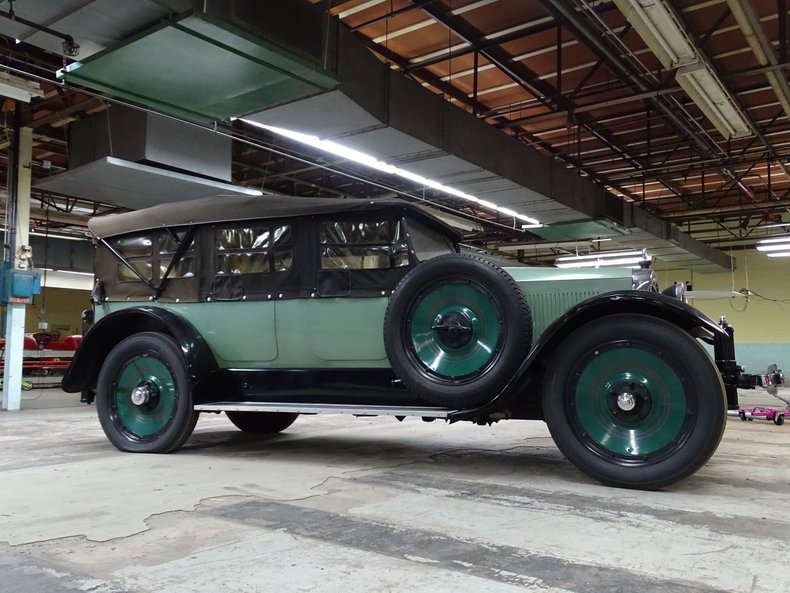
GAA Classic Cars has set aside Saturday, April 24th, to sell the collection of the late Ron Jones of Greeneville, Tennessee, who was the founder and proprietor of RPC Specialty Coatings. Ron certainly liked old cars. His collection numbered 175 of them, vintages 1913 through 2008, all of which will go under the hammer at The Automobile Palace, located at 301 Norwalk St. in Greensboro. Auction chief Johnny Ransom notes the uncommonly strong presence of very early cars in the Jones collection: A pair of massive World War I-era Buick touring cars, three different Ford Model Ts, a pair of Haynes automobiles built in Kokomo, Indiana, including a Model 36 phaeton from 1917 with straight-eight power, and this wondrous creation. It’s a 1920 Winton touring car, which our research pegs as a Model 25, built on the shorter 132-inch wheelbase, and powered by a straight-six that produced 70 horsepower, very substantial output for 1920. This is the automaker that won the first race ever held on the packed sand at Ormond Beach. It’s ready to go, with the apropos side curtains and highly desirable dual sidemount spares. If you’re in the neighborhood, this sale is clearly worth a stop. Speed Sport magazine, to which yours truly is a contributor, will present the GAA auction on MAVTV.

An historic BMW realignment

Change is about to become a serious, tangible reality at BMW, a process that’s actually been underway for a couple of years now, as the Bavarian legend first announced a research initiative into EV powertrains, and then established the BMW Connected Store, one of the industry’s first experiences allowing drivers to pay for over-the-air software upgrades. Now it’s time to get down to the real stuff. This week, BMW revealed the outline of its transition into an EV-dominant company, which will culminate in 2025 when BMW introduces its all-electric Neue Klasse vehicle category, which will boast all-new IT and software architecture, plus environmental sustainability through every chapter of its lifespan, from component purchasing to recycling.

The schedule is comprehensive and impressive. BMW’s all-electric i4 will join existing electrified BMWs three months ahead of schedule as a 2021 model, to be shortly joined by the new iX, which will feature the new, eighth generation of BMW iDrive, the most potent operating system yet installed in one of its vehicles. By the end of the year, more than 2 million BMWs will comprise the world’s largest vehicle fleet capable of over-the-air software upgrades. BMW expects to produce a dozen EVs by 2023, giving it at least one electric choice in 90 percent of the market segments BMW serves. By 2030, EVs will account for half of BMW’s global deliveries. MINI will achieve the same percentage by 2027, and will become an all-electric brand sometime in the early 2030s.

The Viper story in one easy bite

Let’s discuss the author before we talk about his book. If you’re into the world of Chrysler Corporation and its successors, you may not know David Zatz, but you definitely ought to know what he does. David is the founder and the original publisher at Allpar.com, an independent website and online community that covers not only all things Chrysler, but all Jeep and American Motors. If you have a question about Chrysler history, engineering or model development, car or truck, the chances are you’ll find an answer at Allpar, where more than 627,000 historical and data postings are archived. A lot of working journalists rely on Allpar when they need to find a factoid, because the 411 is ready and reliable. So it’s fitting that David Zatz is now also the author of a history on one of Chrysler’s most recently prominent offerings.

The ultra-hairy Viper, with prodigious V-10 power, caused a ruckus out of all proportion to its diminutive production total that’s still going strong. People who do a lot more than venerate Carroll Shelby are mesmerized by this outrageous sports car. In 136 hardcover pages, it tells the story of how the odd couple of Bob Lutz and Francois Castaing brainstormed this Cobra revival, and goes through all the engineering studies, which sadly included a stillborn mid-engine prototype. The full lineup of models, appointments, and the Viper’s impressive competition heritage are discussed in depth. This title comes from Veloce Publishing; we like it because it stands as an easily read model history and a very good quickie reference guide to the wild cars. You can order it direct from Veloce’s website for $27.75.

“Genoa Giant” to DIRT HoF

Genoa, New York, is a little place of fewer than 2,000 souls. It’s in Cayuga County, which places it a little bit north of Ithaca and a little more south of Syracuse. That’s smack in the midst of the Finger Lakes, which means that Genoa is also right in Action Central when it comes to New York’s favorite brand of motorsport, big-block Modifieds running on tight, slick dirt tracks. Fittingly, Cayuga County is also home to the holy place for this sort of racing, the Northeast Dirt Modified Museum and Hall of Fame, right on the grounds of Weedsport Speedway. And it’s proper that a local hot shoe is being recognized for his excellence in the wheelhouse.

The affectionate nickname “Genoa Giant” is a quip on Pat Ward’s diminutive stature, not his ability to win races, something Ward’s been doing since he grabbed his first feature at Fonda Speedway in 1987. Since then, Ward has gone on to another 143 Modified wins at tracks in three states, his resume led by a Labor Day win on the Syracuse dirt mile, the 2012 Outlaw 200 at Fulton Speedway, three Race of Champions series titles and track championships at Fulton, Can-Am and Utica-Rome speedways. Ward will join the hall’s 2020 class, whose induction last year was COVID-cancelled. The 2020 honorees include Delaware star Harold Bunting, Southern Tier standout Joe Donahue, car owner Tico Conley, mechanic and car owner Billy Taylor, promoters Bob and Donna Miller, TV producer Terry Rumsey, April May Preston-Elms, the co-owner of Bear Ridge Speedway in Vermont, and Brett Hearn, the racing genre’s winningest modern driver. Induction ceremonies are set for July 22 at the museum; go to its website to learn more about the sport and its honorees.

Snaky symbolism at Shelby

The phrase “bundle of snakes” has a very special place of respect in the orbit of Ford high performance. It refers to the organized tangle of individual exhaust tubes that Ford created for its racing engines of the 1960s, their port-specific tuning a consequence of Ford’s decision to run a lighter 90-degree crankshaft in the engines, rather than a more normal 180-degree crankshaft that requires counterweights. All the “snakes” are equal length and formed the visual signature of engines used in the original GT40 and Indianapolis 500-winning Lotus 38. When the 2015 Shelby GT350 was being planned for 2015, Ford revived the flat-plane crankshaft and its associated practice of multiple tubes emptying into fewer collector pipes. Now, this famed piece of performance engineering has a Shelby marketing connotation, as well.

To mark what would have been Carroll Shelby’s 98th birthday, and also in recognition of a famous Shelby American competition number, the Las Vegas-based performance automaker is using “Bundle of Snakes” as the verbal entree to its 2021 lineup of modified Ford Mustangs, continuing a tradition that can be traced to the first G.T. 350 of 1965. In ascending order of capability, they are the Shelby GT, Shelby Super Snake and the stirring Shelby GT500SE. all of which will be produced in limited runs of just 98 units per model, along with another 98 copies of the lines’ combined open-top Speedster versions. These Mustangs join the other new Shelby we showed you here recently, the Ford Shelby Super Baja F-250 pickup. Go here to learn about how to get yours, and other Shelby stuff to strengthen your Mustang.

“You have terminal Obsidian.”

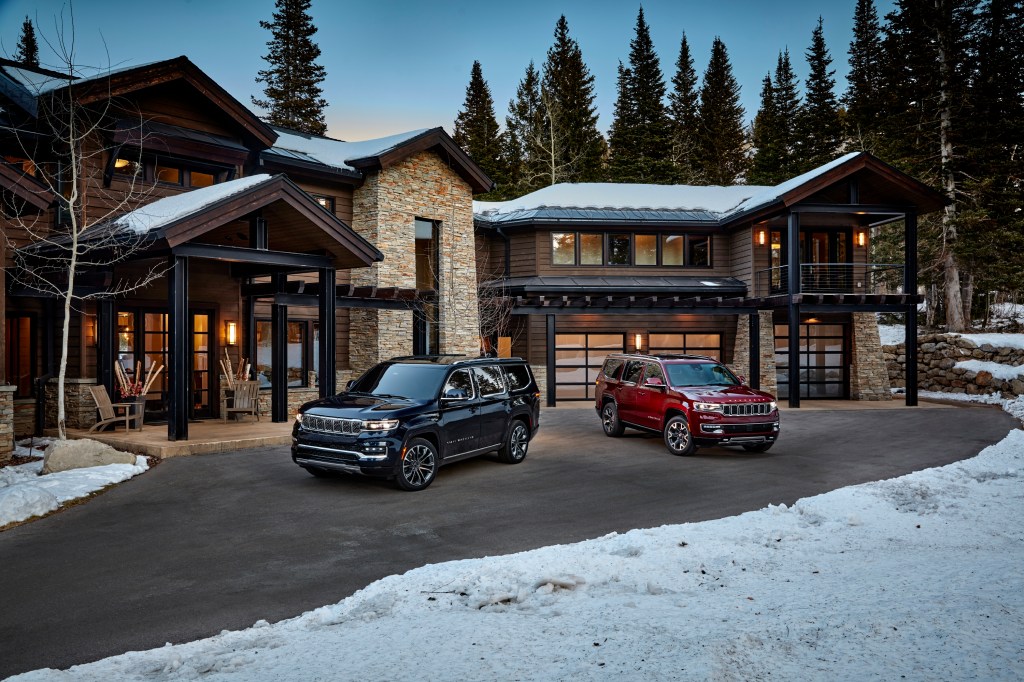
Before people started towing catamarans with loaded Chevrolet Suburbans, before any wizened English farmer conceived that such as thing as a Range Rover would ever exist, people of a certain stripe like to strut in the Jeep Wagoneer and its lavish variant, the wood-side, luggage rack-bedecked Grand Wagoneer. If you’re one of the handful of the more recently born who has no idea what we’re discussing, the original Wagoneer, which lasted in various forms into the 1980s, is the Rodney Dangerfield of historically significant light trucks. It’s based on the station wagon that Kaiser introduced in 1963, which in turn supplanted the ancient Jeep station wagon that had been trundling around since 1948. The Wagoneer, as Kaiser dubbed it, grew in complexity and appointments as Jeep joined the American Motors portfolio. It’s a very big part of the reason why Chrysler bought AMC, and then reimagined the big off-roader as the Grand Wagoneer in 1984, becoming a near-burlesque of traditionalist American station wagon themes.

Chuckle if you wanna, but the facts are that the Wagoneer and Grand Wagoneer made a lot of money for both AMC and Chrysler, and that AMC was selling a premium-level 4×4 station wagon 24 years before the first Range Rover landed on these shores. So take that. You therefore can’t blame Stellantis, the company that builds Chrysler products today, to rekindle some of that high-profit bonfire. It’s announced plans to reintroduce both models during the second half of this year, a strategy that Stellantis’ component firm Fiat Chrysler Automobiles has teased more than once. The late FCA chief Sergio Marchionne voice intentions back in 2015 to revive the luxury wagons. Their WS platform is actually based on the fifth-generation Ram 1500 pickup chassis, which will made the Wagoneers thematic brethren to the Chevrolet Tahoe, Ford Expedition and Nissan Armada. There’s no hybrid version, but the Grand Wagoneer will top out with 6.4-liter V-8 power that mates cylinder deactivation with variable cam timing. And you’ll notice that there’s not a micron of fake wood – the actual industry term is Di-Noc – anywhere in sight. Instead, both vehicles’ multiple trim levels will be led by the Grand Wagonner Obsidian. Say what? We had to look up the word, which refers to a smooth, naturally occurring glass that forms when volcanic rock cools following an eruption. You read it here first, which may also stand as a hint of the premium’s Jeep’s coming interior treatment.

“Shock” therapy for GT3 Cup

Hang around people who’ve been following motorsports for their entire adult lives and, depending on their age, you may hear them yearning for the days when auto racing was a purist exercise in wide-open technical experimentation. We mean the sort of brainstorming that birthed the STP turbines, multi-engine dragsters, the ground-effect brilliance of Jim Hall, and the transformation of world rallying that happened when Audi introduced the quattro system. People responsible for running and broadcasting motorsport at the highest level don’t like the prospect of inadvertent obsolescence, a risk that unchecked technology can create. That’s why most top-tier racing now incoporates strict limits on tires, engines, and body dimensions. One of the few components left that enjoy at least some measure adjustability and tuning that’s acceptable to sanctioning bodies are shock absorbers. That’s what makes this news significant.

Based in Markham, Ontario, in suburban Toronto, Multimatic has been selected to provide its DSSV dampers, as the rest of the world calls them, as the exclusive provider of spec shock absorbers to the new, 2021 edition of the Porsche 911 GT3 Cup racing cars, based on the 992 production platform. This is arguably the world’s best-known and most prestigious brand of competition for single-make race cars, comprising the Porsche Mobil 1 Supercup and numerous Carrera Cup series in individual nations. The DSSV system uses proprietary, precision spool valve technology for accurate, repeatable settings on the track. Shocks have as much to do with grip as tires, so this is hugely important. Multimatic already provides DSSV shocks that took the Ford GT to a Le Mans class win in 2016, and which control the ride of about 40 percent of the field in Formula 1, including Red Bull Racing, all of whose F1 wins have been Multimatic-equipped.

“No parking,” for good reasons

Yes, this industry started out with the construct that anybody who owned a car, especially out in the boondocks, ought to have a reasonable chance of being able to keep it running unassisted. Do a P&L on any car dealership of any size and it will become clear, real fast, that automotive maintenance hasn’t been a solo activity for a very long time now, unless you happen to possess an exceptional level of skills and diagnostic tools. Dealers make nearly as much from fixing vehicles as selling them. They’re the most technologically complicated consumer goods in existence. Sometimes, they break. And when that involves safety or emissions, the federal government, by law, is going to get involved.

This longstanding and well-formed processes of joint manufacturer and regulator oversight had its intended result when Kia told nearly 380,000 owners of the Sportage SUV and the platform-sharing Cadenza sedans that they should avoid parking near dwellings or other structures. That’s because Kia says a short circuit in the vehicles’ hydraulic electronic control units could touch off a fire in the engine bay. The recall notice from the National Highway Traffic Safety Administration reports no actual fires resulting from the problem, which Kia dealers will correct after notifying owners. Vehicles without the Smart Cruise Control system built from 2017 to 2021 (Sportage) and 2017 through 2019 (Cadenza) are covered by the recall. Full disclosure: One such Sportage is part of this household. The issue, along with Kia engine failures, have been under investigation by NHTSA since 2019, and has already resulted in one fiscal settlement by Kia and Hyundai.

Holy kidney punch, Batman!

Ever since Ransom Eli Olds curved the dashboards of his earliest automobiles, manufacturers like himself have wanted their cars to make an up-front statement when they get on the scene. The radiator shell, grille, front valance and everything related to them have been part of that pursuit ever since. Whether it was a Rolls-Royce Silver Ghost, a Loewy-penned Studebaker Commander or, heaven help us, the Pontiac Trans Sport “dustbuster” minivan, the prow of a vehicle has always been a statement of arrival in the most literal sense, At BMW, that’s involved the vertical twin grille, known affectionately as the double kidney, which dates to the BMW Model 303 of 1933, the car that also introduced BMW’s straight-six engine. It’s very difficult to envision any BMW being designed without this grille, in some form. Then we learn this.

What we’ve got here is the first frontal visuals just released of the new-generation, 2021 edition of the wild M3 sport sedan, continuing to ride on the G80 platform, its dedicated version of the current 3-Series’ G20 underpinnings. Look at the front end. Those look more like chasms than kidneys, right? And then there’s the twin oversized grilles on either side of the vertical kidneys. BMW calls this most aggressive M3 – and its coupe stablemate, the M4, shares the same treatment – in history. We don’t disagree. The look still loudly proclaims “Bavaria,” and it’s considerably more tasteful than the kind of frontal arrogance Lexus has been projecting lately, to name just one example. The M3 is loaded: Standard power is the S58 twin-turbocharged 2,993cc straight-six, which produces a based output of 473 horsepower, nearly 60 better than the previous M3. Up to 503 horsepower can be had with Competition variants, and all-wheel xDrive’s available, too.

Where cars really, really matter

It took a few days, but today’s editions of The New York Times included a well-reseached and -crafted appreciation of Bruce Meyers, who invented a whole new category of enthusiast vehicle when he brainstormed the Meyers Manx dune buggy kit in 1967. Meyers died last week in California at age 94, still a little bitter that copycats who flagrantly ripped off his delightfully simple design, a simple fiberglass tub bolted atop a shortened Volkswagen Beetle floorpan. Meyers literally could have sold a million Manxes, other than for legal loopholes that allowed the hordes to copy his patented design without consequence. One of the sources for the Times‘ article was the National Historic Vehicle Association, which in 2014 chose the Manx as the second vehicle – led only by CSX2287, the immortal 1964 Cobra Daytona coupe that Carroll Shelby and Peter Brock created – on its list of culturally significant automobiles.

Perhaps the larger issue here is the existence of the HVA, and what it does. With about 450,000 members globally, the HVA is the world’s largest community of historic-vehicle enthusiasts. The association was founded in 2009 in part through financial support by McKeel Hagerty, whose eponymous Michigan firm is a leader in the market for insuring collectible vehicles. The HVA collaborates with the U.S. Department of the Interior to create and maintain a registry of culturally significant vehicles, one of which was Old Red, the first Meyers Manx ever built. Meyers and his wife, Winnie, were invited to the U.S. Capitol in 2014 as part of HVA’s inaugural Cars at the Capitol gathering. The list of vehicles on the HVA registry is both profound and provocative. Among them are the 15 millionth Ford Model T, the 1969 Corvette formerly owned by Apollo astronaut Alan Bean, and the very first Chrysler minivan to roll off the line in 1983.