The Professor’s holding class

As a technological exercise, auto racing attracts a lot of highly intelligent people who natural curiosity is forged in an unquenchable addiction to go faster than the other guy. In drag racing, it led a farm kid from frigid, rural Minnesota to become one of the sport’s great thinkers, innovators and competitors. In Pro Stock, where hundredths of a second can cover an entire qualified field on race day, Warren Johnson assembled a veritable army of horsepower encompassing himself, son Kurt and hired guns like Don Beverley after he relocated to the warmer climes of Georgia. WJ, as they call him, ranks high on the National Hot Rod Association’s list of its 50 greatest drivers. When Oldsmobile existed as a brand at General Motors, and too briefly became its primary force in pro-level drag racing, Johnson carried the crest in competition and did much of the serious engine research. He is one of the great and influential figures in modern drag racing and now, in retirement, his story is being told.
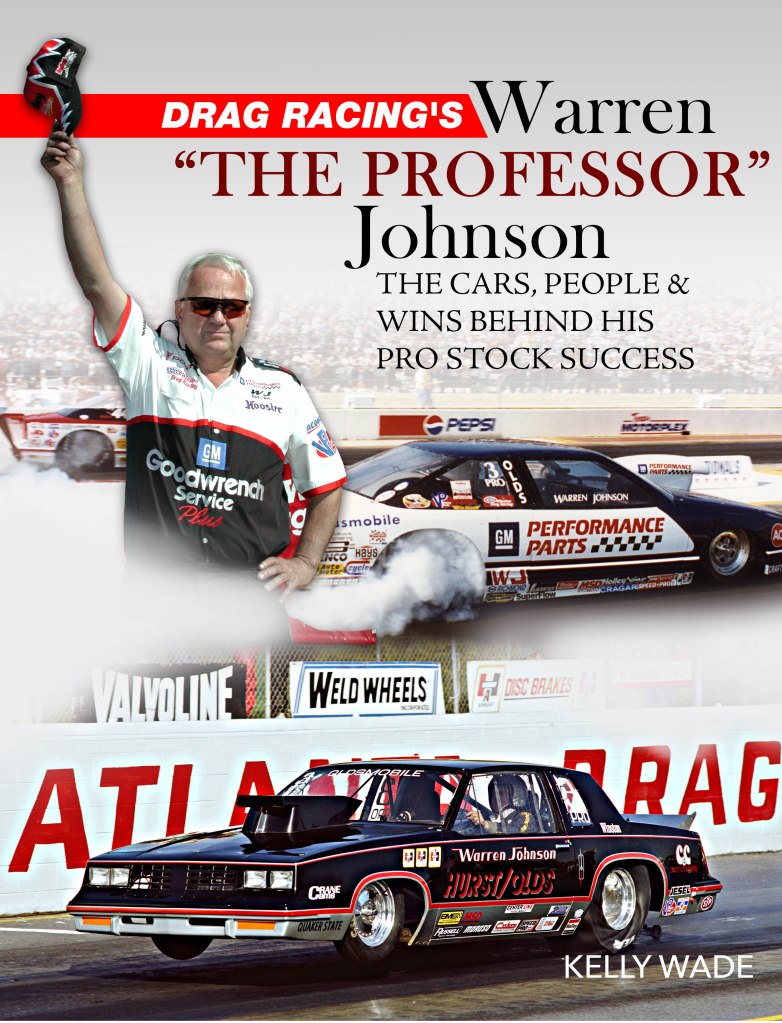
This is the latest entry in the series, or progression, of admirable drag histories that are in the catalog of CarTech publishing, which offers the Johnson saga here, and which like the subject also hails from Minnesota. Its 176 softcover pages are the work of California drag journalist and publicist Kelly Wade, whose narrative benefits immeasurably from an obvious close connection to the Johnson clan, and the richness their tales deliver to the text. This is a comprehensive, chronological story that is chockablock with facts and photos, such as the oft-overlooked reality that in 1999, WJ set top speed of the meet in Pro Stock at every one of the NHRA’s national events that year, the first driver in Pro Stock to accomplish that level of domination. The book includes a priceless photo of The Professor’s first win in Pro Stock – I was there – when he holeshotted the great Lee Shepherd in the final round of the 1982 Summernationals at the fabled Old Bridge Township Raceway Park in Englishtown, New Jersey. Like all these CarTech drag histories, you’ll love it.

Don’t call it a Berlinetta

Look at it this way: If you went out to buy a real, Modena-built Ferrari 250 GT short-wheelbase Berlinetta from the late 1950s, you’d run headlong into two irrefutably realities: Number One, the car would probably cost you something on the order of $20 million to buy. And Number Two, you’d never dare to drive it in anger, due largely to reality Number One. This is Pebble Beach show field stuff we’re talking about here. A more rational solution exists from the blokes at the RML Group of Wellingborough in the United Kingdom – the same town from which Willingboro, New Jersey, where I worked for more than 20 years, takes its name – which has produced very high-end continuation cars for a long time. While no pricing is yet announced for their latest effort, known officially as the RML Short Wheelbase, it stands to be considerably cheaper, and thus worthy of actual driving, than the real article from Italy.

Perhaps the nicest news regarding RML’s new offering is that it does indeed boast deep DNA from Maranello. The engine is Ferrari’s 5,474cc V-12, properly mounted longitudinally and driving the rear wheels to the tune of a claimed 478 horsespower, with a Ferrari six-speed manual transmission completing the driveline. RML claims 0-60 MPH in 4.1 seconds with full chat on the other side of 185 MPH, both far better numbers than the original article could ever manage. Rather than the Berlinetta’s hand-hammered Pininfarina metals, the RML Short Wheelbase utilized carbon-fiber bodywork. A production run estimated at 30 cars is expected to commence by the end of this year.

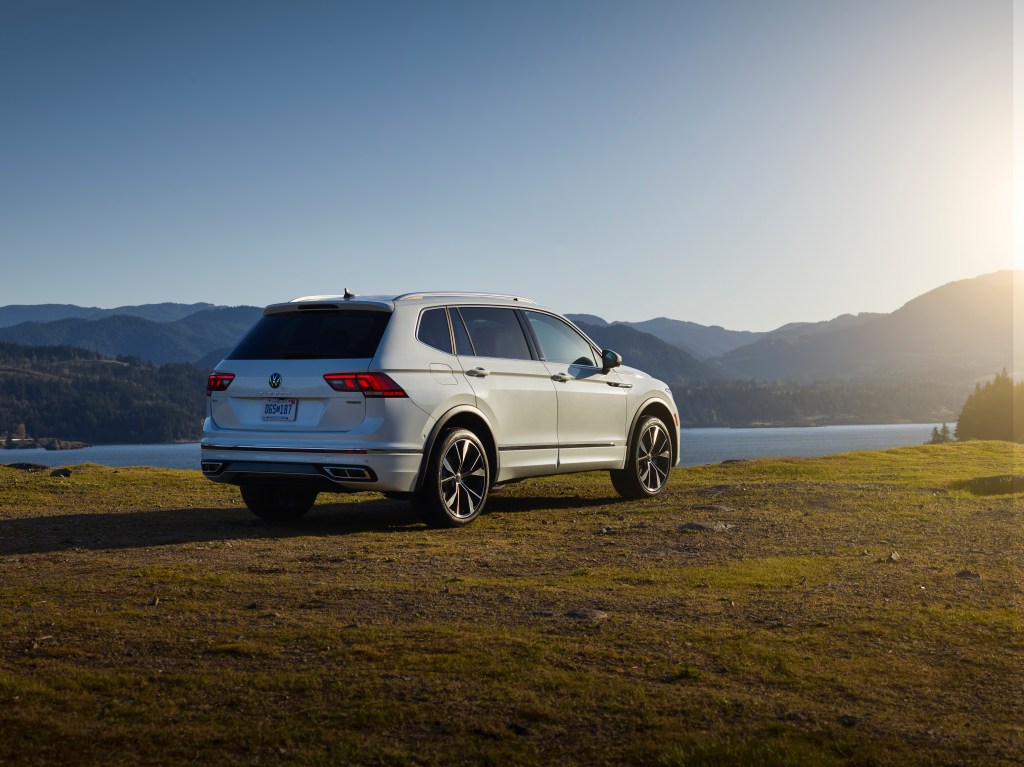
Fresh looks, tech infusion spark 2022 Tiguan

If somebody asks you to pick the top-selling model in Volkswagen’s model portfolio and you replied with Golf of Jetta, bzzzzz! Wrong answer. The right one is the compact Tiguan SUV, which is not only Volkswagen’s popularity leader in North America, but also globally. That’s a geniunely impressive record of success for a vehicle that’s been in the marketplace for fewer than five years. Volkswagen obviously has no intention of seriously messing with a product that has such a demonstrated record of success, but will instead be rolling out a revamped 2022 version that combines some freshened visuals with a significant ration of new interior tech enjoyment.

Tiguan watchers will soon note that the horizontal full-length character line running along the vehicle’s side has survived intact and now incorporates LED taillamps. The grille treatment is refreshed, incorporating a center bar with an available lighting treatment for the Volkswagen “lollipop.” Interior upgrades include the Volkwagen Digital Cockpit with a touchscreen of up to 10 inches optional. Volkswagen Car-Net with WiFi capability is offered through subscription service. Heated front seats are newly standard. The IQ.DRIVE suite will be be offered on all but the base Tiguan model. Base power is the EA888 four-cylinder engine with 184 horsepower. Sales will get underway in the third quarter.

Finally, Subaru goes full EV

It’s not to imply that Subaru was missing the boat on electric vehicles – after all, it offers a plug-in hybrid version of the Crosstrek – but it was becoming increasingly evident that Subaru, famed for its all-wheel drive and demonstrated durability, was nonetheless among the last major auto manufacturers yet to announce a fully electric vehicle. That’s finally changing, given Subaru’s disclosure this week that it will build a new electric SUV, the Solterra, in partnership with Toyota, which is currently doubled up with Subaru on producing the BRZ sport coupe. The Solterra – the name is an amalgam of the Latin for “sun” and “earth” – will be the first vehicle produced on the company’s equally new e-Subaru Global Platform, which, naturally, will be driving all four wheels. Toyota will provide the batteries and related propulsion technology.

One as-yet undisclosed element of the plan is any potential establishment of fast-charging stations at Subaru’s network of about 630 dealerships in the U.S. All Subaru products are already manufactured in zero-landfill assembly plant. Subaru’s major U.S. plant in Lafayette, Indiana, is the only auto assembly facility in the United States designated as a backyard wildlife habitat by the National Wildlife Federation. The Solterra is scheduled to reach showrooms in the U.S., Canada, China, Europe and Japan in 2022.

The unknown racing megastar

If you don’t have to think hard before answering when somebody asks you who Tom Kristensen is, you’ve established your bona fides as a serious racing enthusiast. It’s undeniable that a lot of people who claim they know about racing wouldn’t be able to answer. For their benefit, and others’, Kristensen is a nine-time winner of the 24 Hours of Le Mans, which doesn’t get the attention it merits in the United States, even though American teams have been competing there for a long time. Four of Kristensen’s wins came with Audi, which thankfully has a significant piece of the U.S. auto market and strongly promotes its motorsport excellence, otherwise even fewer Americans would likely have ever heard of this guy.

In winning nine times, Kristensen surpassed the Le Mans victory totals of both Jacky Ickx and Derek Bell, two of the greatest sports car racers ever to grip a wheel. His first wins at both Le Mans and Sebring came as a rookie in each event. Those are astonishing achievements. A former karting champion, Kristensen is a veteran of the wild DTM sedan wars, was a pro-level racer in Japan for years and also a prime Formula 1 prospect who earned tests with multiple teams. So Kristensen’s established his bona fides, too, in a new autobiography co-authored by his fellow Dane, Dan Phillipsen. It’s produced with impressive richness by Evro Publishing in the United Kingdom, and carries appropriate weight at more than 430 hardcover pages. It’s $55.00 and easily available to order here in the United States. This will come to be an important biography for racing libraries because just like Reggie Jackson (and NASCAR’s Harry Gant) was Mr. October, Tom Kristensen is unquestionably Mr. Le Mans.

‘Glass rarity arrives at Amelia

Most people realize that the sports car burst into popularity in the United States following World War II, due in large part to repatriated servicemen who’d seen their first MGs. We also know that Detroit got in the act, sort of, starting with the Corvette. What’s less widely known is that around the same times that British crocks first wobbled onto these shores, a significant cottage industry sprang up offering kits that gearhead types could piece together in their driveways to create a sports car, usually with a fiberglass body. This was a significant of the postwar American car craze that would be largely forgotten today if not for the efforts of longtime Hemmings cohort Geoffrey Hacker, who is arguably the country’s foremost expert on low-production fiberglass cars through American automotive history. His website estimates that something around 1,000 small firms offered these sorts of kits between the war’s end and the mid-1950s, most all of them in very small runs, usually meaning zero surviving examples today. When one does surface, it’s now big news, thanks in large part to Geoff.

This car is a Maverick Sportster, one of seven such creations known to have been built, beginning in 1953, by Sterling “Smoke” Gladwin Jr. – you gotta love the nickname – who, according to Geoff’s site, was a retired aeronautical engineer from Mountain View, California, who had worked for Boeing and Lockheed. Most of the cars used discarded postwar Cadillac frames and the new 331-cu.in. OHV high-rev V-8 for power. The most notable feature was the car’s boattail rear styling, a theme from the prewar coachbuilt era, which Geoff believes makes the Maverick the last American automobile so designed. The flyweight fiberglass body shell gave it an estimated power-to-weight ratio of something like 12:1, which Gladwin conceivably likened to Lockheed fighters like the twin-engine P-38. The restored Maverick Sportster will make its debut two weeks of now on the show field at the Amelia Island Concours d’Elegance in Nassau County, Florida, which is quite simply one of the world’s great automotive events.

Ford, friends feeding Florida

We like this, because it’s about how people can combine their efforts to feed others. That has become a challenge since the global pandemic caused millions of Americans, literally, to find themselves out of work. Food insecurity, the clinical term for not knowing where your next meal is coming from, has become a significant issue in both rural and urban communities. One of the private-sector partnerships that have formed to address it has come into existence in south Florida, where a philanthropic arm of the Ford Motor Company is teaming with areas charities to provide healthy in-home dining for those who otherwise might go hungry. The Ford Motor Company Fund, which supports community wellness and education in more than 50 countries, has joined with Health in the Hood and World Central Kitchen to furnish 5,000 freshly prepared meals to more than 60 families living in areas of Miami-Dade County that have been designated as food deserts. That term describes an area where people have trouble obtaining fresh food because of transportation and shopping limitations where they live, which was true for the part of Vermont that I used to call home.

Any physician will tell you that eating junk food as your basic nourishment, which is common for people who live in food deserts, presents serious health consequences, especially for kids. Ford is donating $25,000 to start the eight-week program, which involves the use of Transit Connect vans to get the meals to people’s homes. Ford volunteers are helping with the deliveries. Another part of the effort, run through Ford’s micromobility business unit, Spin, is planting urban gardens across Dade County. The Ford Fund has earmarked more than $8 million for aid programs in Miami-Dade, most recently involving the distribution of protective masks.

Ford Explorer Timberline boosts off-road chops, trailer capacity

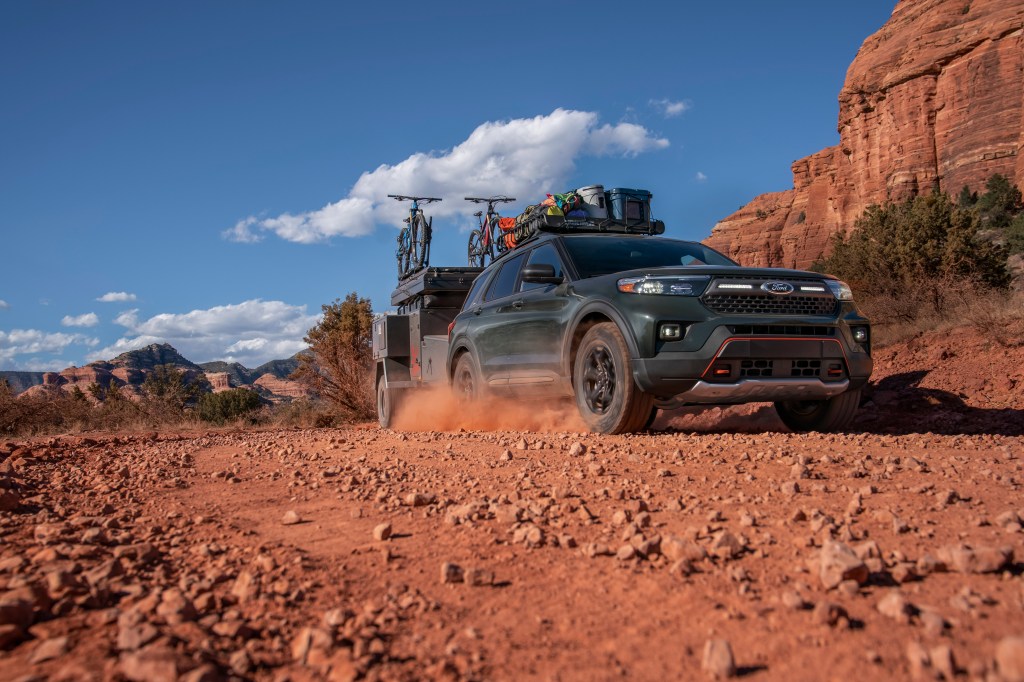
The Ford Explorer isn’t just a vehicle, or an SUV, it’s a franchise. That start back when it singlehandedly transformed Ford’s off-road lineup when it mercifully shoved aside the Bronco II in 1990. Explorers, in a real sense, fill a role at Ford that used to be the province of Di Noc-and-applique Country Squire station wagons. They haul families, their pets and lifestyle gears to a lot of primitive places the floaty old station wagons could never hope to reach. To that end, Ford is rolling an Explorer that’s pre-package for just those sorts of off-pavement gallivanting. The seventh new truck or SUV package that Ford has debuted since 2019, the Explorer Timberland is unquestionably coming to play.

There are clear indications here that this Explorer is serious about the dirt. The Timberline’s ride height is elevated 0.8 inches, which, when combined with model-specific front and rear fascias, put the vehicle’s approach and departures angles on the far side of 23 degrees. The added ride height brings overall ground clearance to 8.7 inches. Heavy-duty, police-spec shock absorbers are also part of the package, along with skid plates. The standard 2.3-liter EcoBoost turbocharged engine produces 300 horsepower, is mated to a standard 10-speed automatic transmission, and turns all-wheel-drive with seven operating modes and a Torsen center differential. Three specials packages – Outfitters SkyBox, Outfitters MegaWarrior and Outfitters FrontLoader – will be offered when the Timberline arrives this summer.

Robert Wickens drives again

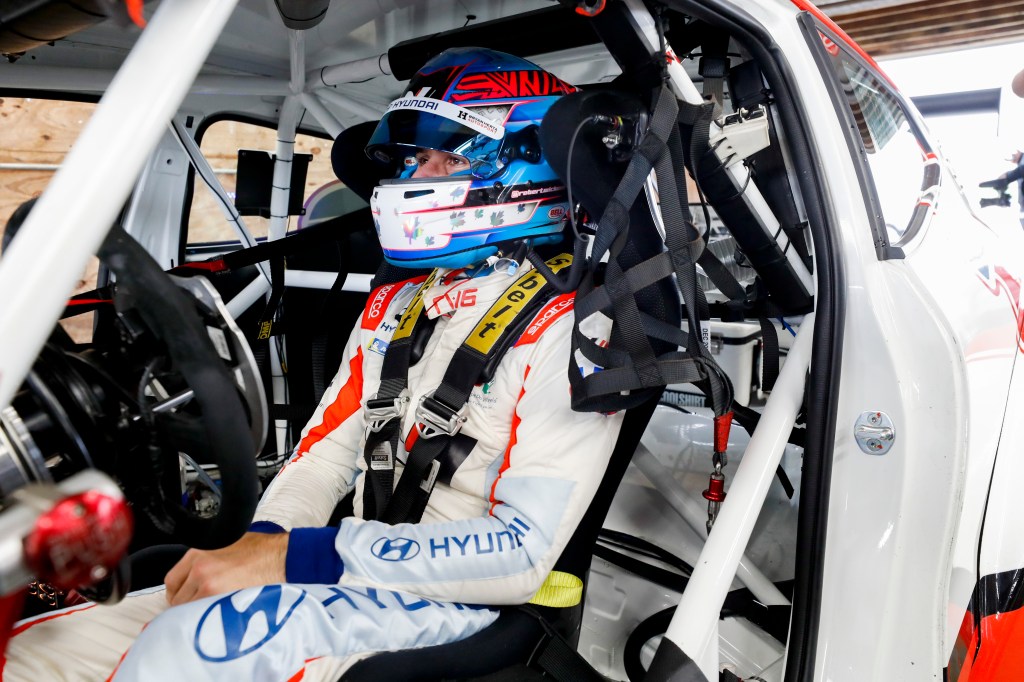
Born in Canada, Robert Wickens was lighting ’em up in Europe, winning an FIA F2 round from the pole and capturing a Formula Renault 3.5 championship before switching to IndyCar with an eye on Formula 1. Things were going great, as Wickens scored a pole and four podium finishes in 2018 as a rookie for then-Schmidt Peterson Motorsports, in addition to Rookie of the Year honors at that year’s Indianapolis 500. Then came the IndyCar round at Pocono. Wickens brushed wheels with Ryan Hunter-Reay and was launched skyward into the catch fencing at more than 200 MPH. The car disintegrated and left Wickens a paraplegic, confined to a wheelchair. It took Wickens another 989 days of rehabilitation to get back behind the wheel of a racing car, but yesterday, he did it. Here’s how.

Wickens’ long list of injuries from the Pocono wreck included a thoracic spinal fracture, spinal cord injury, neck fracture, tibia and fibula fractures to both legs, fractures in both hands, a fractured right forearm, fractured elbow, a concussion, four fractured ribs and a pulmonary contusion. The journey of healing brought Wickens to the Mid-Ohio Sports Car Course in Lexington, where he lapped a hand-controlled Hyundai Veloster N TCR prepared by Bryan Herta Autosport, which prepares the factory cars that Hyundai races in IMSA competition. Herta’s team already has a driver, Michael Johnson, who is confined to a wheelchair and run the Veloster N TCR in IMSA. Johnson and Herta prepared a Hyundai for Wickens whose hand controls are operated by rods and cables attached to machined rings mounted ahead and behind the actual steering wheel, plus paddle shifters. By no means is the final stop for Wickens, whose return to the cockpit is being managed by Herta and Hyundai.

Bobby Unser, 1934-2021

One of the big advantages of this line of work is that you get to cover, and sometimes meet, really consequential people. Once such instance happened for me when I found myself at the induction dinner for the Indianapolis 500 Hall of Fame a few years back. A big part of the evening, which was studded with racing luminaries, came when Bobby Unser sidled up to me, away from the crowd, and just started to talk. We kept at it through a few rounds and most of the ceremony. Bobby had a lot to say, much of it private, and all of it heartfelt. So we know that even a guy who won Indy three times after an extremely violent and dangerous apprenticeship is, in many ways, just a guy. That’s how Bobby Unser, who died this week at 87, presented himself, whether he behind the mike for ABC Sports or just knocking back a couple with an interested admirer. He was a scion of America’s foremost racing family, which can trace its involvement in the sport back a full century and across four generations.

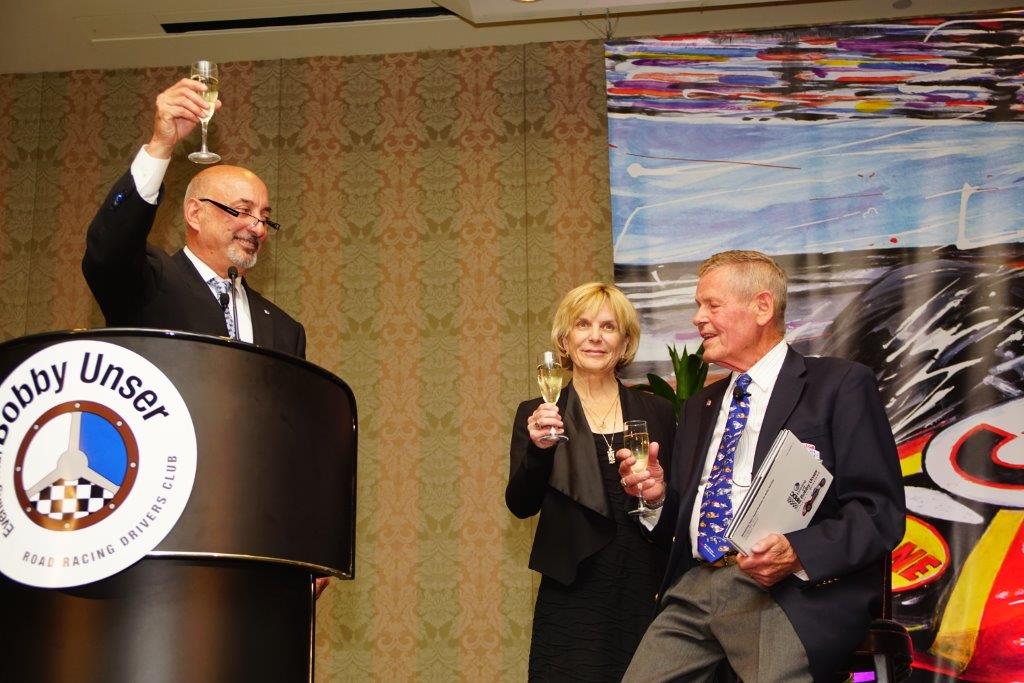
So for me, the accompanying Albert Wong photo from the Road Racing Drivers Club, which honored Uncle Bobby before the IndyCar race at Long Beach in 2015, captures things perfectly. How can you summarize this guy’s existence, or his family’s, without writing a book about it, something that’s already happened a couple of times? Bobby was just one of the Unser family to lay claim to Pikes Peak, mastering the mountainous thrill ride 13 times, including aboard his Trans-Am Audi Quattro that was one of his final rides. He survived a murderous climb through Sprint cars, had a hand at taming the vicious Novi, and won Indy outright in 1968 and 1975. His third win, over Mario Andretti in 1981, required a courtroom battle and six months to resolve, which makes some people forget that Andretti was the only other driver Unser hadn’t lapped during the race. After turning one of IndyCar’s first 200 MPH laps aboard one of Dan Gurney’s Eagles, he demolished the track record at Indy by 17 MPH in 1972. Before starting a 20-year broadcast career, Bobby won 35 times in Indy cars, collecting two USAC national titles. He was incredibly brave, granite tough and above all that, a great guy. The photo shows Bobby being feted by RRDC president Bobby Rahal, himself an Indy champion, with Bobby’s wife Lisa Unser showing her pride.