Journalism is my life. I've been at it since the 1970s, starting in news and developing specialties in covering automobiles and motorsport. I hold more than 50 journalism awards for work in both newspapers and magazines. I have developed a global audience during my career.
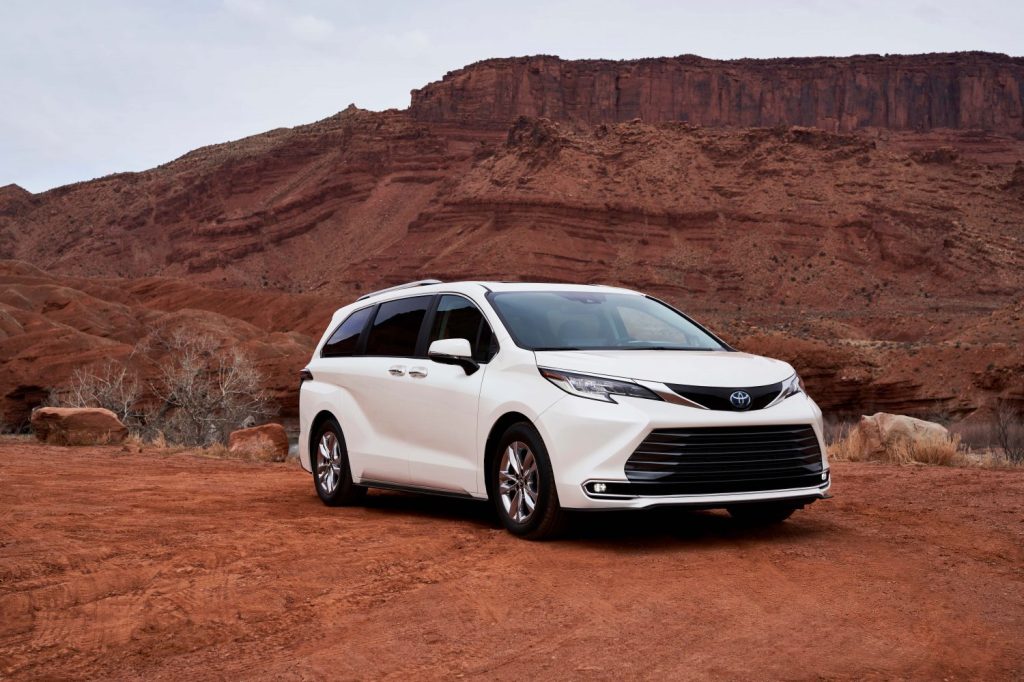
Technically, Toyota has already unveiled its fourth-generation Sienna minivan, a genuine champ in its segment, although the rollout earlier this year involved only the full-electric version. For the universe of petrolheads, Toyota is introducing the rest of the Sienna line, led by a new-for-2022 Woodland Special Edition that combines model-specific styling cues, electronic all-wheel-drive and, very unique for this class, an added measure of off-road ground clearance.
Its appearance crafted by CALTY’s Newport Beach, California, and Ann Arbor, Michigan, design studios, the electronic AWD is available on demand and joins other vehicle upgrades including an onboard 1,500-watt inverter with a 120V AC outlet that can feed just about any electrical goodie you pack for your trip, a towing capacity of up to 3,500 pounds with a manufacturer-installed hitch, and navigation via a JBL audio system with 12 speakers and 1,200 watts of power.
The route no longer goes from Paris through the Sahara, due in large part to ongoing terrorism, but the Dakar Rally remains one of the world’s most punishing automotive tests of any kind. In keeping with everything else it’s done recently from a product-development standpoint, Audi plans to contest the brutal contest’s 2022 running with a from-the-ground-up, fully rally-capable electric vehicle. Following ongoing evaluations in Germany and Spain, Audi Sport landed on the ground last week in Morocco for two weeks of uninterrupted desert trials for its Audi RS Q e-tron rally car. Record-holding Dakar winner Stéphane Peterhansel, plus rally immortal Carlos Sainz and team driver Mattias Ekström took part in the wringing.
Sandstorms and daytime temperatures that easily cleared 100 degrees Celsius caused several interruptions in the test schedule while the Audi Sort contingent regrouped. One issue that became immediately apparent was maintaining the e-tron’s onboard battery performance in the withering desert heat. The RS Q e-tron features an electric-based drivetrain with two motor-generator units borrowed from their original use in Formula E racing. The high-voltage battery, newly developed by Audi Sport, is charged while driving via an energy converter consisting of an Audi gasoline-fueled TFSI engine originally designed for the German Touring Car Championship wars, and from another, third motor-generator unit.
Jeep, Harley-Davidson, Bentley, Ferrari. They’re all fabled names in transportation that have found innovative ways to stay conversationally prominent in ways that don’t always directly involved their vehicles. Harley sells a lifestyle, not just a brand of motorcycle, with a galaxy of boutique extras that let you make you, and your bike, all your owns. For its ongoing centenary, Bentley has grandly applied its logo to all manner of luxury niceties. Jeep arguably stands squarely with Harley-Davidson as the first domestic vehicle manufacturer to truly grasp all this branding and personalization effectively, offering Wranglers, and more, with an array of option and accessory packages that’s far too broad to enumerate here. But as at Harley, the lifestyle and its trappings go beyond the vehicle itself. Here’s a boundary-stretching but still hugely impressive example.
If you’re into history on any level, this just has to blow you away. Stellantis, specifically through Jeep, is partnering with Wallace Detroit Guitars to offer a line of licensed, Jeep-branded custom electric guitars that are – and get this – hand-crafted from old-growth wood recovered from historic Detroit buildings, specifically the long-abandoned and heartbreakingly deteriorated former Packard assembly plant. Each copy of the Deluxe Jeep Guitar, as it’s called, also features a Jeep-logo Humbucker pickup and a hand-applied oil finish, which not only incorporates Jeep logos but also a topographic map of Detroit on the backside of the guitar body. This is a serious instrument for serious musicians although its price, $2,900, is far from out of line for a custom axe like this one.
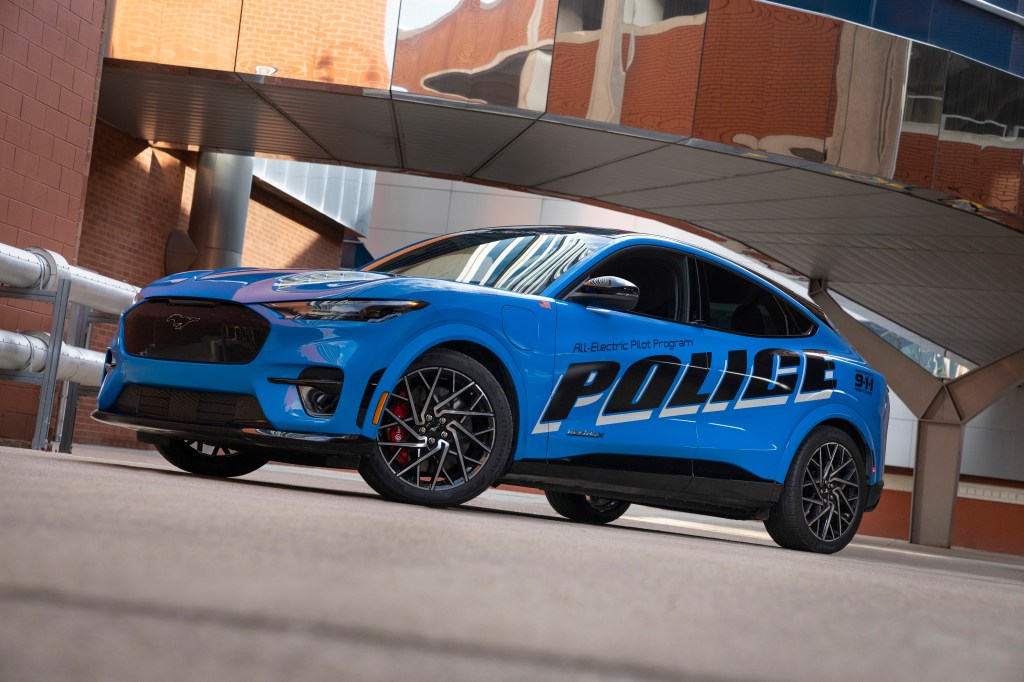
Earlier today, there was evidence of Ford’s long history of law enforcement support in the form of a South Daytona police officer engaged in a traffic stop while using something rarely seen anymore, a Crown Victoria sedan still in front-line fleet service. That’s becoming a very rare sight, and here’s part of the reason why. The Ford Police Interceptor fleet, which includes the Explorer, Taurus and F-Series trucks, is angling toward an all-electric option. The Michigan State Police, one of two major U.S. law enforcement agencies that perform extensive vehicle testing – the other is the Los Angeles Police Department – has begun evaluation of a police EV based on the 2021 Ford Mustang Mach-E, which essentially a prototype that Ford is considering for volume sale to public-safety agencies.
Yes, it’s true that the Mach-E lacks the interior space for police equipment that the Explorer PI offers, but there are a host of non-patrol duties where an EV would be a good fit, such as detective transportation and parking enforcement, to name just two possibilities. Police agencies in the United Kingdom are already evaluating an AWD version of the Mach-E, including the Sussex, Surrey, South Wales, Dyfed Powys, Devon & Cornwall and Police Scotland agencies, along with the Metropolitan Police of London. Stateside, most major agencies pay close attention to MSP vehicle testing and base their fleet-purchase decisions greatly upon the test results. Silent and stealthy, don’t you know?
The world’s largest retailer is beginning to make deliveries to people’s homes without the proverbial delivery person. The Ford Motor Company and its autonomous-driving technology partner Argo AI are joining forces with Walmart on a pilot program for home retail deliveries around Miami, Austin, Texas; and Washington, D.C. using Ford-produced driverless delivery vehicles. Argo AI, based in Pittsburgh, will supply the software and related infrastructure allowing the delivery vehicles to operate on their own.
It’s known internally by the partners as a “last-mile” delivery service, with the initial startup slated for later this year. Walmart customers will be able to place online orders for groceries and other goods from home, with the delivery process commencing from that point. The last-mile program will start out in limited areas within the Miami, Austin and D.C. markets before expanding more broadly within those metropolitan areas. The partnership is designed to jointly address growing consumer demand for same-day or next-day delivery of everyday items, a practice that was already growing considerably before the pandemic upended everybody’s shopping strategies.
A lot of what the new contract between the U.S. Department of State, the sprawling agency that conducts American diplomacy, and GM Defense LLC, a General Motors subsidiary, is necessarily out of public view. Even routine transportation for an ambassador or other ranking State Department dignitary can be a very dangerous proposition in some parts of the world. The State Department has awarded GM Defense a $36.4 million contract to create a new Heavy Duty version of the Suburban, aptly named the Suburban HD, with an initial package of 10 such vehicles to be delivered within two years.
The agreement calls for GM Defense to deliver up to 200 copies of the Suburban HD to the Diplomatic Security Service, the State Department’s protective arm, through 2023. Why does the government need to spend more than 35 million bucks on big Chevrolet SUVs? Because if you’re attentive about such matters, you already know that the Suburban, with its nearly bulletproof powertrain and chassis – sorry, that may not have been the absolutely best description – has long been a world leader in the realm of specialized dignitary and VIP transport. You’ll notice that a whole row of law enforcement Suburbans typically tag along in the wake of the presidential limousine, for instance. Armoring, weaponry and communications systems can be laded aboard its expansive, go-anywhere platform in just about any configuration your unclassified intellect can imagine.
You may have the desire to channel your inner Erik Carlsson but Saab’s long gone and it’s been eons, practically, since a Mini Cooper tamed the Monte Carlo Rally. But it’s still possible to do the bared-teeth-in-the-boonies boogie by visiting your Subaru store, especially early next year when its entirely new, fifth-generation line of compact WRX offerings storm the showrooms. With a very few notable exceptions in the global marketplace, the WRX is one of the very few mass-produced automobiles that can put you within credible striking distance of an all-out rally car’s performance capabilities, simply by passing the necessary credit check. Subaru has long been a dominating force on both the international and North America rally scenes, and that lineage clearly passes on to WRX buyers, no matter which model they select.
That scoop on the hood isn’t just for decoration. On the contrary, it slams cold air into the intake of the WRX’s standard 2.4-liter turbocharged flat-four, with 271 horsepower on tap. A six-speed manual transmission is standard but for 2022, an entirely new automatic transmission that promises to quicken upshifts and downshifts by 30 and 50 percent, respectively, with adaptive shift control. The 2022 model will also roll out a first for the WRX line, electronically controlled dampers with three driver-selectable modes, plus Drive Mode Select that will allow up to 430 combinations of kinetic personalization, such as feedback levels for Subaru’s dual-pinion electric power steering, which we can personally attest is laser-accurate and nearly effortless. No mention, at least yet, of the full-potency WRX STI variant that everybody’s hoping for, but stay tuned, because a new, premium WRX GT trim level with standard Recaro seating has already been announced. Built on the Subaru Global Platform, the new WRX arrives in early 2022.
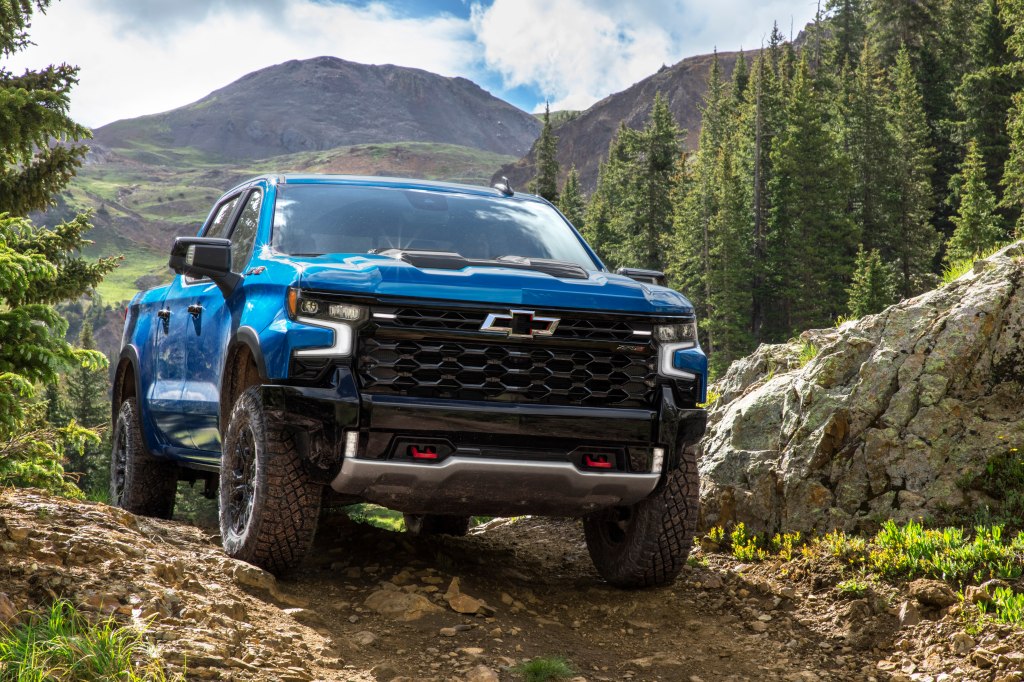
We still live in a world where the introduction of a new American-branded full-size pickup is a news event equal in proportions to the vehicle itself. That reality has manifested itself at Chevrolet, which had the dazzle-burst debut of its 2022 Silverado line last week. This is a big vehicle with a comparatively big MSRP with baked-in big profits, so this rollout is hugely important to General Motors. As you might have expected, there’s a variety of trim levels in the Silverado range but the biggest news here in the addition of a new ZR2 to the lineup, standing as Chevrolet’s premier off-road truck offering.
In this context, “off road” stands for a pickup with a factory-developed suspension lift, essentially presenting buyers with a seriously tricked truck straight from the showroom, the same thing that Jeep and to a lesser extent, Ford, is recently carrying off with marked success. The Silverado ZR2 is based around Chevrolet’s 6.2-liter truck V-8, with 420 horsepower and 460 lb-ft of torque, linked to a standard 10-speed automatic transmission. The ZR2 will also mark the first Silverado usage of Multimatic 40mm DSSV spool-valve dampers, with three separate spool valves for damping management and three connected chambers for fluid flow control. The package also includes model-specific 33-inch MT tires, a model-specific skidplate package and high-approach front bumper. A fully redesigned cab interior goes into all Silverado models, including a color touchscreen and configurable instrument display.
It’s been a long time since Bob Cicconi strapped on a race car but people still haven’t stopped talking about what happened when he was still doing it. He is the eldest son of a racing dynasty formed outside Philadelphia by his father, Lou Cicconi Sr., who I helped vote into the Eastern Motorsport Press Association‘s Hall of Fame in 2013. Lou Sr. was the patriarch of a clan that has stood tall and proudly in American open-wheel auto racing via the exploits of sons Bob, “Liquid Lou” and Guy. Bob Cicconi, shown here in the potent Jim Rieder-owned Midget with Gaerte horsepower at Lucas Oil Raceway in Indianapolis, owns wins in USAC (both Sprint and Midget), a podium finish at the Little 500 for Sprint cars in Anderson, Indiana; was a formidable competitor in the USAC Mini Indy series for Super Vee formula cars, has amassed Midget trophies from ARDC and NEMA, holds a USAC Silver Crown victory, and has performed on stages including the Chili Bowl Nationals, the Hoosier Hundred and the Oswego International Classic for Supermodifieds. The guy, like his brothers, is a racer. It’s no exaggeration to suggest that with a few favorable breaks, Bob Cicconi could easily have punched his ticket to the Brickyard.
I was talking to Bob this week for a forthcoming Speed Sport feature and asked what he’s been up to. You may be as surprised by his answer as I was. Since stepping out of the cockpit, he’s become a competitive builder of scale models, a terrifically cool pastime, specializing in replicas of historic warships but also dabbling in, you guessed it, racing cars of the past. Like yours truly, Bob’s a member in good standing of the International Plastic Modelers Society/USA, the United States offshoot of a modelers’ group first founded in Britain during the 1960s. IPMS/USA is a huge organization, encompassing 220 chapters in the United States plus affiliates in Canada and the Philippines. Its biggest event is the annual IPMS National Contest, which attracts hundreds of modelers’ precision replicas. To people who create miniatures in scale, winning it is akin to standing atop the Knoxville Nationals podium, and Bob’s accomplished that.
Here’s one example. Bob’s speciality is the dreadnought era of combat ships, here embodied by this waterline replica of the U.S.S. Arkansas, a battlewagon that saw duty in the World War I years. Modeled in 1/700th scale, this earned Bob second in class at the IPMS/USA Nationals.
Here’s more. Also in 1/700th scale, this is the U.S.S. Phelps, a Porter-class destroyer from World War II that served with distinction at Midway, Coral Sea and in the Aleutians campaign before being decommissioned and scrapped in Philadelphia. Note the intricate, well-executed maritime camouflage finish on the hull. This won Bob first in class at the Nationals.
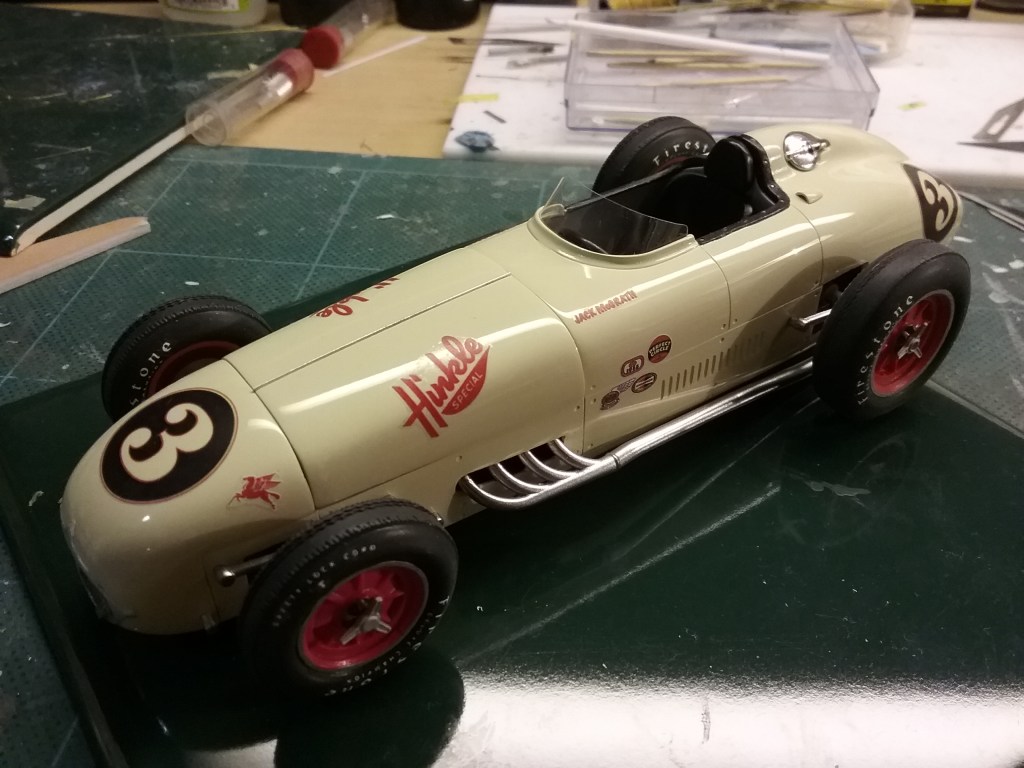
Naturally, model cars are another outlet for Bob’s creativity. The first replicas is the Miller 122 that the great Frank Lockhart used to win the Indianapolis 500 as a rookie in 1926. Based on the 1/25th scale kit from Etzell’s Speed Classics, Bob added intricate aftermarket wire wheels and wired the supercharged straight-eight engine. The second car, looking to be based on the famous Monogram kit, is the Hinkle Special, the Kurtis-Kraft 500C roadster, with Offy power, that the California hot rod and Midget hero Jack McGrath raced in the 1955 Indianapolis 500 until the engine failed, just months before his death on the Phoenix dirt. If nothing else, Bob’s work makes it clear that at their core, racers are determined, competitive people in virtually any undertaking they choose to pursue.
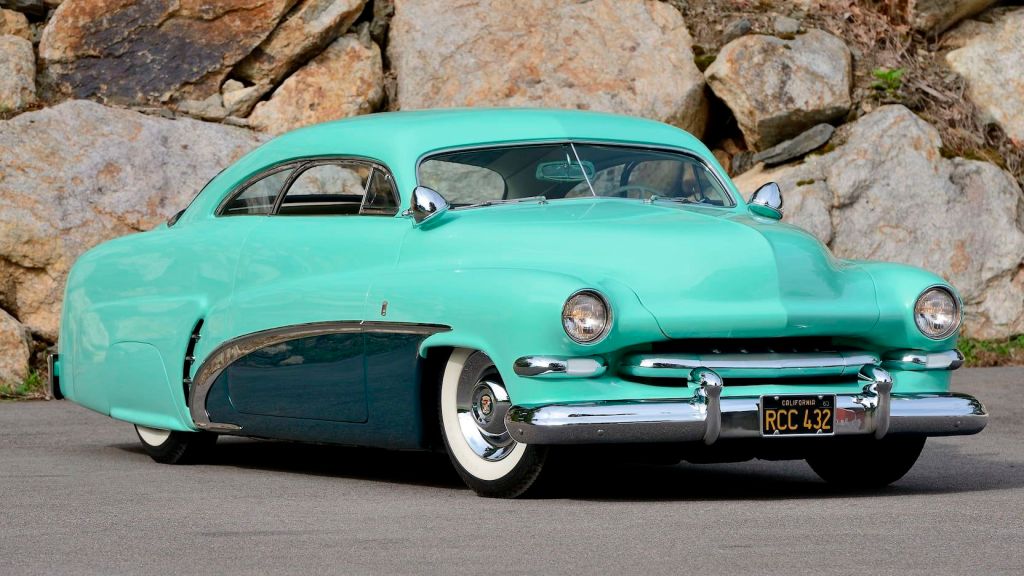
Full disclosure: I occasionally contribute to Mecum Auctions and have a longstanding, strong relationship with Hemmings Motor News. That’s why it was doubly stunning, and satisfying, to receive the Hemmings Daily last week – if you haven’t already done so, you can sign up for free at the site – and learn from Daniel Strohl, the web-content editor at Hemmings, that the landmark full custom known as the Hirohata Mercury is headed to auction next January at Mecum’s huge sale in Kissimmee, Florida, which is fast gaining a reputation for megastar sales like this one. If you don’t immediately recognize the name, the photo, courtesy Mecum, surely ought to help you.
Bob Hirohata was a Navy veteran from Southern California who was deeply fascinated by the region’s exploding car culture and wanted a radical custom created by the very best. After leaving the service in 1952, Hirohata found a very clean 1951 Mercury coupe on a used car lot in the San Fernando Valley and grabbed it. Like everyone else, he wanted a chopped top, but Hirohata also wanted the hardtop look that trademarked the pioneering 1940 Mercury coupe owned by Nick Matranga, whose conventional B-pillars were eliminated in favor of a hardtop treatment with hand-formed, curved window frames. So Hirohata went to the guys who built the Matranga car, George and Sam Barris. What you see is the result. Dramatically lowered and with its rear quarters extended, the Mercury also received Buick Riviera side trim, functional rear brake scoops, a raked windshield, a full interior from the Carson Top Shop and a dashboard mural painted by Von Dutch himself. Despite being a daily driver – in 1953, Hirohata swapped the original Mercury flathead for a Cadillac OHV V-8 and drove it from California to the Indianapolis 500 – the Mercury was the subject of innumerable magazine covers and feature stories, and won at least 26 trophies at major auto shows, in addition to a star turn in the 1953 Mamie Von Dohren potboiler Running Wild, before selling the car. It passed through several owners, and redone appearances, before 16-year-old Jim McNiel bought it for $500 in 1959. McNiel, who died in 1998, drove the Hirohata Merc for five years before hiding it away in his garage. The hot rod and custom historian Pat Ganahl, who calls this the first 1951 Mercury to have its roof chopped, located the car and persuaded McNiel to let Rod and Custom magazine, which Pat was editing, pay for the car’s restoration to its 1952 appearance. The result was a new starring role in 2015 when the Pebble Beach Concours d’Elegance featured historic customs as a judged class for the first time. According to Daniel, Mecum expects this car to command a million dollars at auction. Given what the clapped-out Mustang from Bullitt delivered at Mecum’s 2020 sale in Kissimmee, we bet that estimate will prove to be on the light side.






 Jim Donnelly On Wheels