Hyundai tops safety picks

Two models in Hyundai’s U.S. model lineup, the compact Elantra sedan and the midsize Tucson SUV, have both been noted as recipients of the Top Safety Pick award from the Insurance Institute of Highway Safety, which is the highest honor bestowed by the liability industry’s national trade organization. Both vehicles were recognized for passing the current level of IIHS occupant-protection standards, in addition to marking their adoption of advanced systems that prevent pedestrian impacts.

The IIHS specifically cited the Elantra and Tucson front-protection systems in bestowing the award. Updated side-impact tests and measurements of headlamp effectiveness are other parameters that go into the Top Safety Pick formulation.
From Alaska to the World

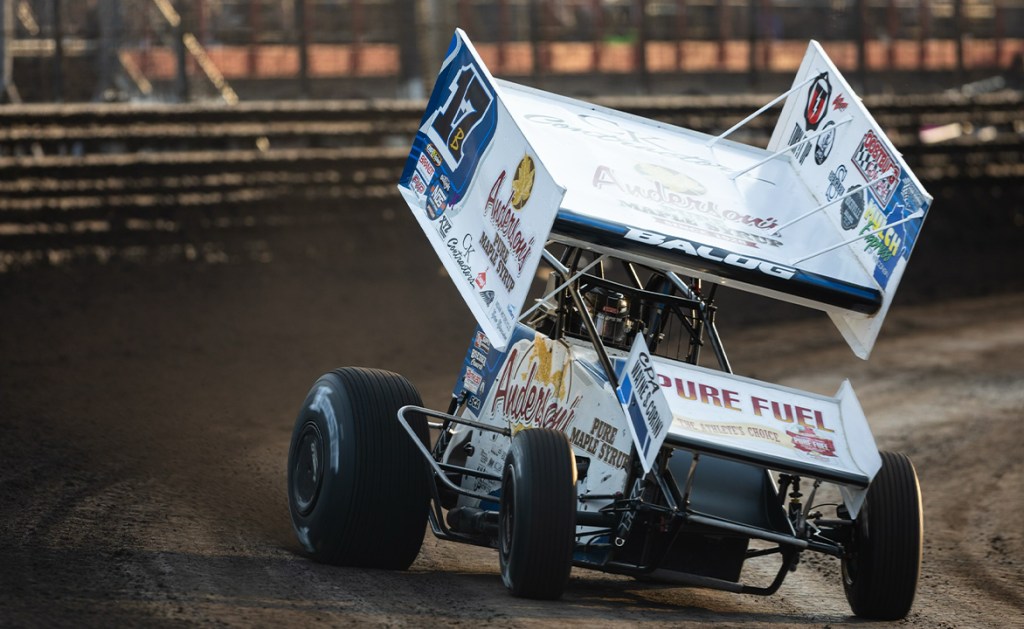
What’s North Pole, Alaska, known for, besides being the hometown of that big guy with the sleigh who’s busy around this time of year? It’s also the unusual hometown of a highly accomplished Sprint car driver. Bill Balog is 44 years old and calls North Pole home. For professional reasons, which means manhandling a 900-horsepower winged Sprint car, Balog has relocated to Wisconsin, where he holds 10 championships with the Interstate Racing Association regional sanctioning body. Balog is about to join the big time for real.

Now planning to embark on a campaign to win the World of Outlaws rookie of the year honors in 2024, Balog already leads all IRA competitors with 138 feature event wins, plus another five in what used to be the All Star Circuit of Champions before its recent purchase by the High Limits tour. Balog joins a younger rookie, Landon Crawley, in seeking the prestigious WoO rookie crown bestowed by the national touring Sprint series. The award is named in honor of the late Kevin Gobrecht, who came out of central Pennsylvania and was a rising WoO star when his untimely passing occurred.

More diesel power among 2025 Suburban, Tahoe improvements

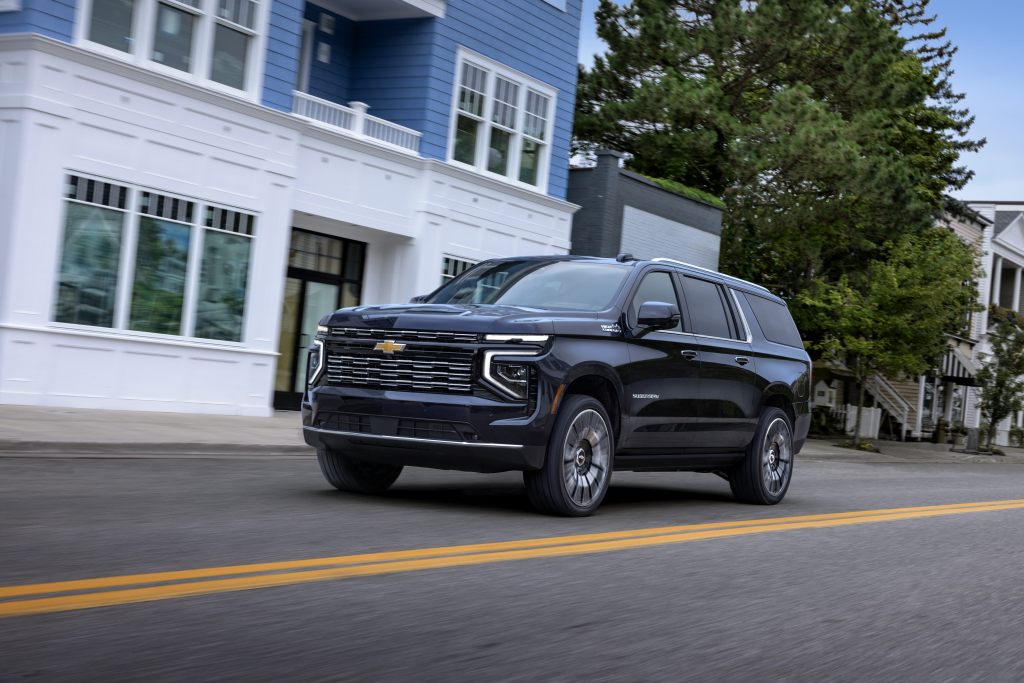
If you tow, travel, run a fire department or otherwise have need for mega hauling capability, then the Chevrolet Suburban and its shorter-wheelbase Tahoe sibling have undoubtedly been on your shopping list. There are new, freshened versions of both vehicles coming next year as 2025 models, with upgrades inside and out, including new theme lighting and a class-leading 17.5-inch touchscreen. But there’s more.

Suburbans, led by the High Country version you see here, will also benefit by receiving, again, available diesel power in the form of a more powerful turbocharged diesel engine that was previously added to the Silverado pickup’s powertrain lineup. Mated to a 10-speed automatic transmission, the 3.0-liter Duramax engine will be offered across all Suburban and Tahoe trim levels, with brawny output numbers of 305 horsepower and 495-lbs.ft. of torque. The 2025 models will continue with base 5.3-liter and available 6.2-liter ICE powertrains as well.

Reinventing the wheel, Hyundai EV style

If you spend time on social media, you’ll soon realize that not everybody is happy about the auto industry’s ongoing shifts to EVs, with even the manufacturers themselves beading sweat over initially uninspiring sales figures for pure BEVs, as opposed to hybrids. What’s impossible to deny is that this emerging frontier has directly led to a technological boom in the automotive world. Which is why you can’t help but be impressed by the deliciously simple idea that Hyundai has about maximizing space in tomorrow’s EVs. In a very real sense, Hyundai has reinvented the wheel.

Hyundai, along with Kia, have just unveiled what they call their Universal Wheel Drive System, which they refer to as the Uniwheel for short, an advance that has the potential to serious transform the way EVs are packaged. The EV puts the powertrain’s reduction gearset directly inside the previously empty space inside the wheel’s hub. This, therefore, is a completely new structure for the drive system, moving most of its components outboard into the hub and away from their current location under the vehicle’s floor. That should translate to added interior space for any EV using the Uniwheel. The big question: As potentially transformative as this may be, what does it do to the time-honored concept of reducing unsprung weight at each wheel?

A impressive look back at drag’s racing’s iconoclasts

First, the NHRA banned the use of nitromethane in its dragster classes. Next, they banned the use of aircraft powerplants in competition cars. And then, when the Funny Car exploded on the scene as drag racing’s newest and most popular class, the NHRA banned them, too. While all of this was happening as the 1950s played out, racers had nonetheless found themselves a newer, more welcoming place to participate in the evolving sport. First founded in the 1950s by a drag enthusiast from Philadelphia, the American Hot Rod Association embraced these NHRA castoffs with open arms, later led by the intrepid Jim Tice Sr., and in doing so created an entirely new drag racing experience rooted in traditional fuel and fury.

Tice took the reins from founding lead racer Don Garlits, who contributes the foreword to the long-overdue story of the AHRA, entitled Drag Racing’s Rebels, published by CarTech, and authored by the highly respected drag historian Doug Boyce. The organization’s relentless racer-focused rule- and schedule-making allowed it to swell to 10 national events by 1970, which made it a legitimate competitor to the NHRA, a reality that lasted until Tice’s untimely death. This excellent volume runs to 192 pages and retails for $34.95.

Crankshaft is back with its seventh stellar issue

Just hitting the U.S. Postal Service route to subscribers’ mailboxes is Issue 7 of Crankshaft, the premium U.S.-produced quarterly publication on automotive and racing history. Every issue of Crankshaft is fully laden with in-depth feature stories on compelling cars of the past, and their restorations. The lead story in Issue 7, fittingly, is Richard Lentinello’s analysis of a gorgeous 1934 S.S.1 Airline Coupe, an almost never-seen car on these shores, which he unexpectedly spotted at a Southern concours.

My own contribution to the editorial lineup includes a look at a gotta-have car of the 1980s, the 1986 Chevrolet Monte Carlo SS, something dealers couldn’t keep on their lots when the SS was new. This one is in astoundingly good original shape and occupies a lot of pages, with exceptional photography by Richard. I also provided a story on the dizzy-fast board speedway that existed outside Atlantic City, New Jersey, during the 1920s. If you’re not a reader yet, do yourself – or someone else – a favor and sign up for a subscription on the website.

Nissan will emblazon new stadium for NFL Titans

One of America’s most vibrant and rapidly growing metropolitan areas is the one that surrounds Nashville, Tennessee. Nashville is the soul of country music, hosts a very successful IndyCar street race and has long been home to the Volunteer State’s favorite team, the Tennessee Titans. Nashville is also the U.S. home of Nissan, which is cementing its long alliance with the Titans by gaining the naming rights for the new Titans stadium that’s presently under construction.

This architect’s rendering depicts the new Nissan Stadium, which is slated to open in 2027 and will host Titans home games, along with the Tennessee State University football team and a host of major public happenings. Announced last week, the deal between Titans management and Nissan will give the automaker the stadium naming rights for the next 20 years. The new stadium will be built in the East Bank section of Nashville, along the Tennessee River and nearby the current stadium’s downtown location.

A longer, more luxurious Hyundai Santa Fe

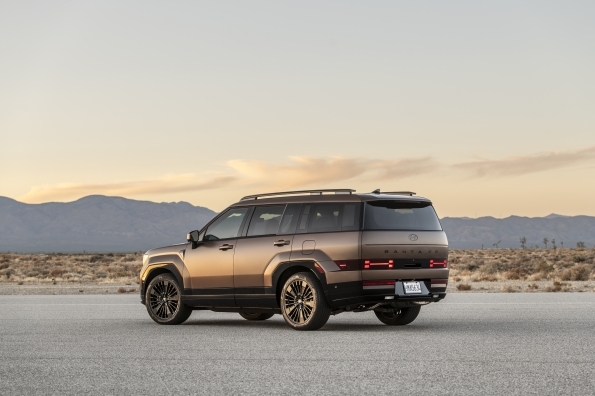
Hyundai chose last week’s AutoMobility expo in Los Angeles as the locale for introducing its new-generation Santa Fe, its big three-row SUV, which is an entirely reengineered vehicle on a longer platform than its strong-selling predecessor. Its wheelbase stretched to 110.8 inches, the new-generation Santa Fe includes a plethora of new features, led by a dimensionally larger rear liftgate that opens onto a “terraced” rear cargo area. That, in turn, translates to a maximum of more than 50 square feet of room for goodies in the back.

Premium versions of the Santa Fe offer power-adjustable captain’s chairs for the second seating row, just a hint of the appointments that Hyundai has incorporated into the new SUV. Available accessorization, depending on model, includes dual, wireless charging systems for smartphones, Wireless Apple CarPlay and Android Auto as standard equipment, plus a USB-C terminal with a maximum charging rate of 27 watts and a third-row USB port also available. In addition, a UV-C sterilization compartment is available for the top of the Santa Fe’s glove compartment, providing ultraviolet light-based sterilization of items such as cell phones, wallets, and glasses. A Bose 12-speaker premium sound system is also available. Standard ICE power is a 2.5-liter turbocharged inline four-cylinder engine with direct injection, producing 277 horsepower, and mated to an eight-speed automatic transmission.

Big-size MINI boasts performance and AWD

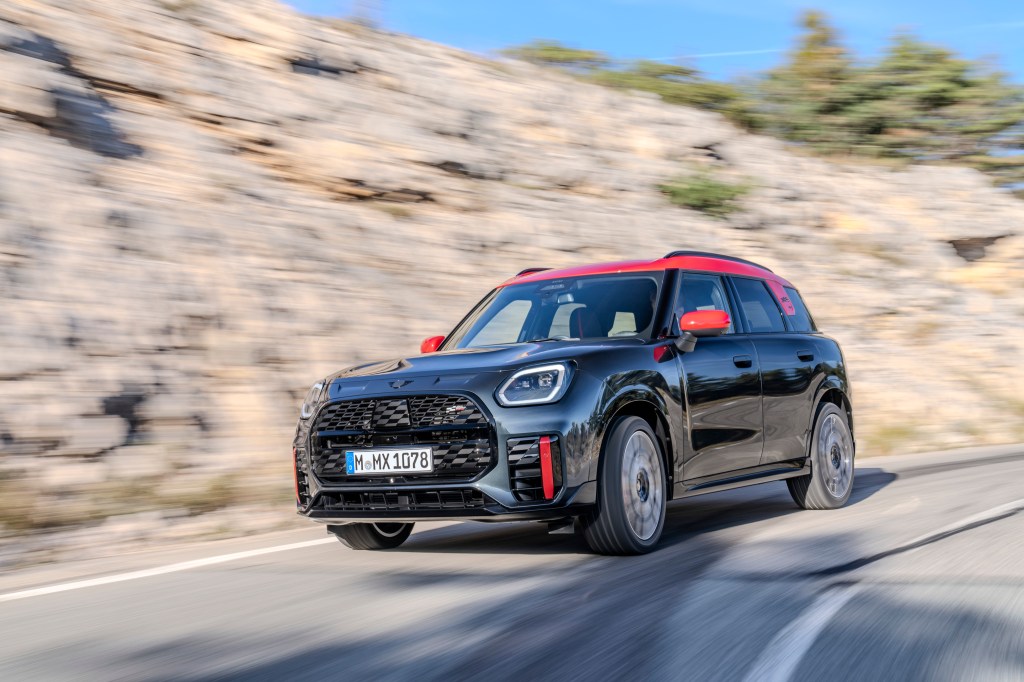
If you’re into sprightly performance in a compact package, you likely already know about MINI, now owned by BMW, and its John Cooper Works model lineup, which commemorates one of the great geniuses in British motorsport history who also did some magical things with the original Mini, such as win the Monte Carlo Rally, among many others. The latest edition of the MINI Countryman four-door wagon now also boasts a John Cooper Works edition, with combines copious power with MINI’s permanently engaged all-wheel drive, dubbed ALL4.

At the heart of this package is a 2.0-liter turbocharged four-cylinder engine that is rated at 312 horsepower in U.S. trim. MINI is advertising a top speed of 155 MPH for the John Cooper Works Countryman. The model fairly bristles with extras, but here’s the one that caught our attention: An even dozen ultrasonic sensors, and four exterior monitoring cameras, all aimed at vehicle security in an uncertain world. The dashboard has a two-level treatment that makes use of recycled polyester as a material, augmenting the JCW sport seats that help explain what this go-fast Countryman is all about. Figure on spending $46,900 when the JCW Countryman arrives next May.

California Special returns as Mustang nears age 60

If you remember back that far, to the jaw-dropping year of 1968, Ford enhanced its all-conquering Mustang by offering it in a limited California Special edition, visually distinguished by its oversize side scoops and wide rear taillamps. Today, authentic examples of the original California Special – not the knockoffs or tributes built out of Mustang parts catalogs – are highly prized by Ford and Mustang collectors. As the Mustang nears its 60th anniversary in the automotive marketplace, with an all-new car for 2024, it’s planning a partial commemoration by returning the California Special to the lineup as an option package for 2024 Mustang GT coupes and convertibles.

Like the original California Special, the option package is intended to add a measure of visual distinction to the 2024 Mustang. The huge nostril air intakes are an immediate giveaway, part of Ford’s new Rave Blue appearance design for its specialty car. The California Special also gets package-specific wheels, and, of course, bold body graphics. The package will add $1,995 to the price of a Mustang GT coupe or convertible when it goes on sale early next year. The California Special makes its debut next week at the Los Angeles Auto Show, appropriately. Order banks are now open and you can point your browser here to build your very own.